Get started
Still unsure of the impact of Sonik?
See it for yourself and ask for your free trial


A buying signal is any observable event that makes a prospect more likely to take a call and book a meeting today than they were yesterday. Most of them are already in your CRM and your website logs. Here are the 10 signals that move connect and meeting rates in our data, ranked roughly by how fast you should act, with the action for each one.
Two numbers from Sonik's own pipeline explain this article. Reps use only about 20% of the signals already sitting in their CRM. And 50% of Sonik's pipeline comes from signals that were already in the CRM before anyone looked.
The reason is timing. Across our benchmark of 1,000,000 B2B cold calls in France, trigger-based openers reach a 7-10% meeting rate, against 2-3% for pitch-first openers. The same prospect, called the week something changed, with an opener that names the change, is three times more likely to book. Signals tell you which week and which change.
Someone at a target account read your pricing page twice this week. That is the strongest implicit signal you own. Action: identify the account, call the most likely champion the same day, and open with the topic of the page, not with the visit itself.
A demo request or content download that marketing qualified and nobody called. Action: call within the hour. In our experience the gap between a five-minute and a next-day response is the difference between a meeting and a ghost.
An old contact opens three emails in a day or revisits the site after six months. Action: call and open with "How have you been?". Our data shows that opener reaches about 10% success with a known contact, versus roughly 1.5% for a standard cold open. See how to reactivate dormant leads.
Your champion at account A just became VP Sales at account B. Action: call within the week, congratulate, and ask how they plan to set up the team. This is the highest meeting-rate signal we see, because the relationship already exists.
You lost the deal 11 months ago to a competitor or to "not now". Contracts renew, and the reason you lost may have expired. Action: call the month before the anniversary with a question about how the chosen option worked out.
A job post for an SDR, a sales manager, a RevOps lead. Budget exists and the stack is being built. Action: call the hiring manager, not the recruiter, and ask how they plan to ramp the new hire.
A round, or in France a capital increase published in the BODACC. Money arrives, plans change. Action: call the founder in the two weeks after the announcement, around 10am, when our data shows founders pick up most.
A target persona liked or commented on a post about your problem space, yours or a peer's. Action: connect, then call within 48 hours and reference the topic, never the like.
A new CRO, CMO or Head of Sales in their first 90 days. New leaders audit the stack. Action: call in weeks three to eight, when the audit is happening, with a benchmark they can use.
The account adopted or dropped a tool adjacent to yours: a new CRM, a sequencer, a data provider. Action: call with a question about the migration, not a pitch about integration.
One signal is a hint. Two signals on the same account in the same fortnight are a priority. Build a simple score: strong signals (1 to 5) count three, medium signals (6 to 10) count one, and anything older than 30 days decays to zero. Re-rank the call list every morning.
Fit still comes first. A pricing page visit from an account outside your ICP is noise. Apply the ICP filter before the signal score, never after.
And measure it. For each signal, track calls, connects and meetings over a quarter. In our experience, two or three signals will produce most of your meetings, and the rest can be demoted.
Sonik connects to the CRM and the website and generates signals continuously: visitors from target accounts, job changes, closed-lost anniversaries, dormant leads waking up, social intent. Each signal re-ranks the rep's call list, so the morning session starts with the 20 contacts where something changed. Details on the signals page.
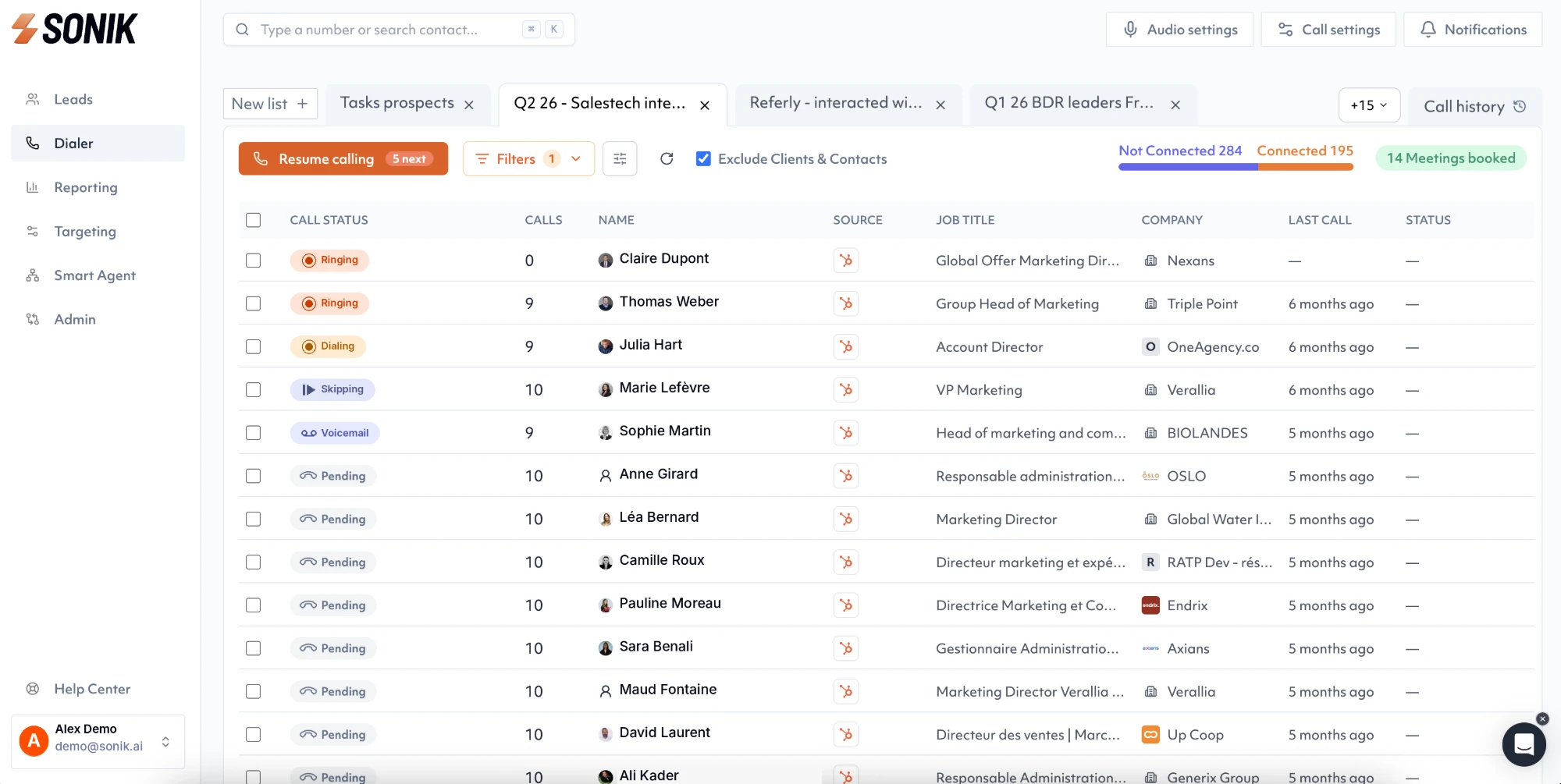

The signal is pushed into the call itself. The AI call prep shows the trigger and suggests the opener, because the meeting rate difference between a trigger opener and a pitch opener is the whole point. Parallel dialing then gets through the ranked list about five times faster than manual dialing.
Buying signals are not a data product you buy; most of them are events your CRM already records and nobody reads. Pick the five strong ones, act on them the same day, and open every call with the trigger. This week, export every contact who changed jobs in the last 90 days and call them with a congratulation.

