Get started
Still unsure of the impact of Sonik?
See it for yourself and ask for your free trial


A solo founder can book around 30 meetings a month with three AI agents: one that writes content, one that detects warm accounts, and one that qualifies cold leads at scale. That is the setup I presented with HubSpot at Le Village by CA, and it is how my own pipeline runs while I sleep. Here is what each agent does, what the stack looks like, and where the human still has to show up.
When I was at Google Cloud, I had every resource imaginable: BDRs, marketing, inbound leads, a partner ecosystem, budget. As a founder-led sales startup? None of that. Just me.
The only way to compete is to reinvent prospecting with AI. The good news is that in the last five years the stack has completely changed. What used to need three people and an agency now runs on a few tools and a prompt library, for a fraction of one salary.
The constraint that does not change is the phone. In the 1,000,000 B2B cold calls we analyzed with Katana, the average connect rate is 11.3%. Agents can decide who to call and why; they cannot replace the conversation. So the goal of the three agents is simple: fill my calling blocks with people who have a reason to pick up.
The Copywriter generates B2B content without a marketing team. LinkedIn posts, the occasional newsletter, the follow-up emails after a meeting.
How it works: a prompt library with my voice, my benchmarks and my client stories, fed with the raw material of the week (a call that went well, an objection I heard three times, a number from our data). The agent drafts, I edit for ten minutes, I post.
What it is for: not vanity. Content is a signal generator. Every person who engages with a post about cold calling becomes a lead with a reason to be called. The Detector picks them up.
The Detector finds my website visitors, my competitors' audience, and my warmest leads, every day.
How it works: website visitor identification resolves the accounts, and when possible the contacts, visiting sonik.ai. Social listening tracks who engages with my content and with competitors' content. CRM signals flag job changes of former champions and closed-lost deals coming due. An automation workflow pushes each one into a call list with the trigger attached.
What it is for: timing. A trigger-based opener reaches a 7-10% meeting rate in our benchmark against 2-3% for a pitch-first opener. The Detector is what gives me the trigger.
The Qualifier qualifies thousands of cold leads with AI, so I only call the ones that fit.
How it works: a scored ICP (headcount, sales team size, tooling, hiring signals, geography) applied to large lists, with the AI reading each company's website and job posts to answer the questions a human SDR would spend five minutes on. Output: a short list with a one-line "why them" for each company.
What it is for: not wasting dials. A list of 2,000 becomes a few hundred worth calling, and each one has a reason in the opener.
The deck I presented breaks everything down with full transparency: the prompts I use, the tools, the cost of each agent down to the euro, and playbooks you can copy. The tools I rely on are Clay, LinkedIn, lemlist, HubSpot, Trigify, Vector, RB2B, Claap, n8n and Sonik. None of them is magic; the value is in the chain between them.
The output of the chain is a daily call list where every contact comes with a trigger. I work it in calling blocks, at the slots where my personas pick up: our benchmark puts founders around 10am and the best overall slot at 4pm, with a 15.8% connect rate. That is where the 30 meetings a month come from, not from the agents booking anything themselves.
Sonik is the last link in the chain: the place where the Detector's and the Qualifier's output becomes conversations. Signals cover the detection part natively (website visitors, job changes, closed-lost, dormant leads, social intent), the parallel dialer gives around 5x more live conversations per hour, and AI call prep puts the trigger in front of the rep before the call connects.

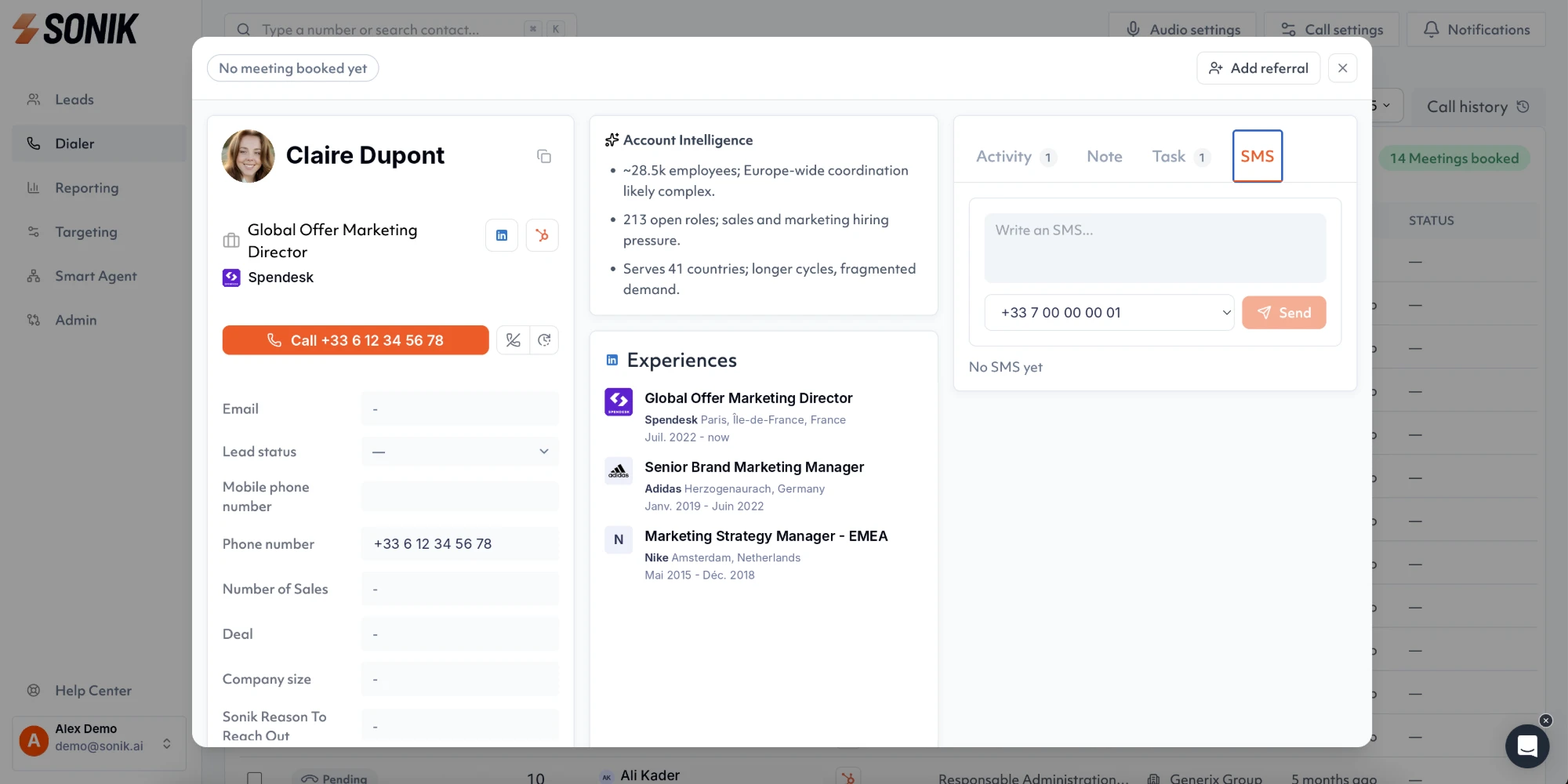
Our own outbound runs on this setup. Half of Sonik's pipeline comes from signals that were already in the CRM, surfaced by the Detector and called the same day.
Three agents, one founder, around 30 meetings a month: the Copywriter creates signals, the Detector catches them, the Qualifier filters the rest, and the human makes the calls. The pipeline runs while you sleep only because the calls happen while you are awake. This week, set up one thing: website visitor identification pushed to a daily list, and call every known contact on it within 24 hours.

