Get started
Still unsure of the impact of Sonik?
See it for yourself and ask for your free trial

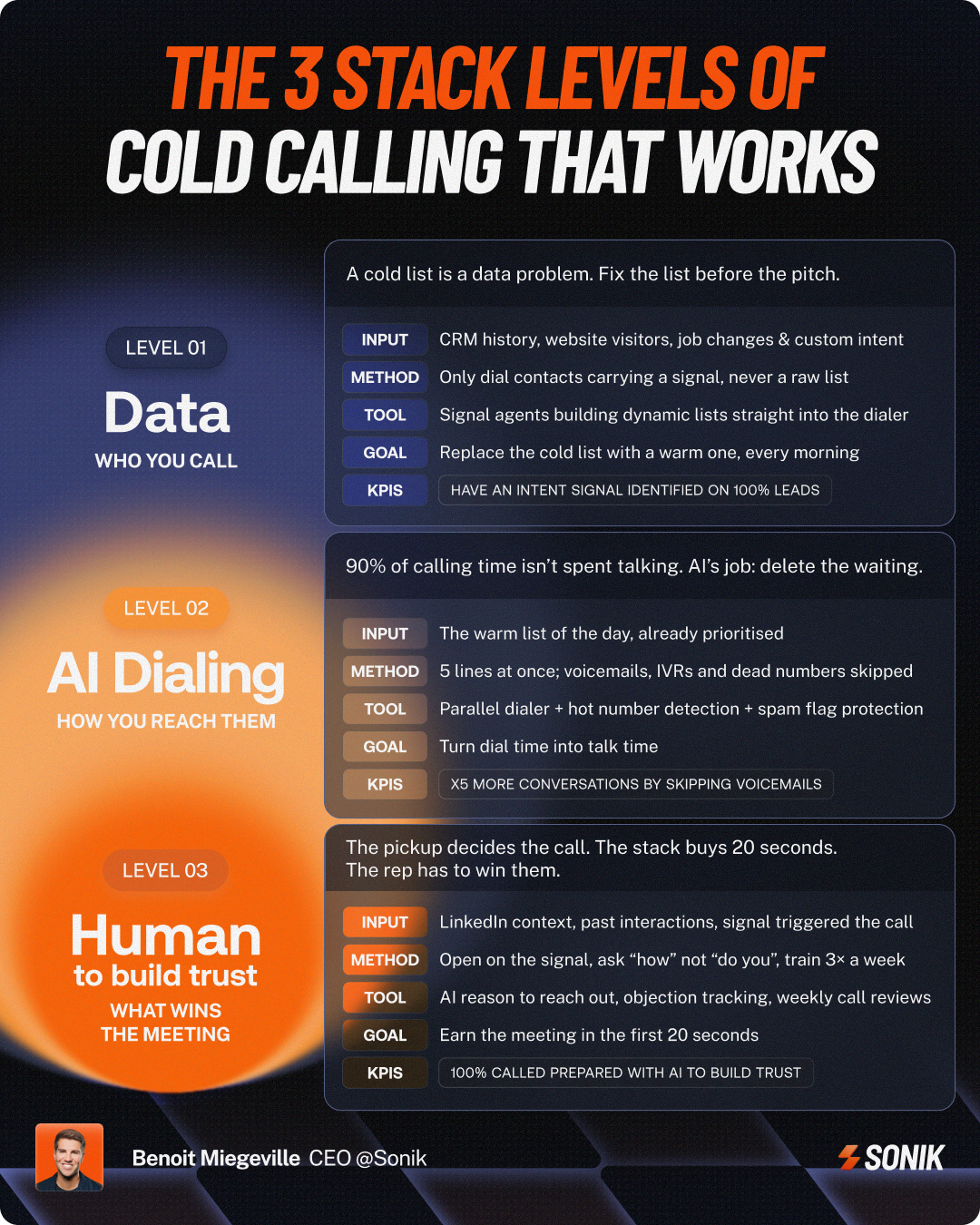
B2B outbound no longer has a signal problem. It has a speed-to-conversation problem. Modern cold calling needs three layers working together: intent data to know who to call, AI dialing to actually reach them while the signal is warm, and a human to build trust once someone picks up. Remove one layer and the other two are worth very little.
At Sonik, since 2025, we have been building an intent signal platform to tell sales reps exactly who to call. Website visitors, job changes, closed-lost deals, dormant leads, people engaging with competitors' content. The idea came from Google Ads. In B2C, intent triggers action instantly: you look at a pair of shoes, and seconds later you are retargeted.
Then we discovered the uncomfortable truth. Finding the right prospect was only a third of the problem.
In B2B, a prospect shows intent today. Sales acts on it one to three days later on average. The rep calls once, hits voicemail, and moves on. The signal was correct. The action never happened. A signal you do not act on is just data.
The gap is already visible in most CRMs: reps use only about 20% of the signals that are sitting there. The problem is not detection. It is what happens in the hours after detection.
The first layer replaces the cold list with a warm one. A cold list is a data problem, and you fix the list before you fix the pitch.
The payoff is in the conversion numbers. Trigger-based openers reach a 7-10% meeting rate against 2-3% for pitch-first openers. A call to a dormant contact that opens with "How have you been?" succeeds about 10% of the time, against roughly 1.5% for a standard cold open. And 50% of Sonik's own pipeline comes from signals that were already in the CRM.
The second layer is where most teams leak. Across the 1,000,000 B2B cold calls we analyzed with Katana, the average connect rate is 11.3%. Around 90% of calling time is not spent talking: it is rings, voicemails, IVRs and wrong numbers. AI's job here is to delete the waiting.
Timing belongs to this layer too. 4pm connects at 15.8% across personas, 10am at 14%, 8am at 9.8%. Founders pick up more around 10am, marketing around 4pm, HR around 1pm. In our experience, most connects happen within the first three attempts, which is an argument for retrying fast, not for giving up after one voicemail.
The pickup decides the call. The stack buys 20 seconds. The rep has to win them.
This is where the benchmark is most striking. Discovery questions starting with "how" lift conversion by 190%. Asking "What do you mean?" before answering an objection lifts it by 197%. Neither is something AI does for the rep. Both are things AI can make possible by giving the rep context and time.
Sonik started as a signal platform and became a dialer because of the second layer. Today the product covers all three: signal agents build a warm list every morning from the CRM, a parallel dialer turns it into 5x more conversations, and AI call prep gives the rep the reason to reach out before each connect.


The design principle is right person, right moment, right conversation. The CRM tells us who. The dialer decides when, which is now, while the signal is warm. The rep handles the conversation.
Our north-star funnel is 20 conversations per day per SDR, with 2x more meetings as the outcome. You can see how the layers connect on the signals and dialer pages, and the dormant-lead playbook in how to reactivate dormant leads.
Intent data told sales who to call. It did not solve the one-to-three-day delay or the single voicemail. The stack that works has three layers: signals, AI dialing, human trust. This week, take the last 20 signals your CRM produced and check how many turned into a conversation within 24 hours. That number is your real bottleneck.

