Get started
Still unsure of the impact of Sonik?
See it for yourself and ask for your free trial

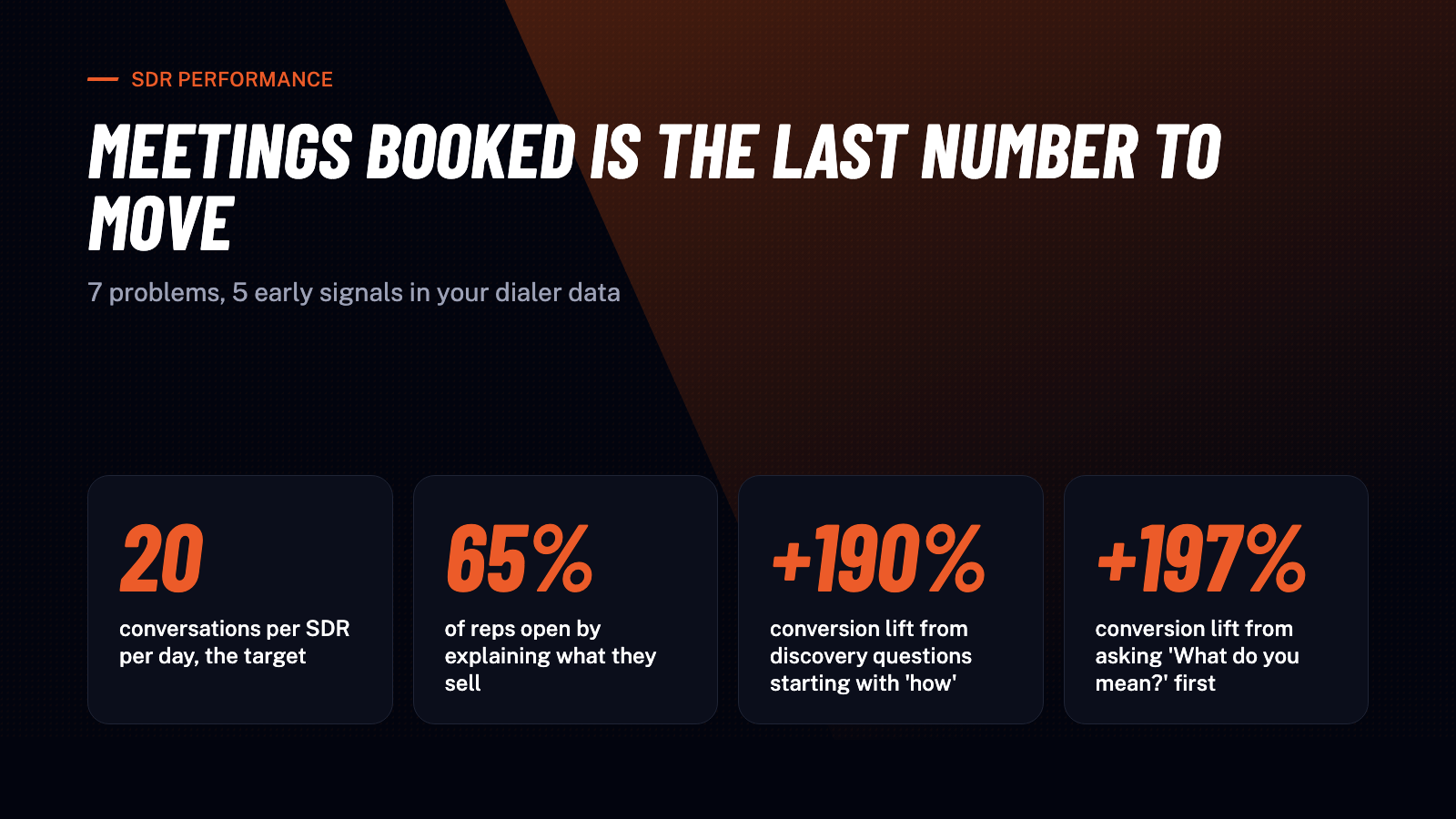
SDR performance problems show up in dialer data two to three weeks before they show up in the meeting count. Conversations per day, connect rate by slot, meeting rate per conversation, talk time and no-show rate each move first, and each points to a different cause. Here are the seven problems we see most often in European SDR teams, the early signal for each one, and the fix, with benchmarks from our analysis of 1,000,000 B2B cold calls in France.
Most managers diagnose an SDR at the end of the month, when the meeting number is in. By then the cause is three weeks old and the rep has repeated it 300 times. Meetings booked is the last number to move; the numbers before it are where you intervene.
Almost every performance problem has one of three roots: a process gap (wrong list, wrong slot, no script), a skill gap (opener, discovery, objections) or a fit gap (the role is wrong for the person). The first two are fixable in a fortnight. The third is rarer than managers assume, and you can only tell it apart from the others once the first two are ruled out.
Early signal: conversations per day under 10 against our north star of 20, with dials drifting down week over week. Usual cause: time lost to list building and CRM admin, plus a dose of rejection avoidance. Salesforce's State of Sales report puts average selling time at about 28% of a rep's week. Fix: build the list for the rep, block two dial sessions a day, and put them on a parallel dialer, which gives about 5x more conversations per hour.
Early signal: connect rate under 9% while the team sits at 11-13%. Usual cause: dial blocks at 8am (9.8% connect rate in our data) or lists heavy on personas who rarely answer. Fix: move blocks to 10am (14%) and 4pm (15.8%), and match the slot to the persona: founders around 10am, marketing around 4pm, HR around 1pm.
Early signal: connect rate is healthy but meeting rate per conversation sits under 3%. Usual cause: the rep opens by explaining what the company does. 65% of reps do. Fix: rewrite the first 20 seconds around the trigger (the visit, the hire, the old deal). Trigger-based openers reach a 7-10% meeting rate per conversation against 2-3% for pitch-first.
Early signal: average talk time on connected calls falling, with a growing share of calls under 90 seconds. Usual cause: closed questions and a rush to the pitch. Fix: three discovery questions that start with "how". In our benchmark they lift conversion by 190%.
Early signal: a high share of calls ending within 15 seconds of the first objection, visible in transcripts. Usual cause: the rep answers the objection instead of understanding it. Fix: one reflex, ask "What do you mean?" before answering. In our data it lifts conversion by 197%.
Early signal: no-show rate climbing above the team's average. Usual cause: the meeting was agreed in principle and the invite sent later, or the rep booked a persona who never owned the problem. Fix: book the slot on the call, send the invite before hanging up, and confirm the day before with the reason the prospect gave, in their words.
Early signal: conversations and meetings swinging 50% from one week to the next with no change in the list. Usual cause: no fixed routine, or early burnout. Fix: a written daily routine with two dial blocks at fixed slots, and a weekly one-to-one that coaches one metric at a time from real calls, not a list of everything.
You do not need a quarterly review to catch any of the seven. Every Monday, open the dialer dashboard for each rep and read five numbers against last week and against the team: conversations per day, connect rate by slot, meeting rate per conversation, median talk time on connects, and no-show rate.
Then pull the last ten connected calls and count: how many opened with the trigger, how many asked a "how" question, how many met an objection with a question. Ten calls is enough to see a pattern and short enough to do for every rep.
When two problems show up together, fix the process one first. A rep dialing at 8am with a pitch-first opener looks like a skill problem; move the dial block and half the gap disappears before any coaching.
Only call something a fit problem when the list is good, the slot is right, the opener is trigger-first, and the numbers still do not move after four weeks of coaching one metric at a time. In our experience that describes far fewer reps than managers expect, and it is a decision you should be able to defend with the dashboard, not a feeling.
The Sonik dashboard reports the five early signals above per rep, per slot and per persona, so a drop in connect rate at 8am or a meeting rate under 3% is visible in the first week rather than at the end of the month.
AI call coaching reads every connected call and tags the opener type, the discovery questions asked and how the first objection was handled. That turns "pull the last ten calls" into a column you can sort, and gives the weekly one-to-one a single metric to work on.
The parallel dialer and signals remove the two process gaps that cause most of the rest: reps get a list built from CRM signals each morning and reach 20 conversations a day without building anything themselves.
SDR performance problems are visible in the inputs weeks before they are visible in the output. Watch conversations per day, connect rate by slot, meeting rate per conversation, talk time and no-shows, and fix process before skill. This week, pick your most worrying rep, read those five numbers, and listen to their last ten connected calls with one question in mind: trigger or pitch.

