Get started
Still unsure of the impact of Sonik?
See it for yourself and ask for your free trial


An AI sales assistant is software that does the work around a rep's conversations: research before, prompts during, summary and CRM update after. It does not hold the conversation. The best ones live inside the tool where the rep already works, because an assistant in a separate tab is an assistant nobody opens during a call block.
Forget the feature lists for a minute. An assistant has five jobs, in the order the rep meets them.
Most products do two or three of these well. The sales pitch will claim all five. Ask which ones the rep actually touches during a call block.
Here is the test we apply. Where is the rep when the prospect picks up?
On a parallel dialer, the rep has about two seconds between the pickup and the first word. If the account brief is in another tab, it does not exist. The rep falls back on the pitch. That is how 65% of reps end up opening by explaining what they sell, and why pitch-first openers book 2 to 3% of meetings versus 7 to 10% for trigger-based openers.
The assistant earns its keep in those two seconds. Everything else (research, drafting, CRM hygiene) can run in the background. The support job cannot.
Be honest about the limits before the demo.
It does not fix connect rate. Our benchmark on 1,000,000 B2B cold calls in France puts the average at 11.3%. An assistant can tell you to call founders around 10am and marketing around 4pm. It cannot make the phone ring on the other side. Number reputation, mobile data quality and dialing volume do that.
It does not fix a bad list. A perfect brief on the wrong account is a well-prepared waste of a call.
It does not replace the manager's ear. Scorecards find patterns. A manager listening to two calls a week finds the hesitation in the rep's voice on the price question.
Run a two-week trial with half the team, and track three numbers for both halves.
Ignore time-saved estimates from the vendor. Time saved on admin is only worth something if it turns into conversations.
In Sonik the assistant lives inside the dialer. Before the block, it builds the call queue from CRM signals (website visitors, job changes, closed-lost, dormant leads, social intent) and writes a prep card per account. At pickup, the trigger and the suggested opener are on the same screen as the call. After the call, the summary and next step go to HubSpot or Salesforce.

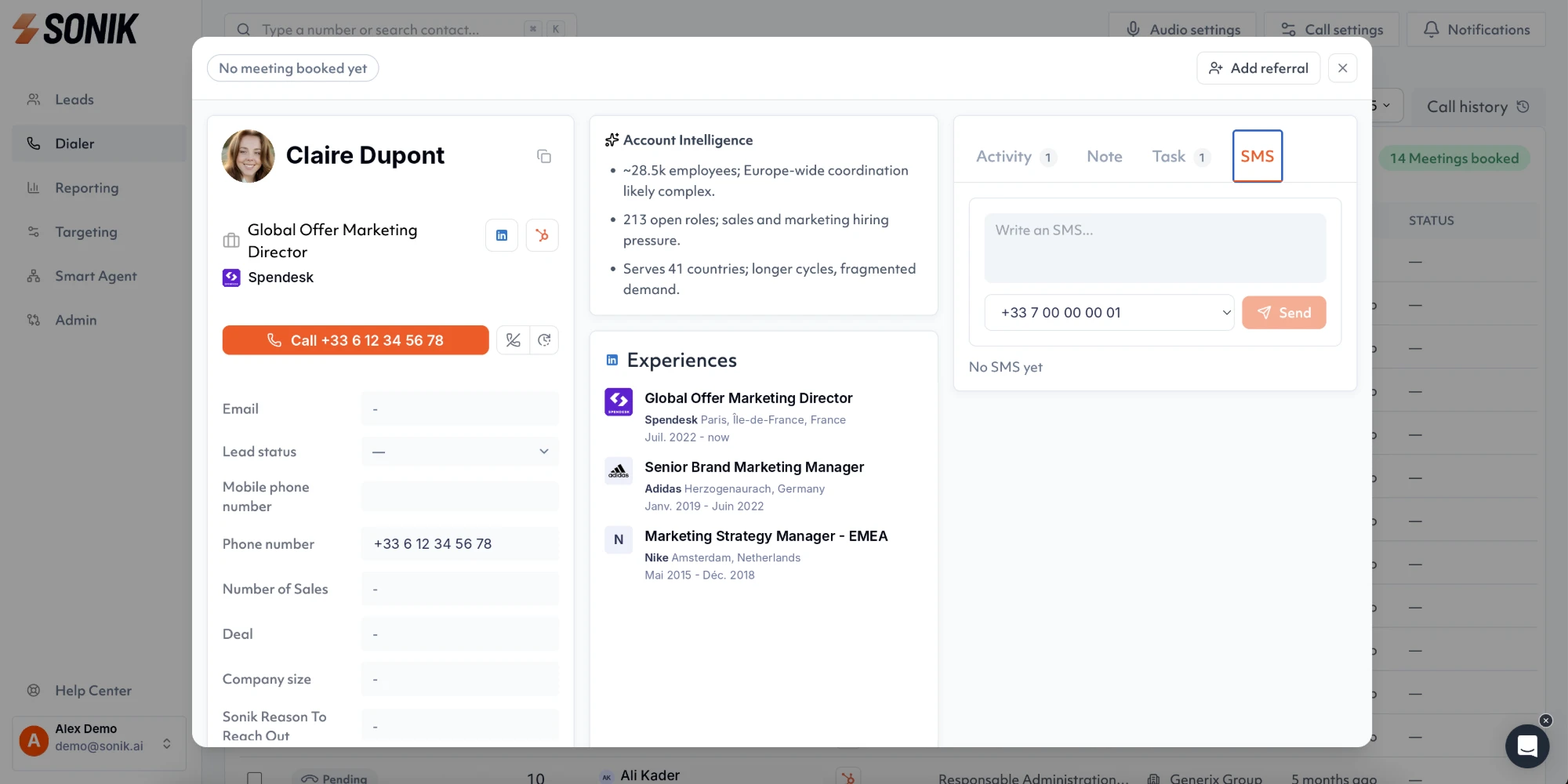
The coaching layer scores the three behaviours our data says matter most: the trigger opener, a question before answering an objection (+197% conversion), and "how" discovery questions (+190%). We built it for European teams: French transcription, European hosting, mobile data from several providers.
Detail on the dialer and the signals.
An AI sales assistant is worth it when it changes what happens in the two seconds after pickup, and when every action lands in the CRM. This week, listen to 10 calls per rep and count trigger openers. That number is your baseline; any assistant you trial should move it within two weeks.

