Get started
Still unsure of the impact of Sonik?
See it for yourself and ask for your free trial

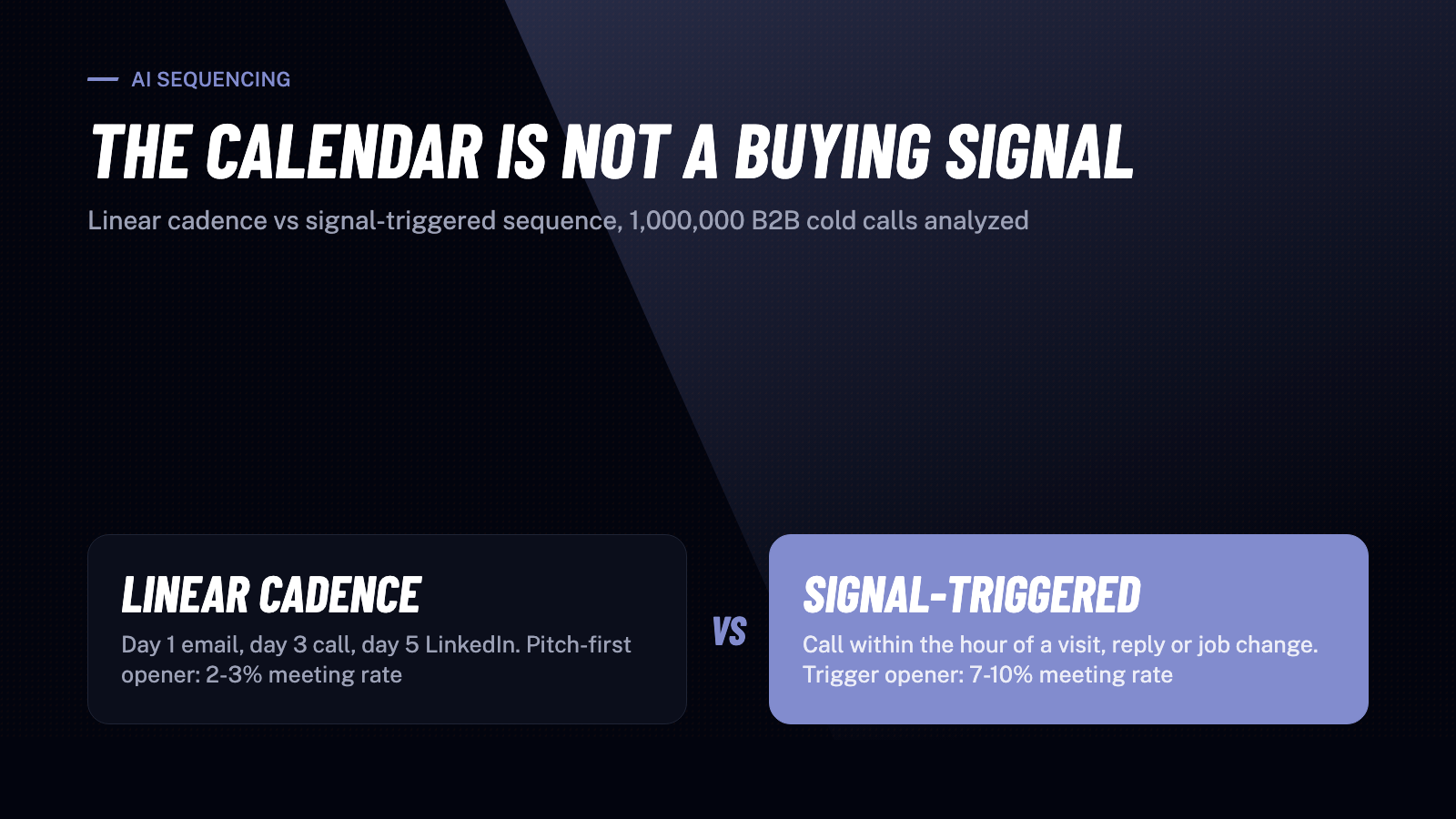
AI sequencing means the next touch in your outreach is chosen by what the prospect just did, not by the day number of a cadence. Day 1 email, day 3 call, day 5 LinkedIn fails because the prospect's week does not follow your calendar. A sequence that calls when the prospect visits your pricing page, replies, or changes job gets a trigger to open with, and in our data a trigger opener books 7-10% of conversations against 2-3% for a pitch.
A fixed cadence makes three bets. That the prospect is as likely to be ready on day 1 as on day 12. That the same message fits whatever happened at their company this week. That the channel order is right for every persona.
All three fail in predictable ways. The window gets missed: the prospect looked at your site on Tuesday and got your day-5 email on Friday. The message lands wrong: a "just following up" note arrives the day after a layoff announcement. And the channel order ignores the data: founders pick up more around 10am, marketing around 4pm, HR around 1pm. A cadence that calls everyone on day 3 at 11am calls most of them at the wrong time.
Three things, in order of importance.
What does not change: the human on the phone. AI sequencing decides when and with what context. It does not hold the conversation.
From our analysis of 1,000,000 B2B cold calls in France with Quentin Despas:
There is an attempt rule: in our experience, most connects happen within the first three attempts. A sequence that gives up after one call throws away most of its connects; one that keeps calling after the third is spending time it will not get back.
A bad list stays bad. Contacts without a mobile number stay unreachable. A number labelled as spam stays unanswered. A rep who pitches first stays at 2-3%. AI sequencing moves the moment and the context of the call; the connect rate benchmark of 11.3% and the opener still decide the rest. If your connect rate is under 5%, fix the numbers before the sequence.
Sonik is not an email sequencer, and we do not plan to become one. We do the call side of the sequence. The signals layer reads HubSpot or Salesforce for website visitors, job changes, closed-lost deals, dormant leads and social intent, and builds the day's call list with the signal attached.

The parallel dialer places the calls in the best slot per persona, shows the trigger and a suggested opener before pickup, and writes the outcome back, so your sequencer can branch on it. 50% of Sonik's own pipeline comes from signals that were already in our CRM. That is the sequence we run on ourselves.
Linear cadences fail because the calendar is not a buying signal. AI sequencing replaces the date with the trigger and the template with a prepared conversation. This week, pull every contact in your CRM who changed job in the last 30 days, call them at 10am, and open with the move. Count the meetings per 100 conversations against your day-3 call step. That one comparison tells you whether to keep the cadence.

