Get started
Still unsure of the impact of Sonik?
See it for yourself and ask for your free trial

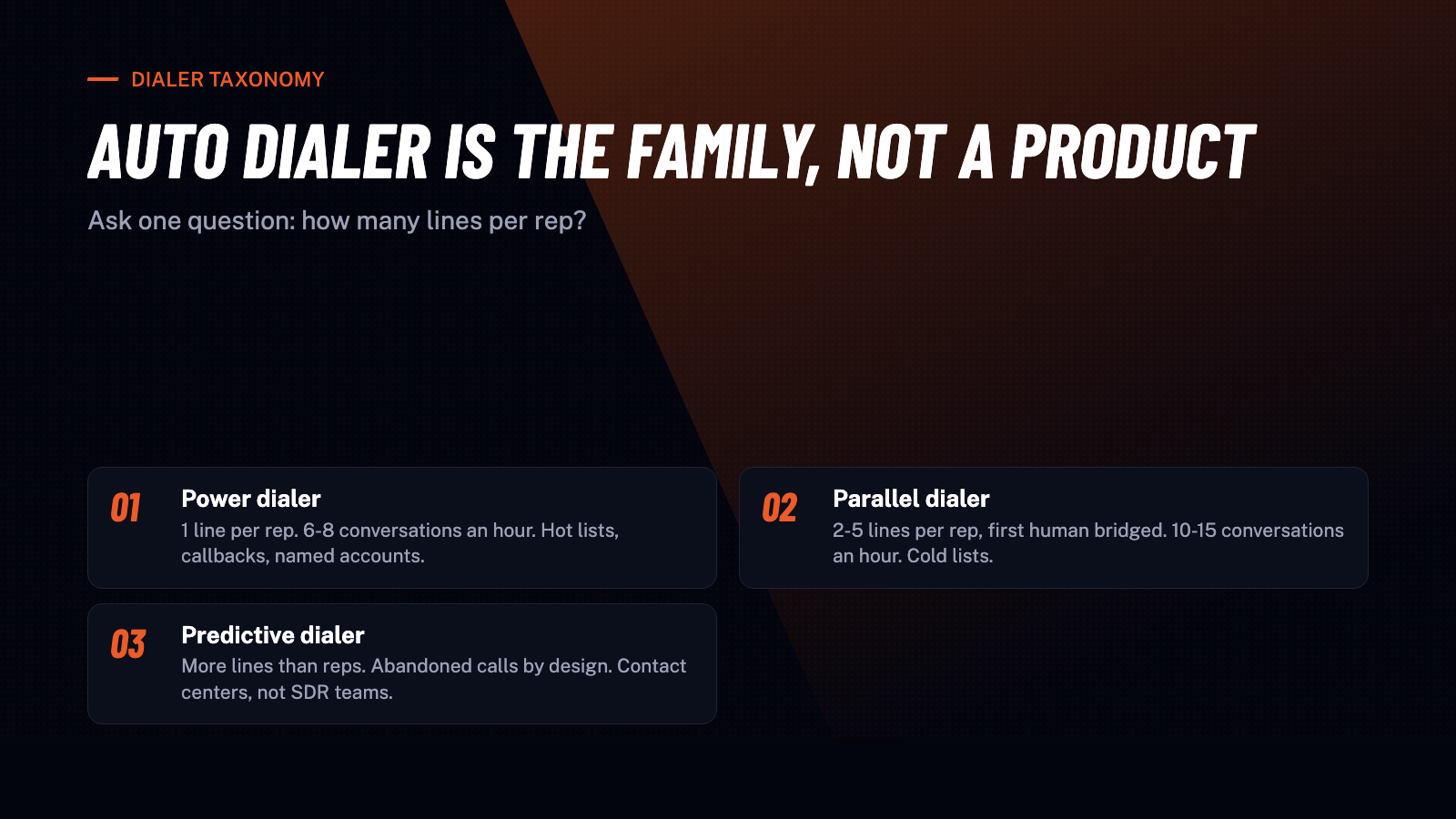
An auto dialer is the category; a power dialer is one of its subtypes. Every power dialer is an auto dialer, but an auto dialer may also be a parallel dialer or a predictive dialer, and those three behave very differently on a B2B list. When a vendor pits "auto dialer vs power dialer", they are usually comparing a predictive contact-center tool with a one-line sales tool. Here is the taxonomy, the one legal line that separates the subtypes in Europe, and how to decode vendor labels.
So the honest version of the question is "power vs parallel vs predictive". "Auto dialer" alone tells you nothing about what you are buying.
One rule separates the subtypes: does the dialer ever produce more answered calls than it has reps?
Power and parallel dialers never do. Power dials one line per rep. Parallel dials several lines per rep but bridges only the first human and drops the rest before a greeting completes. Neither produces an abandoned call by design.
Predictive dialers do, as a feature. The forecast keeps agents busy by over-dialing, and abandoned calls are the tuning parameter, capped at 3% by regulators in the US and the UK.
In France there is no published percentage, but the exposure is real: since August 2026 consumer cold calling is opt-in, the DGCCRF fines unlawful cold-calling practices up to 375,000 euros for a company under the Consumer Code, and since 2024 operators authenticate caller IDs while carriers flag numbers that generate silent calls. For a B2B team, the flagged number is the fine that arrives first.
Our position: for B2B in Europe, the choice is between power and parallel. Predictive is a contact-center category.
Our analysis of 1,000,000 B2B cold calls in France gives an average connect rate of 11.3%. Neither dialer changes that number. They change how many dials fit in an hour.
Power dialer: 50 to 70 dials an hour in our experience, 6 to 8 conversations. The rep waits through 89 rings and voicemails for every 11 humans.
Parallel dialer on 4 lines: 150 or more dials an hour, 10 to 15 conversations, which is the limit of one voice. Parallel dialing gives reps 5x more conversations than manual dialing, and gets a team to 20 conversations per SDR per day, our north star.
The rule of thumb: under 60 dials a day per rep, a power dialer is enough. Above, parallel pays for itself in the first month.
Vendors use the generic word when the specific one would scare a buyer, or when the product does several things. Four questions cut through it.
A claim of "300 dials an hour per rep" is parallel or predictive. A claim of "AI dialer" is a layer (signals, prep, coaching) on top of one of the three subtypes; ask which one is underneath.
Choose a power dialer when reps make under 60 dials a day, lists are hot (callbacks, inbound leads, dormant leads where "How have you been?" reaches about 10% success against 1.5% for a cold open), accounts need 15 minutes of research per call, or reps mix inbound and outbound in the same hour.
Choose a parallel dialer when reps make over 60 dials a day on cold lists, personas sit at the low end of the connect range (marketing, HR), calling windows are short (4pm connects at 15.8%, 8am at 9.8%), or new SDRs need more conversations to ramp.
Choose a predictive dialer when you run a contact center with dozens of agents on a consented consumer list. If you are reading a B2B sales blog, that is probably not you.
Most teams need both of the first two. The mistake is buying two tools for it; the logging breaks at the seam.
Sonik sits in the parallel subtype, with a 1-line power mode, and deliberately no predictive mode. Managers set the mode per list: power for callbacks and hot leads, up to 4 lines for cold lists. The abandoned-call counter is visible and expected to read zero.

The list is ranked from CRM signals (reps use only about 20% of what is already there; half of our own pipeline comes from those signals), the trigger is on screen before the pickup, and outcomes go back to HubSpot or Salesforce with an AI summary. Numbers are owned French and EU numbers with reputation monitoring.
See the dialer page for the modes.
Auto dialer is the family name; power, parallel and predictive are the members, and only the first two belong in B2B sales in Europe. Decide between power and parallel by dials per rep per day, and never buy a dialer without asking how many lines per rep and what the abandoned-call rate is. This week, put those two questions to your current vendor by email. The answer, or the silence, tells you what you own.

