Get started
Still unsure of the impact of Sonik?
See it for yourself and ask for your free trial

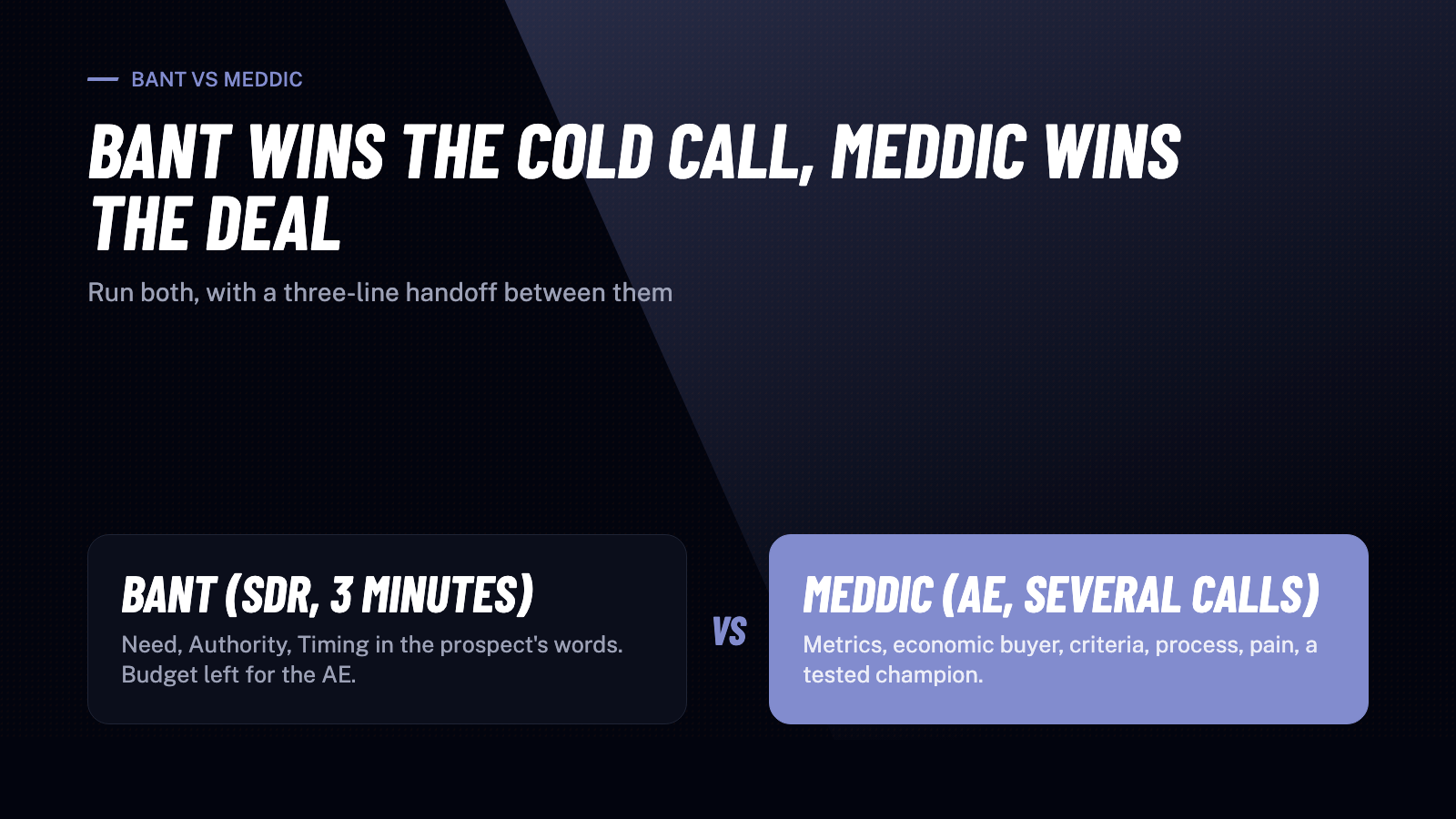
BANT wins the cold call and MEDDIC wins the opportunity. Asking which one wins overall is a category error: BANT is a four-question filter an SDR can start in three minutes, MEDDIC is a six-field deal map an AE builds over several meetings. The teams that close the most in our experience run both, with a clean handoff between them. Here is the verdict by stage, and what the SDR should hand the AE.
Deal under roughly 25,000 euros a year, one or two decision-makers, cycle under 60 days: BANT, run as Need, Authority, Timing, Budget. MEDDIC would be overkill and the prospect would feel interrogated.
Deal above roughly 50,000 euros, three or more stakeholders, cycle over 90 days: MEDDIC at the AE level, with the SDR still using a light BANT on the first call because that is all three minutes allow.
In between: BANT on the SDR call, a lightened MEDDIC (pain, champion, decision process) on the first AE discovery, full MEDDIC only if the deal survives it.
Budget, Authority, Need, Timing. Four questions, created at IBM decades ago, still the most used qualification framework because it is fast and anyone can learn it in an afternoon.
Its known flaw is the order. Opening a cold call with "do you have budget for this?" gets you a polite refusal. Run it backwards: Need first ("how are you handling X today?"), then Authority ("who else is involved when you change this?"), Timing ("is there a date this is tied to?"), and Budget last, often left for the AE.
Its structural flaw is bigger: it assumes one decision-maker. Gartner puts the typical B2B buying group at six to ten people. On a complex deal, BANT's "Authority" box is ticked and the deal still dies in a committee nobody mapped.
What BANT is good at: telling an SDR in three minutes whether a meeting is worth an AE's hour.
Metrics, Economic buyer, Decision criteria, Decision process, Identify pain, Champion. Six fields, built from analysing won and lost deals in enterprise software sales, designed for deals that take months and involve a committee.
Each field covers a way deals die. No metrics: no business case, no urgency. No economic buyer named: the person you talk to cannot sign. No decision criteria: you are being evaluated on a list you have not seen. No decision process: the forecast date is a guess. No pain: nice-to-have. No champion: nobody fights for you when you are not in the room.
The champion is the field that predicts the outcome, in our experience and in most practitioners'. A champion is not a friendly contact. It is someone with influence who will spend their own credibility to get the deal done.
What MEDDIC is bad at: cold calls. You cannot ask a stranger who the economic buyer is in minute two.
BANT breaks on complex deals because it stops at the first "yes". The SDR hears "yes we have budget, yes I decide" and books a meeting with someone who turns out to be one of eight voices.
MEDDIC breaks on volume. It takes 30 to 90 minutes of conversation across several calls to fill honestly. Ask an SDR to run MEDDIC on 20 conversations a day and you get six fields of guesses in the CRM.
Both break on the same thing: execution. A BANT run with questions that start with "do you" instead of "how" gets yes/no answers. In the 1,000,000 French B2B cold calls we analysed with Quentin Despas (Katana), discovery questions starting with "how" lift conversion by 190%. The framework does not fix the phrasing.
This is the model that makes the "BANT vs MEDDIC" debate disappear.
The SDR, in a three-minute cold call, fills Need (the pain, in the prospect's words), a first hint at Authority (who else cares), and Timing (any date). That is the "N", "A" and "T" of BANT, and it maps directly onto MEDDIC's Identify pain, a candidate Champion, and the start of the Decision process.
The AE, in discovery, takes those three and builds the rest: Metrics (what the pain costs), Economic buyer (who signs, in French mid-market often the finance director), Decision criteria, and a tested Champion.
The handoff note is three lines. Pain in their words. Who else was named. Date mentioned. An AE who opens discovery with "you told my colleague the renewal is in March" starts MEDDIC at minute one instead of minute twenty.
In our experience selling to French mid-market companies, the buying group is often smaller than Gartner's six to ten, but the decision process is longer and more formal: a finance director validates, a works council may be consulted on tooling that touches employee data, legal reviews the data processing agreement. MEDDIC's Decision process field matters more here than Decision criteria. Map the steps early, or the forecast slips a quarter.
Sonik's AI call prep pre-fills the SDR's BANT fields from signals in the CRM before the call: a new VP Sales fills Authority, a closed-lost deal from last year fills Need and Timing, a pricing-page visit fills Need. The rep opens on the trigger, which reaches a 7-10% meeting rate in our data versus 2-3% for a pitch-first opener.

After the call, the AI summary writes the three-line handoff and maps it to the team's MEDDIC fields, so the AE's deal record starts with pain, candidate champion and timing already filled. The parallel dialer gives the SDR 5x more conversations to run BANT on, which is where the qualified pipeline is actually constrained.
BANT for the cold call, MEDDIC for the opportunity, and a three-line handoff between them: pain, people, date. This week, read your last ten SDR-to-AE handoff notes and check whether the AE could have opened discovery from them. If not, the problem is the handoff, not the framework.

