Best AI Sales Assistants for Outbound: A Buyer's Guide 2026
The best AI sales assistant for outbound is the one your reps still open in week six, inside the tool where they dial. Most "top 5" pages are written by a vendor who ranks itself first. This guide does something more useful: it names the five categories of AI sales assistant, the seven criteria that separate them for a European team, and a two-week test you can run before you sign anything.
What counts as an AI sales assistant in 2026
An AI sales assistant does the work around the conversation. Research before the call, prompts during it, notes and CRM update after it. It does not hold the conversation. That is the line between an assistant and an AI SDR agent that sends and replies on its own.
You need one because the arithmetic of outbound does not work by hand. Salesforce's State of Sales research puts the share of a rep's week spent actually selling at about 28%. Our own benchmark says a rep needs 20 conversations a day to hit a normal SaaS quota. At the 11.3% average connect rate we measured on 1,000,000 B2B cold calls in France, that is roughly 180 dials a day. Nobody does 180 dials, 180 CRM updates and 20 prepared conversations with a notepad.
The five categories of AI sales assistant
Vendors use the same label for five different products. Decide which job you are buying first, then compare inside that category.
Assistants inside the dialer. A prep card before pickup, prompts during the call, a summary written back after. Strength: reps use them during call blocks, because they are already on screen. Weakness: you are choosing a dialer at the same time.
Conversation intelligence. Records, transcribes, scores and flags coaching moments. Strength: managers coach from real calls. Weakness: everything happens after the call; nothing changes the call itself.
Research and drafting assistants. Account briefs, first-draft emails, LinkedIn notes. Strength: cuts research minutes. Weakness: generic input gives generic output, and generic output at scale is how domains get burned.
CRM copilots. Live inside HubSpot or Salesforce, summarise records, suggest next steps, clean fields. Strength: they sit in the system of record. Weakness: reps are not in the CRM during a call block.
Signal and prioritisation assistants. Tell the rep who to call today and why. Strength: relevance. In our data, reps use only about 20% of the signals already sitting in their CRM, and 50% of Sonik's own pipeline comes from signals that were already there.
Seven criteria that matter for a European outbound team
Where it lives. In the call block or in a separate tab. An assistant nobody opens between two dials is a dashboard.
What it does before the pickup. 65% of reps open by explaining what they sell. Trigger-based openers reach a 7-10% meeting rate against 2-3% for pitch-first openers. If the assistant does not surface the trigger and suggest the opener, it is missing the biggest lever.
Language quality. Test transcription and summaries on real French, German or Spanish calls, with accents, interruptions and a bad mobile line. Demo calls in clean English prove nothing.
CRM write-back. Bidirectional, field-level, into your existing objects. If the vendor keeps its own copy of contacts and activities, you now own a shadow CRM.
GDPR and hosting. EU hosting, a signed DPA, a public sub-processor list, and a recording notice that matches the rules of each country you call. For France, check how the tool handles the information duty before recording.
The coaching loop. Does it score the behaviours that book meetings, or just talk ratio? Discovery questions starting with "how" lift conversion by 190% in our benchmark. Asking "What do you mean?" before answering an objection: +197%. An assistant that cannot see those is scoring the wrong things.
Price in euros, all in. Per seat, with or without telephony minutes, with or without the dialer. Compare the full monthly cost per rep, not the headline.
How to run a two-week comparison
Do not compare demos. Compare outcomes on your own lists.
Split the team: one squad with the assistant, one without. Same lists, same slots. Our data says 4pm (15.8% connect) and 10am (14%) are the slots to protect.
Measure five things: conversations per rep per day, meetings per 100 conversations, CRM fields filled without manual typing, prep minutes per call, and how many reps still use it on day 10.
Ignore dials and any count of "insights generated". Those are activity, not output.
Ask each vendor the job-change question: a contact in an active sequence moves company today. What happens, which trigger fires, and where does it show in the CRM?
Red flags in vendor comparison charts
The vendor ranks itself first. Read it as a feature list, not a ranking.
Results quoted as "up to". Ask for the median and the sample.
Review-site stars without the number of reviews or the date.
No price in euros on the page.
Any promise to replace your SDRs. An assistant that holds the conversation for you is a different product with different risks, in Europe especially.
How Sonik approaches the AI sales assistant
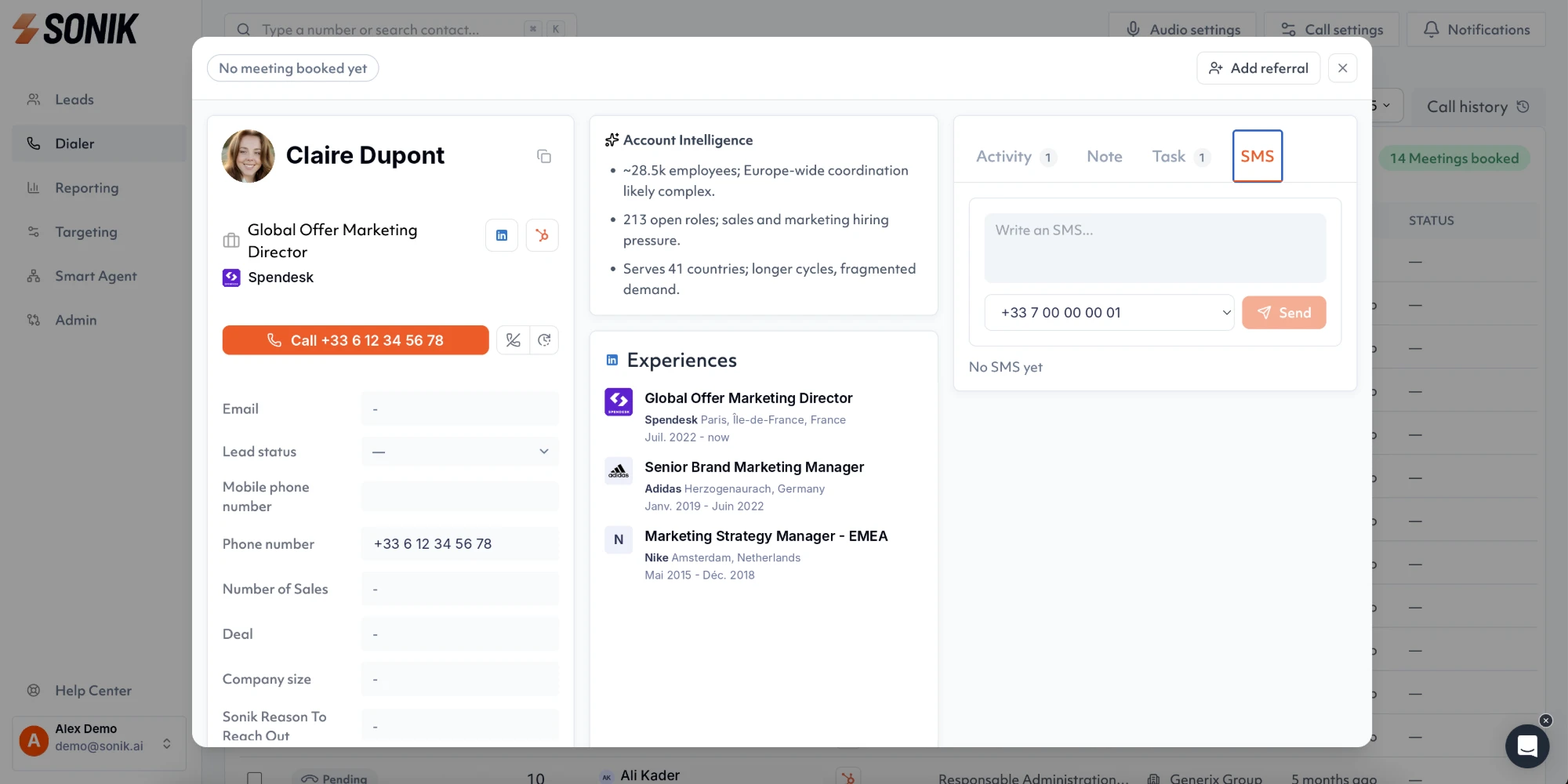
Sonik's assistant sits inside the parallel dialer, so it is on screen during the call block. Before pickup, it builds a one-screen brief from the signals in your CRM: website visit, job change, closed-lost deal, dormant lead, social intent. It suggests the opener from the trigger.
The Sonik dialer during a session: parallel calls, statuses and the running count of meetings booked.Before the pickup: account intelligence, experiences and the signals that qualify the contact, on one screen.
During the call, the trigger and the last notes stay visible. After it, the summary and the next step are written to HubSpot or Salesforce. Coaching scores the behaviours from the 1,000,000-call benchmark, not talk ratio.
That makes Sonik one option in the first category. If your bottleneck is email drafting or post-call review, another category may serve you better. Buy the job.
Conclusion
There is no best AI sales assistant, only the best one for the job your reps are failing at today. Name that job, pick the category, then run the seven criteria and the two-week split. This week: pull your last 20 call recordings and count how many openers start with what you sell. If it is more than half, the assistant you need is the one that puts the trigger on screen before the pickup.