Get started
Still unsure of the impact of Sonik?
See it for yourself and ask for your free trial


The best parallel dialer for your sales team's efficiency is the one that turns the most dials into live conversations per rep-hour on your own list, at your own connect rate, without burning your caller IDs. In our benchmark of 1,000,000 B2B cold calls in France, a rep goes from 3.2 conversations an hour dialing by hand to 16.2 on a parallel dialer, and that 5x is the entire efficiency case. It only pays off above roughly 60 dials per rep per day on cold or warm lists; below that, or on a 30-account list, a parallel dialer makes you faster at the wrong thing. Here is the math, the thresholds, the prerequisites, and the five KPIs to compare tools on in a pilot.
Start with what efficiency means on an outbound floor. It is two numbers multiplied: conversations per rep-hour, and meetings per conversation. A parallel dialer moves the first one. It does not touch the second, and a tool that quadruples your conversations with the wrong people quadruples your "not interested".
So the best parallel dialer for efficiency is not the one with the most lines. It is the one that gets your reps to about 16 conversations an hour on lists built from signals, with the brief on screen before the "hello", and with a caller ID that still works in week six. Lines are the easy part. Every vendor has lines.
What follows is the way we evaluate it on our own floor, with the numbers from the benchmark we ran with Quentin Despas of Katana.
Take 100 numbers from a cold persona list. At the 11.3% average connect rate in our benchmark, 11 people pick up. That ratio does not move when you add lines, because the dialer does not decide who answers.
By hand, a rep gets through 30 to 40 numbers an hour: 3.2 conversations. On a power dialer, the dialing and the typing disappear: 5.4. On a parallel dialer with 2 to 4 lines, the ringing and the voicemails disappear too, and the rep only hears humans: 16.2.
Why not 40 on four lines? Talk time. A real cold call lasts 3 to 5 minutes, so a rep cannot hold more than 10 to 16 conversations in an hour whatever the line count. Beyond 4 lines on a B2B list, extra lines mostly produce double pickups, and a double pickup is an abandoned call.

Over a 4-hour calling block, the difference is 13 conversations versus 65. Over 20 calling days, 260 versus 1,300. That is the efficiency gain, and it is large enough that the choice between vendors matters less than the choice to switch at all, as long as the prerequisites below hold.
Two numbers from your call log decide it. Dials per rep per day: under 40, a parallel dialer is premature and the money belongs in data and training; between 40 and 60, a power dialer is usually enough; above 60, you are the target customer and the first month pays for the seat. Connect rate: under 8%, fix the list and the caller ID before adding a single line, because lines multiply whatever is wrong with the list.
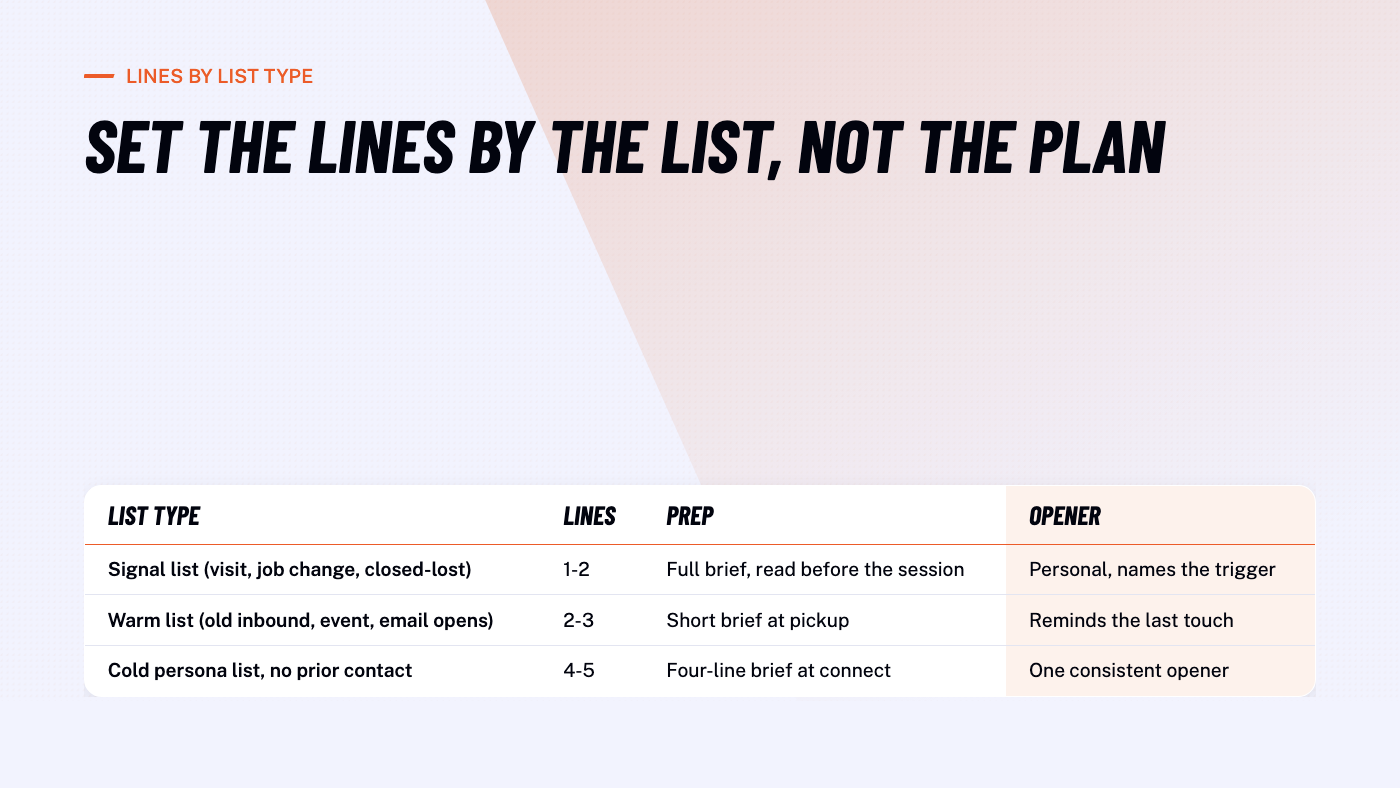
Then set the lines by list type, not by what the plan allows. Signal lists, the website visitor from a target account or the champion who changed jobs, deserve 1 to 2 lines and full prep. Warm lists, inbound leads older than a month or event attendees, take 2 to 3 lines. Cold persona lists with no prior interaction run at 4 to 5 lines, with one consistent opener.
High volume exposes bad data faster. If 15% of your numbers are dead, four lines burn through them four times faster and flag your caller ID four times faster. In our experience the connect rate of a team that skips this step falls within two weeks, and the dialer gets the blame.
Three prerequisites, in order. Numbers you own, French or EU, with authenticated caller ID: since 2024 French operators verify that the displayed number belongs to the caller and block spoofed calls. A list cleaned before the session, with a cap on attempts per contact: in our experience most connects happen within the first three attempts, so a fourth attempt is mostly caller-ID damage. An abandoned-call counter that reads zero, because a dropped human in B2B is a burned account, not a 3% statistic.
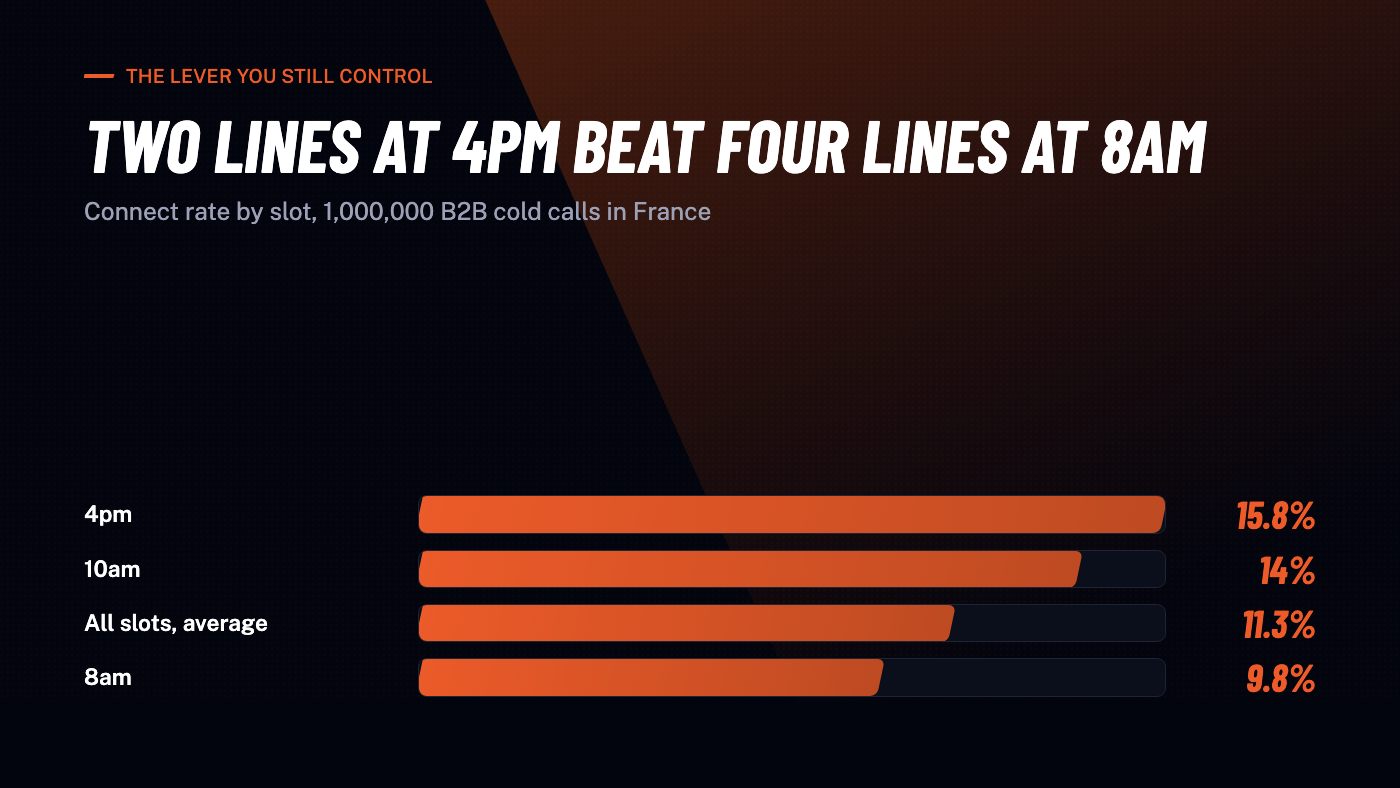
And timing, which the dialer cannot fix but can display. In our benchmark, 4pm connects at 15.8%, 10am at 14%, 8am at 9.8%. Four lines at 8am is still less efficient than two lines at 4pm.
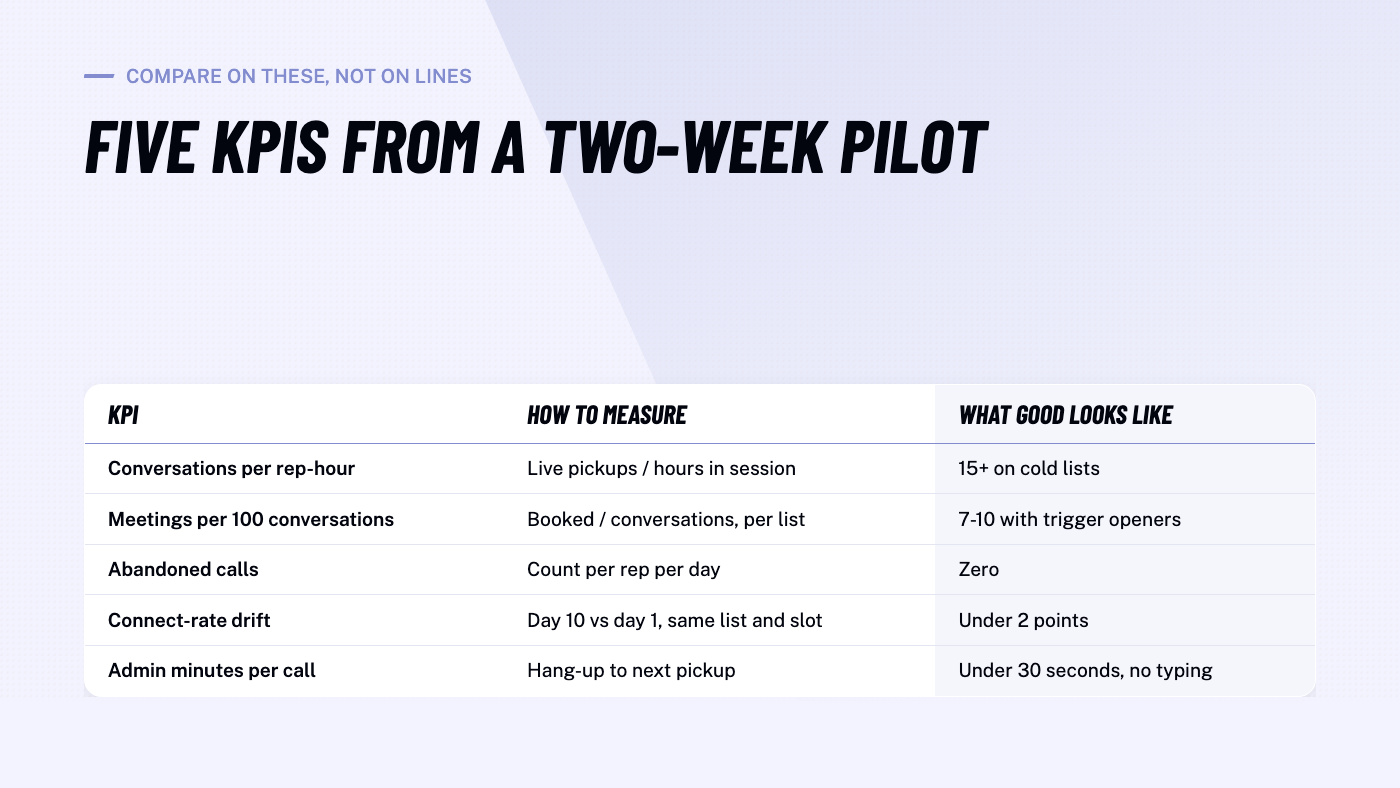
Vendor comparison tables list max lines, price and a star rating. None of those is an efficiency metric. These five are, and all of them come out of a two-week pilot on your own list.
Conversations per rep-hour. The headline number. Target 15 or more on cold lists; a tool that gets you to 8 has a latency or detection problem.
Meetings per 100 conversations. The check that the extra conversations are with the right people. In our benchmark, trigger-based openers book 7 to 10 per 100, pitch-first openers 2 to 3. If this number drops when conversations rise, the list or the prep is the problem.
Abandoned calls. Count, not rate. Expect zero. A tool that cannot show you the counter per rep per day is hiding it.
Connect-rate drift. Your connect rate on day 10 against day 1, same list type, same slot. A drop of more than two points means the caller IDs are being flagged.
Admin minutes per call. Time between hang-up and next pickup. If logging involves typing, each rep loses about 30 minutes a day, which is two of the 16 conversations.
A power dialer keeps one line and the rep hears everything: 5.4 conversations an hour in our data, and the right tool for warm lists where the person expects context. A parallel dialer removes the waiting: 16.2, and the right tool for cold lists. A predictive dialer dials ahead of agent availability and accepts dropped calls to keep agents busy; it is a consumer call-centre tool, and in European B2B it costs you the accounts you wanted. Most outbound teams need power and parallel, switched per list, and no predictive at all.

When we ran the 1,000,000-call analysis with Quentin Despas, the number I expected to matter was the connect rate by line count. It barely moved. Two lines or four, the share of humans picking up stayed around the same 11%, and what changed was how many numbers a rep got through before 11am.
The lever that did move the connect rate was the clock. The same persona at 4pm and at 8am were two different lists, 15.8% against 9.8%. Since then our rule on the floor has been slot first, list second, lines last. A team that gets the first two right reaches 20 conversations a day on two lines. A team that gets them wrong does not reach it on five.
Two weeks, two reps, one list of 500 contacts split at random. Half on the current setup, half on the trial dialer, same 10am and 4pm blocks, same opener. Record the five KPIs daily. On day ten, compare conversations per rep-hour and meetings per 100 conversations side by side. If the first moved and the second held, the dialer works. If the first moved and the second fell, you have found your real bottleneck, and you now have three times more conversations a day to fix it with.
Sonik is a parallel dialer built in France for European B2B outbound teams, and one option in this category. It runs up to 4 lines per rep with a 1-line mode per list, on owned French and EU numbers with reputation monitoring, and shows the abandoned-call counter per rep.

The efficiency case is the one above: 5x more conversations per hour at your existing connect rate. To protect the second number, meetings per conversation, the list is built from CRM signals (website visits, job changes, closed-lost dates, dormant leads) and the brief appears at connect. 50% of our own pipeline comes from signals that were already in the CRM. Reporting shows connect rate by persona and hour against the benchmark, so the slot-first rule is visible on screen. Our north-star funnel for customers is 20 conversations per SDR per day, for 2x more meetings. Details on sonik.ai/dialer.
Two to four. Set by list type: 1 to 2 on signal lists, 2 to 3 on warm lists, 4 to 5 on cold persona lists. Beyond that on B2B lists, extra lines produce double pickups and abandoned calls, not conversations, because talk time caps a rep at 10 to 16 conversations an hour.
No. In our 1,000,000-call benchmark the connect rate stays around 11.3% whatever the line count. It increases conversations per hour by removing ringing and voicemails from the rep's time. Timing moves the connect rate: 15.8% at 4pm against 9.8% at 8am.
Yes for B2B prospecting, which runs on legitimate interest under the GDPR with a right to object you must honour. The risks are abandoned calls, which should be zero, and caller-ID spoofing, which French operators have blocked since 2024. Owned numbers and a shared do-not-call list are the minimum.
About 16 on a parallel dialer on cold lists, 5 on a power dialer, 3 by hand. Our north-star funnel is 20 conversations per SDR per day, which a parallel dialer reaches in about 90 minutes of calling in the right slots.
The best parallel dialer for efficiency is the one that gets your reps from about 3 to about 16 conversations an hour without moving your connect rate down, and the pilot proves it in two weeks. Check the threshold, clean the list, own the numbers, then compare tools on the five KPIs. This week, count last week's dials and conversations per rep, and if dials are above 60 and conversations below 10, the lines are your bottleneck.

