
Best Parallel Dialers for IT Services and Cybersecurity (2026)

The best parallel dialers for IT services firms and cybersecurity vendors are the ones that make you look legitimate in the first three seconds. Your buyers, CIOs, CISOs and IT managers, are among the most solicited people in B2B, and security training tells them to distrust unexpected calls. A dialer that shows a strange number, starts with silence or stores recordings nobody can locate works against you. Here is how to choose.
Why selling IT and security changes the dialer question
The buyer treats an unknown call as a risk
Voice phishing is part of every awareness programme. A security leader who picks up and hears a second of nothing files the call under attack attempts, not under vendors. Three things follow: a number that can be called back and reaches a person, a name and company in the first sentence, and no silent calls at all.
The buyer will audit the seller
If you sell security or managed services, your own tools are part of your credibility. Expect a prospect to ask where your call recordings are hosted and who can access them. A dialer you cannot document is a liability in your own sales cycle.
Reasons to call are concrete in this market
IT and security purchases follow events. A new CISO or CIO reviews suppliers in the first months, in our experience. European rules such as NIS2 and DORA have put security on the agenda of companies that never had a dedicated team. A visit to your page on a specific offer, a job post for a security analyst, a contract coming up for renewal: each is a reason the prospect will accept.
Our data shows what a reason is worth. Trigger-based openers reach a 7 to 10% meeting rate against 2 to 3% for pitch-first openers, across 1,000,000 B2B cold calls. One caution: calling a company the week after a public incident reads as opportunism. We do not recommend it.
IT services firms run two call flows
A business developer in an IT services company calls IT managers to place skills and projects, at high volume, and often has to get listed with procurement before large accounts will talk. Parallel dialing fits the mid-market volume side. It does not get you past a supplier listing process.
Conversations are technical
A rep who confuses two acronyms loses the call. The brief at pickup has to show the role, the known stack and the last exchange, and any AI summary has to survive technical vocabulary.
Which category fits IT and security sellers
- Standalone parallel dialers. Fit the high-volume IT manager motion. Check caller ID practices closely; avoid any "local presence" feature that shows a number you do not own.
- Dialers inside a sales engagement platform. Suit account-based security sales, where a call is one touch among several to a buying group.
- CRM-native dialers. The simplest answer to "where is the data". Limited lines, which suits small named lists.
- AI-native dialers. Signals supply the reason to call and the brief supplies the context. Check hosting and the documentation you can hand to a prospect.
Seven criteria for this market
- Owned, callable numbers. Dedicated per rep, answering on callback.
- A human on every connected call. And a line setting low enough that nobody hears silence.
- Signals as list source. Job changes, site visits, custom events on named accounts.
- Brief at pickup. Role, account context, reason for the call, before hello.
- Security documentation. Hosting region, data processing agreement, subprocessors, access controls. You will forward it.
- Recording options. A notice, a retention period, and a mode that keeps a summary without audio for sensitive conversations.
- Transcription on technical calls. Test it on a real conversation full of acronyms before you trust the summaries.
The pilot: two segments, two line settings
Split the test. On a mid-market list of IT managers, run three to five lines in shared blocks. On a named list of CISOs, run one or two lines with a signal on every contact. Compare meetings per 100 conversations, not dials.
Our French benchmark gives an 11.3% average connect rate, with 10am at 14% and 4pm at 15.8%. We do not publish a figure for IT personas, so measure your own for 200 dials before judging the tool. Our reference session is 127 dials, 10 conversations and 0.66 meetings per hour, and senior security lists will sit below it on dials and should sit above it on relevance.
Parallel dialers to shortlist for IT services and cybersecurity sellers
The tools below say on their own sites that they offer parallel dialing and serve this market. They are in alphabetical order, with facts taken from each vendor's site on 9 November 2026. This is not a ranking: confirm current details with each vendor and let your own pilot decide.
- CloudTalk. Its parallel dialer page describes dialing up to 5 contacts at once per rep, with campaigns set from 2 to 5 lines, voicemail detection, number rotation and scheduled callbacks. It names integrations with HubSpot, Salesforce, Pipedrive and Zoho CRM, local numbers in 160+ countries, and SOC 2, ISO 27001 and GDPR compliance. The site lists offices in London, Barcelona, Lisbon, Munich and Prague, among others. A fit for teams that want sales and support calling on one phone system across many countries.
- Orum. Its site describes AI-powered parallel dialing with number rotation, country matching and reputation monitoring, a virtual sales floor with leaderboards and live listening, and AI coaching with scorecards and roleplay. Integrations named include Salesforce, HubSpot, Outreach and Salesloft. It states calling across 160+ countries and regions depending on plan, SOC 2 Type II, and a platform built for enterprise. A fit for large SDR and BDR teams, including distributed ones.
- Salesfinity. Its site says the AI parallel dialer calls up to five lines at once, with voicemail skipping and live coaching, plus a virtual salesfloor, AI list building and waterfall enrichment across 7+ data providers. Integrations named include Salesforce, HubSpot, Outreach and Salesloft. It states SOC 2 Type II certification and no seat minimums to get started, and has solution pages for B2B SaaS, cybersecurity, outbound agencies and recruitment. A fit for SDR teams at growing B2B companies.
- Sonik. An AI sales dialer built in France. Its differentiator is the list: calls start from signals (website visitors, job changes, social intent, custom intent on key accounts) synced with HubSpot or Salesforce. It dials up to five lines in parallel with a sequential mode for any list, finds a verified mobile number for 72% of contacts, hosts data in Europe and publishes its price: 200 euros per user per month with calls and minutes included, after a free proof of concept. A fit for teams whose first problem is who to call and why.
How Sonik approaches IT services and cybersecurity teams
With Sonik, a human is always on the line and no automated message is played. The rep is bridged in under 0.33 seconds with the prospect's context on screen, and each rep has dedicated numbers that prospects can call back.
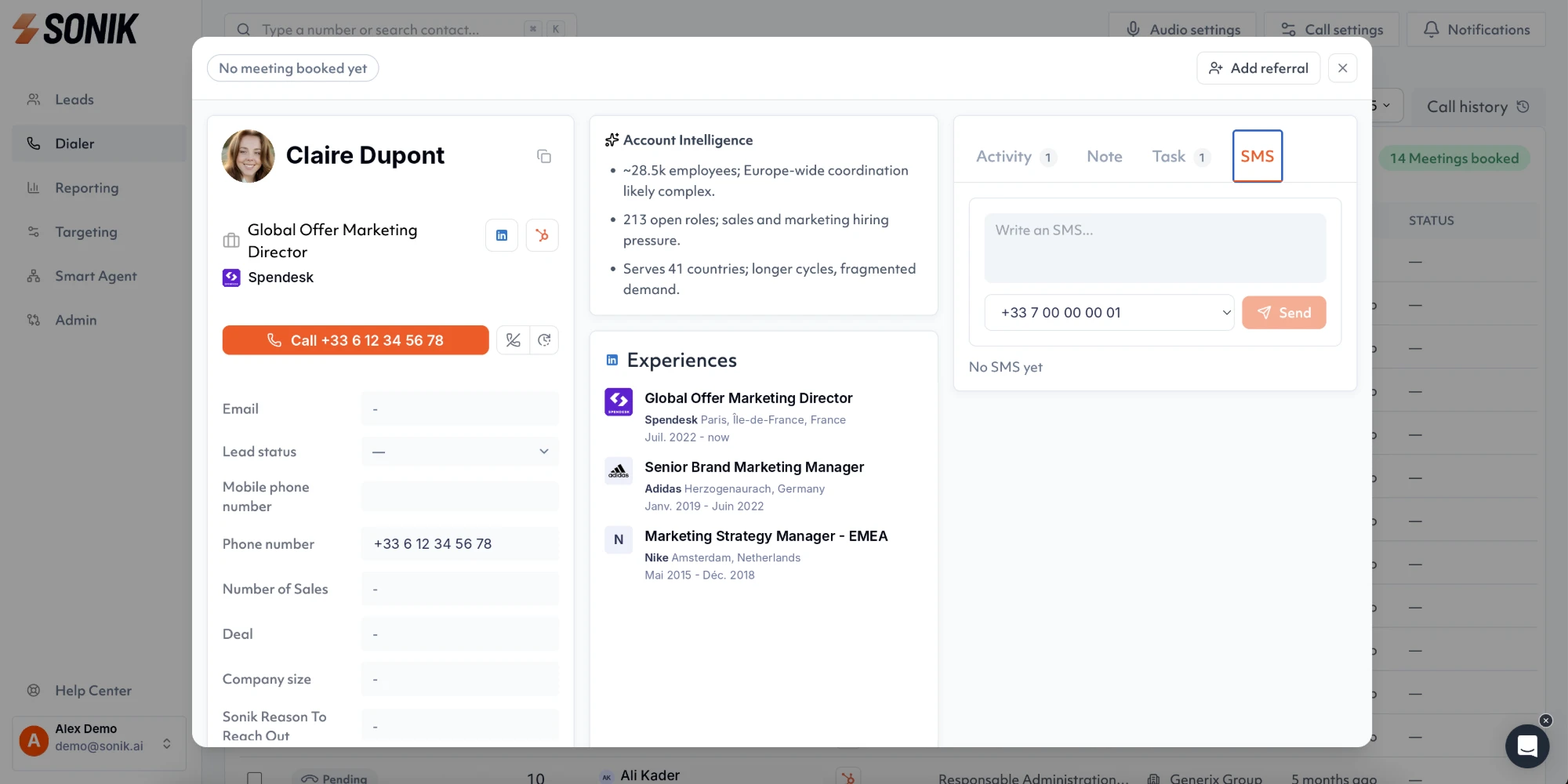
Lists are built from signals: website visitors, job changes, social intent and custom intent on your key accounts, synced with HubSpot or Salesforce. The dialer runs up to five lines in parallel, with a sequential mode for named lists. Sonik finds a verified mobile number for 72% of contacts, which matters for personas who never answer the switchboard.
On the audit side, Sonik acts as a data processor, data is hosted in Europe, the DPA is available on request, and you can keep only an AI summary of each call with no audio. Ask us for the documentation your prospects will ask you for. See the signals page and our GDPR checklist.
Conclusion
Selling to IT and security leaders by phone is a trust exercise. The best parallel dialer for it shows who you are, never goes silent, gives the rep a reason and stands up to the audit your buyer would run. This week, call your own CISO from your sales number and ask what they would have thought. Their answer is your requirements list.