
Best Parallel Dialers for SDR Teams (2026): A Manager's Guide

The best parallel dialers for SDR teams are the ones that change what you manage. With one line, an SDR manager counts dials because conversations are too rare to coach on. With parallel dialing, each rep can reach 20 conversations a day, and the job becomes improving those conversations. The tool to choose is the one that gives you that second job: volume, plus the means to coach it.
What an SDR team needs that other buyers do not
- A different KPI. Parallel dialing multiplies dials by construction. A dial target becomes meaningless on day one. Conversations per day and meetings per 100 conversations replace it.
- Faster ramp. A new SDR learns from conversations. At three an hour, ramp takes months. At ten an hour, the same number of repetitions fits in weeks.
- Coaching material. In our benchmark of 1,000,000 B2B cold calls, 65% of reps open by explaining what they sell. You cannot fix that from a dashboard of dial counts.
- Energy. What wears SDRs out is dead time: rings, voicemails, typing notes. Remove it and the afternoon block gets easier to staff. Turnover has a price; we estimated it in the real cost of SDR turnover.
- Team rhythm. Shared blocks at 10am and 4pm, the two best slots in our data (14% and 15.8% connect rates), work better than each rep dialing when they feel like it.
Which category fits an SDR team
- Standalone parallel dialers. Built for exactly this user. Strong on lines and speed. Coaching and list building usually come from other tools.
- Dialers inside a sales engagement platform. Good when SDRs run true multichannel sequences. Check whether the parallel mode is as fast as a dedicated tool.
- CRM-native dialers. Fine for hybrid roles. Often too few lines for full-time SDRs.
- AI-native dialers. Signals rank the list, the brief shows at pickup and calls are scored. One tool covers the list, the dial and the coaching. Sonik is in this category.
Eight criteria from the manager's chair
- Conversations per rep, per hour, per slot. On one screen, without an export.
- Line ramp for new reps. Two lines in week one, more when the opener holds. A new SDR on five lines learns to panic.
- List assignment. No contact in two reps' sessions, fair distribution of the best signals.
- The brief at pickup. Who this is and why now, before the rep says hello. Without it, parallel dialing produces generic openers at scale.
- Automatic scoring. Opener, discovery questions, objection handling, per call and per rep.
- Objection library. The objections your market really raises, grouped across the team, for the weekly session.
- Number health per rep. Pickup rate per line, per day, so a burnt number is not mistaken for a bad week.
- Clean handoff to AEs. The meeting, the summary and the recording on the CRM record the AE opens.
What to coach once the volume is there
Three findings from our data make a first quarter of coaching.
The opener. Trigger-based openers book 7 to 10% of conversations, pitch-first openers 2 to 3%. Listen to the first fifteen seconds of ten calls per rep.
Discovery. Questions that start with "how" lift conversion by 190%. Count them per call.
Objections. Asking "What do you mean?" before answering lifts conversion by 197%. Most reps answer at once.
None of this is coachable at fifteen conversations a week. All of it is at twenty a day.
A four-week rollout for a team
- Week 0. Baseline: conversations per rep per day, meetings per 100 conversations, on the current setup.
- Week 1. Two reps, two lines, shared blocks at 10am and 4pm. Check logging and numbers.
- Week 2. Whole team, line count per rep by seniority. Dial targets removed, conversation targets set.
- Weeks 3 and 4. First coaching cycle on openers. Compare with week 0.
Our reference session is 127 dials, 10 conversations and 0.66 meetings per hour. Two focused hours a day is enough to reach the 20-conversation mark. The rest of the day goes to follow-ups and research, which is also how you keep a remote team in rhythm; see nine rituals for remote SDR teams.
Parallel dialers to shortlist for an SDR team
The tools below say on their own sites that they offer parallel dialing and serve this market. They are in alphabetical order, with facts taken from each vendor's site on 9 November 2026. This is not a ranking: confirm current details with each vendor and let your own pilot decide.
- Koncert. Its site lists several dialers, including an AI parallel dialer, with automated local presence, managed caller ID health, a remote salesfloor, remote coaching and a multichannel cadence tool. It shows SOC 2 Type II, GDPR and TCPA badges and addresses SDR and BDR managers, account executives and revenue leaders. A fit for teams that want several dialing modes and a sequencer from one vendor.
- Orum. Its site describes AI-powered parallel dialing with number rotation, country matching and reputation monitoring, a virtual sales floor with leaderboards and live listening, and AI coaching with scorecards and roleplay. Integrations named include Salesforce, HubSpot, Outreach and Salesloft. It states calling across 160+ countries and regions depending on plan, SOC 2 Type II, and a platform built for enterprise. A fit for large SDR and BDR teams, including distributed ones.
- Salesfinity. Its site says the AI parallel dialer calls up to five lines at once, with voicemail skipping and live coaching, plus a virtual salesfloor, AI list building and waterfall enrichment across 7+ data providers. Integrations named include Salesforce, HubSpot, Outreach and Salesloft. It states SOC 2 Type II certification and no seat minimums to get started, and has solution pages for B2B SaaS, cybersecurity, outbound agencies and recruitment. A fit for SDR teams at growing B2B companies.
- Sonik. An AI sales dialer built in France. Its differentiator is the list: calls start from signals (website visitors, job changes, social intent, custom intent on key accounts) synced with HubSpot or Salesforce. It dials up to five lines in parallel with a sequential mode for any list, finds a verified mobile number for 72% of contacts, hosts data in Europe and publishes its price: 200 euros per user per month with calls and minutes included, after a free proof of concept. A fit for teams whose first problem is who to call and why.
- Trellus. Its site describes power and parallel dialing, Hot Numbers that rank contacts by estimated pickup likelihood, number management, real-time AI coaching, a virtual salesfloor and AI sales roleplay. Integrations named include HubSpot, Salesforce, Outreach, Salesloft, Close and Attio, and it shows a SOC 2 Type II badge. It has industry pages for B2B SaaS, recruiting and staffing, sales agencies and white-label dialing, and addresses sales teams and founders.
How Sonik approaches SDR teams
Sonik's north star is 20 conversations per SDR per day. The dialer calls up to five lines in parallel, skips voicemails and bridges the rep in under 0.33 seconds with the prospect's context on screen. A sequential mode is available for any list, which is how new reps start.

Lists are built from signals in HubSpot or Salesforce and refreshed daily, so SDRs start the block with a ranked list instead of building one. Calls are transcribed and logged automatically, and AI coaching and objection tracking give the manager the material for the weekly review.
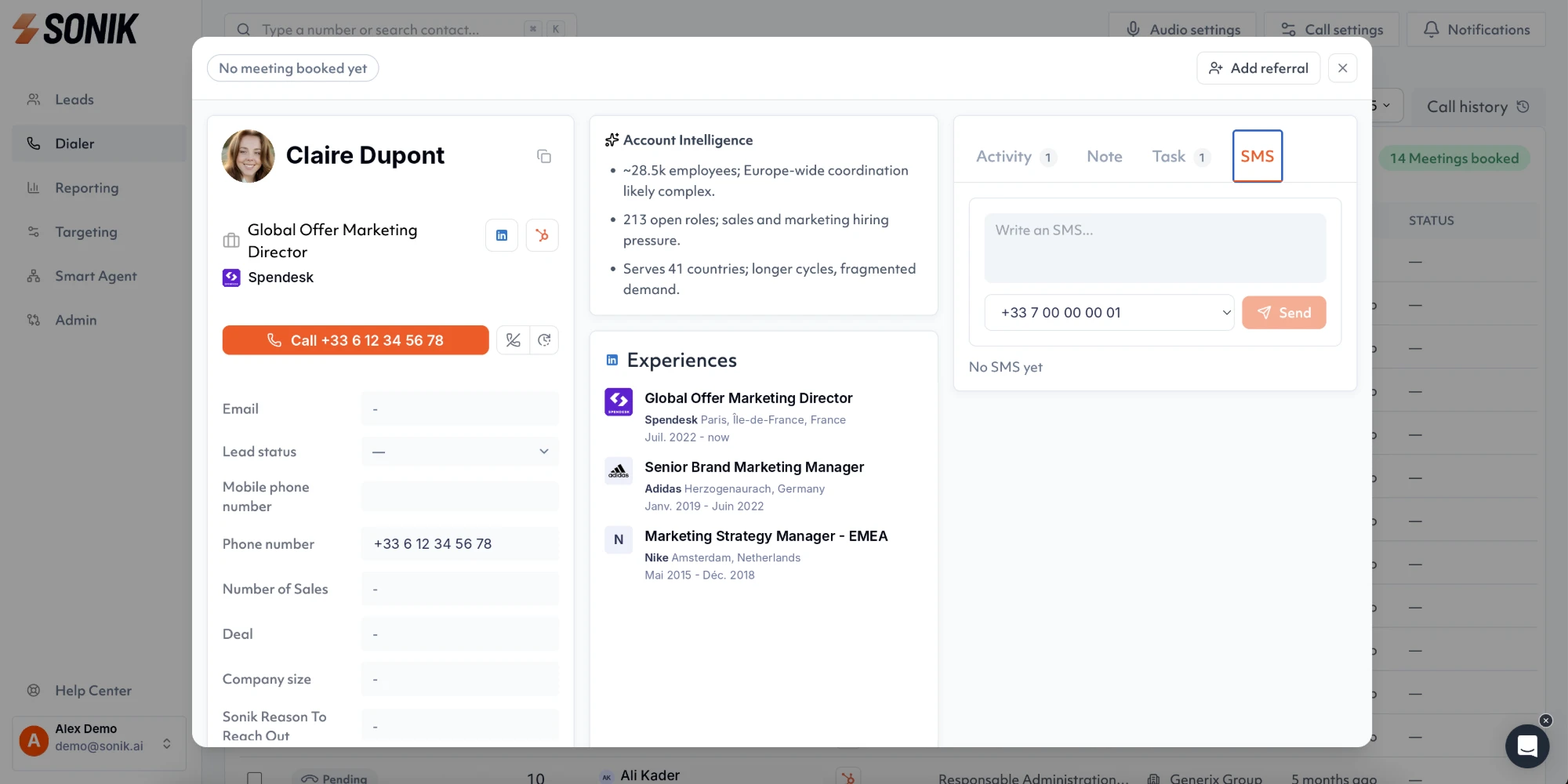
Each licence includes two numbers in rotation, with pickup rate visible per line and per day. The AI Dialer plan is 200 euros per user per month, calls and minutes included; see the pricing page.
Conclusion
For an SDR team, the best parallel dialer is the one that lets the manager stop counting dials. Volume first, then the brief, the scoring and the objection library that turn volume into skill. This week, pull the first fifteen seconds of ten calls per rep and count the pitch-first openers. That count is your coaching plan.