
Best Parallel Dialers in Germany and DACH (2026): A Guide

The best parallel dialers in Germany and DACH are the ones that let you prove why you called each person. German law asks for at least presumed consent before a B2B cold call, recording a call without agreement is a criminal matter, and decision makers sit behind a switchboard. A dialer built for US volume fails all three. Here is what to check, by category of tool.
What is specific to calling Germany, Austria and Switzerland
Presumed consent, not legitimate interest alone
Under section 7 of the German act against unfair competition (UWG), a cold call to a business needs at least presumed consent: concrete reasons to think this person would welcome a call on this subject. A shared industry is not enough in our reading; a job post, a tender, a visit to your pricing page or an existing relationship is a stronger basis. Calls to consumers need explicit prior consent.
Austria is stricter: as we understand the telecoms act, advertising calls need prior consent, B2B included. Switzerland works differently again, with a directory mark that bans advertising calls to the numbers carrying it. Three countries, three regimes. Check each with counsel before a volume campaign; this is not legal advice.
Recording needs agreement
In Germany, recording the spoken word without the consent of the people speaking falls under the criminal code. In practice that means asking at the start of the call and switching recording off when the answer is no. Call monitoring tools also fall under works council co-determination in companies that have one. A dialer where recording is always on cannot be deployed in a German team.
The switchboard culture
In our experience German companies publish the switchboard (the Zentrale) and keep direct extensions and mobiles private. Parallel dialing a list of switchboards gives you five receptionists and no decision maker. Direct numbers decide the outcome more than the line count.
Hours, language, form
The day starts early. In our experience 8am to 10am works in DACH in a way it does not in France, where our benchmark shows 9.8% at 8am against 15.8% at 4pm. Open in German, with "Sie" and the surname, and state your company and your reason in the first sentence. Switzerland adds French and Italian regions to the same list.
Which category fits a DACH team
- Standalone parallel dialers. Built for volume on cold lists, which is the motion German law likes least. Usable on consented or signal-based lists if recording can be off by default.
- Dialers inside a sales engagement platform. A fit when calls follow an email reply or a form, because the reason is documented in the cadence.
- CRM-native dialers. Low line counts suit the market. Check German transcription and recording consent handling.
- AI-native dialers. Lists built from signals give each contact a documented reason, which is what presumed consent asks for. Check hosting and the consent workflow first.
Six checks for a DACH pilot
- A reason field per contact. The signal or relationship behind the call, stored with the call record.
- Recording off by default. Switched on per call after agreement, or a mode with no audio at all.
- German numbers. A +49 number with a recognisable area code or mobile prefix, registered properly. In our experience carriers ask for a local address, so start the paperwork early.
- Two or three lines, and a one-line mode. German markets are often small and named. A dropped call to a Mittelstand director costs more than a slow hour.
- German-language transcription and coaching. Compound nouns and company names included.
- EU hosting and a DPA your works council can read. Subprocessors listed, retention configurable.
The pilot: smaller, cleaner, earlier
Take 300 contacts with a documented reason and a direct number. Run two weeks in an 8:30am to 10am block and a mid-afternoon block. Count conversations per hour, calls answered by a switchboard, recordings declined and outcomes logged without a click.
Do not import the French baseline. Our 11.3% average connect rate comes from 1,000,000 B2B cold calls in France; your German number will depend mostly on the share of direct lines in the list. Measure it per country: Germany, Austria and Switzerland are three rows, not one.
Parallel dialers to shortlist in Germany and DACH
The tools below say on their own sites that they offer parallel dialing and serve this market. They are in alphabetical order, with facts taken from each vendor's site on 9 November 2026. This is not a ranking: confirm current details with each vendor and let your own pilot decide.
- CloudTalk. Its parallel dialer page describes dialing up to 5 contacts at once per rep, with campaigns set from 2 to 5 lines, voicemail detection, number rotation and scheduled callbacks. It names integrations with HubSpot, Salesforce, Pipedrive and Zoho CRM, local numbers in 160+ countries, and SOC 2, ISO 27001 and GDPR compliance. The site lists offices in London, Barcelona, Lisbon, Munich and Prague, among others. A fit for teams that want sales and support calling on one phone system across many countries.
- Skipcall. A French software company. Its site describes a parallel dialer that calls four numbers at once with AI answering-machine detection, a power dialer, transcription and AI summaries, and call and SMS sequences. It names bidirectional sync with HubSpot, Pipedrive, Salesforce and Attio. The base offer includes numbers in France, the UK, Germany, Austria, Switzerland, Spain, Italy, the Netherlands, Belgium, Luxembourg, Finland and Sweden, and the site is available in several European languages. It states EU hosting in Paris, a DPA and SSO, and publishes prices from 60 to 210 euros per licence per month for the plans that include the parallel dialer. Audiences named include sales teams, founders, recruiters and prospecting agencies.
- Sonik. An AI sales dialer built in France. Its differentiator is the list: calls start from signals (website visitors, job changes, social intent, custom intent on key accounts) synced with HubSpot or Salesforce. It dials up to five lines in parallel with a sequential mode for any list, finds a verified mobile number for 72% of contacts, hosts data in Europe and publishes its price: 200 euros per user per month with calls and minutes included, after a free proof of concept. A fit for teams whose first problem is who to call and why.
How Sonik approaches DACH
Sonik builds the calling list from signals already in your CRM: website visitors, job changes, social intent and custom intent on key accounts. In a market that asks why you called, starting from a signal is the method, not a feature.
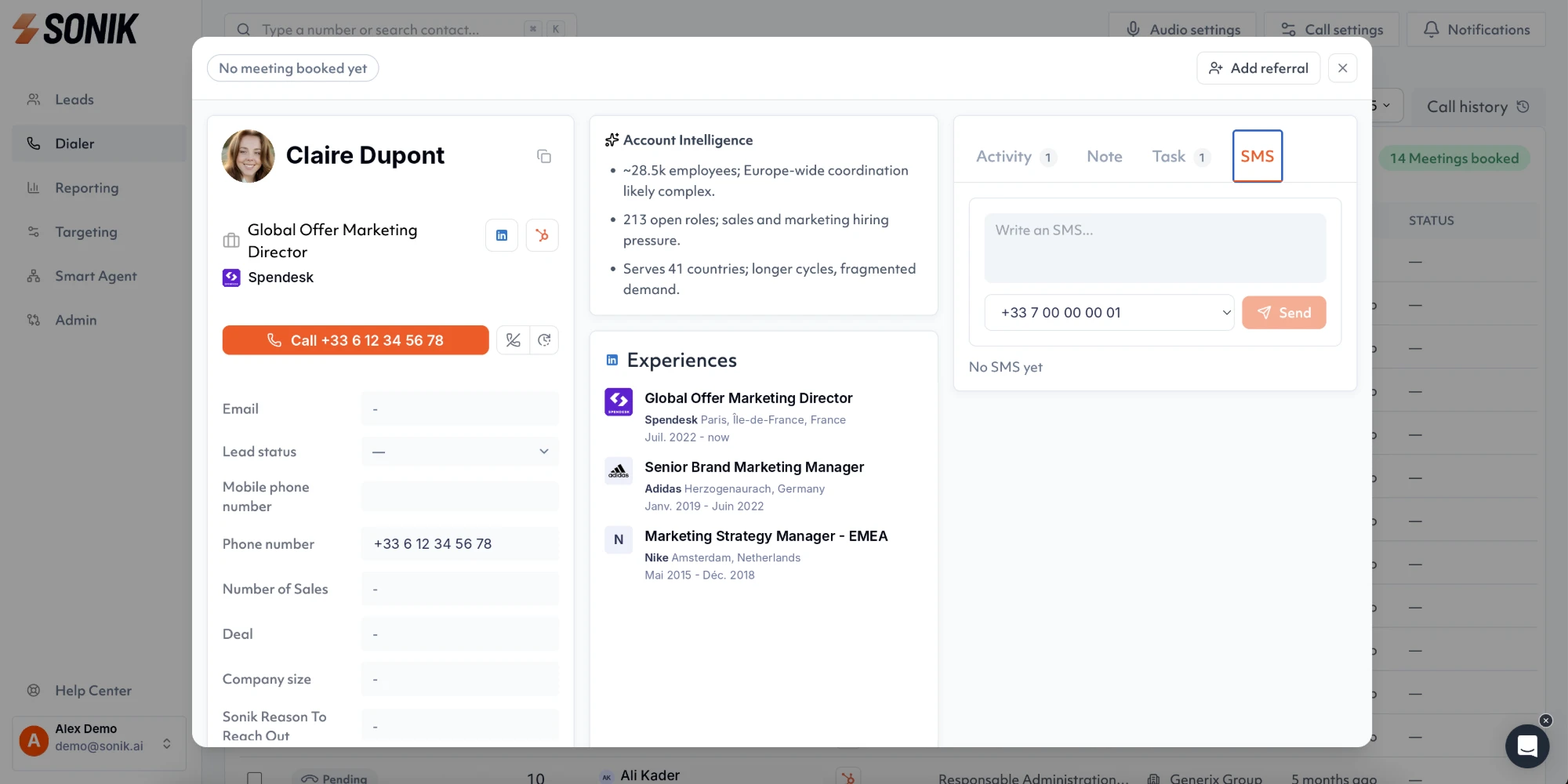
The dialer runs up to five lines in parallel, with a sequential mode for any list, and a human is always on the line. Data is hosted in Europe, the DPA is available on request, and you can choose to keep only an AI summary of each call with no audio recording. That option is a starting point for the discussion with your counsel and works council, not a substitute for the prospect's agreement.
Ask us for the current German, Austrian and Swiss number coverage and the languages our transcription handles. Outcomes sync to HubSpot or Salesforce. See the signals page and our GDPR checklist for parallel dialers.
Conclusion
In DACH the best parallel dialer is the one that dials less and documents more. A reason per contact, recording by agreement, direct numbers, two or three lines. This week, open your German list and write the reason to call next to twenty names. The ones where you cannot are the ones to remove before any tool touches them.