Get started
Still unsure of the impact of Sonik?
See it for yourself and ask for your free trial


The best sales coaching platforms in 2026 fall into four layers, and the best one for your team is the layer that closes your coaching gap: conversation intelligence when managers hear almost none of the calls, AI roleplay when ramp time is the problem, readiness and enablement when the playbook exists but is not applied, and real-time in-call guidance when reps know the playbook and lose it under pressure. No platform is best at all four. This guide shows how to diagnose the gap, which behaviours to coach according to 1,000,000 B2B cold calls, what to demand in a 30-day pilot, and how to compare prices in euros.
Vendor pages answer with a ranked list. The honest answer is a map, because "sales coaching platform" covers four products that do different jobs.
Conversation intelligence. Records, transcribes and scores calls and meetings against a scorecard, so a manager sees 100% of calls instead of the four they listened to on Friday. Its job is coverage and evidence.
AI roleplay. A simulated prospect the rep practises against, with a scored debrief. Its job is reps and ramp: a new SDR runs 30 cold-call openers before a real one.
Readiness and enablement. Courses, certifications, playbooks, quizzes. Its job is knowledge: does the rep know the pricing, the three objections, the discovery questions. It does not tell you whether they use them.
Real-time in-call guidance. A prompt on the rep's screen during the call: the trigger before the "hello", the next question after a silence, the counter when an objection lands. Its job is behaviour at the moment it matters, on a 90-second cold call where nobody has time to open a playbook.
Many platforms sell two of the four. Few do all four well, and the one you need first depends on the gap below.

Friday, 5:30pm. A sales manager in a Paris SaaS has 12 SDRs. This week they made about 1,200 conversations between them. She listened to six. Her coaching this week was a deal review and one "nice job" in Slack.
That is not a people problem. Gallup puts the average manager at 12.1 direct reports in 2026. Twelve reps at 20 conversations a day is 1,200 conversations a week, and a manager who listens to ten of them has heard under 1%. In the State of Sales Coaching survey by Aircall and MySalesCoach, 38% of reps say they are rarely or never coached, while 90% of leaders say they coach at least monthly. Both are telling the truth.
Three questions locate the gap. Can the manager see every call scored this week? If not, the gap is coverage. Do new reps take more than 60 days to book their first meeting at the team's rate? Ramp. Do experienced reps pass the quiz and still open with a pitch? Behaviour under pressure. Each answer points to a different layer, and buying the wrong one is how a team ends up with a recording tool nobody opens.
A coaching platform scores what you tell it to score. Most scorecards are copied from a 45-minute discovery demo. A cold call is 90 seconds, and the behaviours that move it are known.
In our analysis of 1,000,000 B2B cold calls in France, run with Quentin Despas of Katana, 65% of reps open by explaining what they sell. Those openers book meetings at 2 to 3% of conversations. Openers built on a trigger, a job change, a website visit, a closed-lost deal, book at 7 to 10%. Discovery questions that start with "how" lift conversion by 190%. Asking "What do you mean?" before answering an objection lifts it by 197%. Calling a known contact and opening with "How have you been?" succeeds around 10% of the time against 1.5% for a standard cold open.
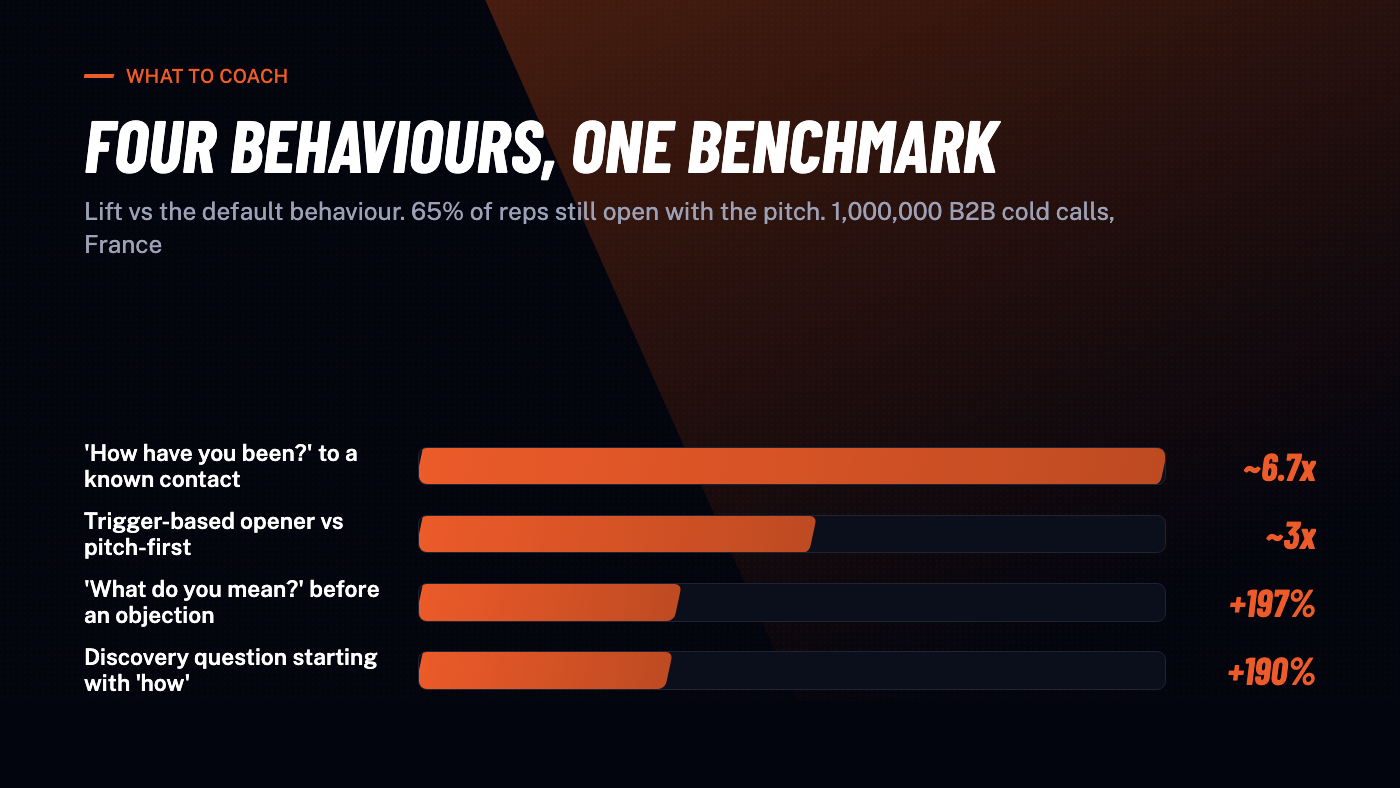
Five behaviours. All of them visible in a transcript, all of them coachable in a roleplay, and two of them, the opener and the objection question, best fixed by a prompt on screen during the call. That is the test of a scorecard: does it score these five, or does it score "rapport"?
Whatever layer you pick, five capabilities separate a platform that changes behaviour from one that produces dashboards.
Scores every call, in French. Ask for a live demo on one of your recorded French cold calls, not on the vendor's English sample. Transcription accuracy on a 90-second call with a bad mobile line is where most platforms built for English meetings fall apart.
One behaviour per rep per week. A rep given 14 improvement areas changes none. The platform should name the one thing, and the manager should be able to override it.
Practice generated from real gaps. Roleplay scenarios built from the rep's own calls, with their own objections, not a generic library of "the budget objection".
Improvement measured on later calls. The only proof coaching worked is the score on next week's real calls. If the platform cannot show a rep's "how" question rate over six weeks, it cannot show coaching worked.
Writes back to the CRM and the dialer. Scorecards that live in a separate tab get opened on Friday. Scores that appear next to the call in the dialer get seen on Monday at 10:05.

Two weeks is enough for a dialer pilot. Coaching needs 30 days, because behaviour change has to show up on later calls. Four outcomes, agreed with the vendor before day one.
Coverage: the share of calls scored by day 7, target 100% of cold calls. Ramp: days to first booked meeting for the two newest reps, against the last two hires. Behaviour: share of conversations with a trigger-based opener and at least one "how" question, week 1 against week 4. Outcome: meeting rate per conversation for the pilot reps against the rest of the team, same lists, same slots.
A platform that moves coverage and nothing else is a recording tool. A platform that moves behaviour and meeting rate in 30 days is a coaching platform.

Three pricing lines decide the real cost, and none of them is the per-seat price on the website. The platform fee, charged whatever the seat count, which turns a 40-euro seat into 150 for a 5-rep team. The seat minimum, often 5 or 10, which a 3-rep team pays in full. The recording storage and its location: ask where the recordings sit, for how long, and whether a contact's deletion request is handled, because under the GDPR a cold-call recording of a French prospect is personal data.
Compare on cost per rep per month with all three lines included, and on one more number the vendor will not volunteer: the price of a seat that is only used on Fridays.
At Google Cloud I had five years of formal enablement: certifications, a playbook per product, quarterly pipeline reviews. My quota went from 1.5 million to 10 million euros, and almost none of that came from the courses. It came from the account executive at the next desk who heard my calls and said, after one of them, "you answered the objection before you understood it".
That is the in-call layer, delivered by a human who happened to sit two metres away. It does not scale to 12 reps in three cities, which is why we built the live prompt into Sonik: "What do you mean?" appears on screen at the moment the objection lands, and the 197% in our benchmark is the reason it is that sentence and not another.
Sonik is an AI sales dialer with coaching built into the call rather than a standalone coaching platform, so it sits in the in-call guidance layer with conversation intelligence on top. Before the pickup, the brief shows the trigger and the suggested opener. During the call, a prompt flags the pitch-first opener, the missing "how" question and the objection answered too fast. After it, every cold call is scored against the five behaviours from the 1,000,000-call benchmark, in French and English, and the score lands next to the call in the dialer and in HubSpot or Salesforce.
What Sonik does not do: certifications, course libraries, or roleplay against a simulated prospect. For a team whose gap is ramp or knowledge, pair it with a roleplay or enablement tool. For a team whose gap is coverage on cold calls and behaviour under pressure, it is one option to pilot.
Conversation intelligence records, transcribes and scores calls; it is one layer of coaching, the coverage layer. A coaching platform also has to change behaviour on later calls, through roleplay, in-call prompts or a weekly focus per rep, and prove it with a score trend.
Yes, and on cold calls it should: 100% coverage is the point, since a manager hears under 1% by ear. Check the accuracy on your own language and line quality, and keep the manager in the loop for the one-behaviour-per-week decision.
Coverage in a week, behaviour change on real calls in four weeks, meeting rate per conversation in one to three months. Any vendor promising quota impact in two weeks is describing adoption, not coaching.
New SDRs need roleplay in the first 30 days, before they burn real leads. Everyone else improves faster on real calls, because the objections are real and the score counts. Most teams end up with both, in that order.
The best sales coaching platform is the one that closes the gap you actually have: coverage, ramp, knowledge or behaviour under pressure. Diagnose first, score the five cold-call behaviours, and run a 30-day pilot with four outcomes agreed in advance. This week, count how many of your team's calls a manager heard, divide by the total, and put that percentage at the top of the vendor shortlist.

