Get started
Still unsure of the impact of Sonik?
See it for yourself and ask for your free trial

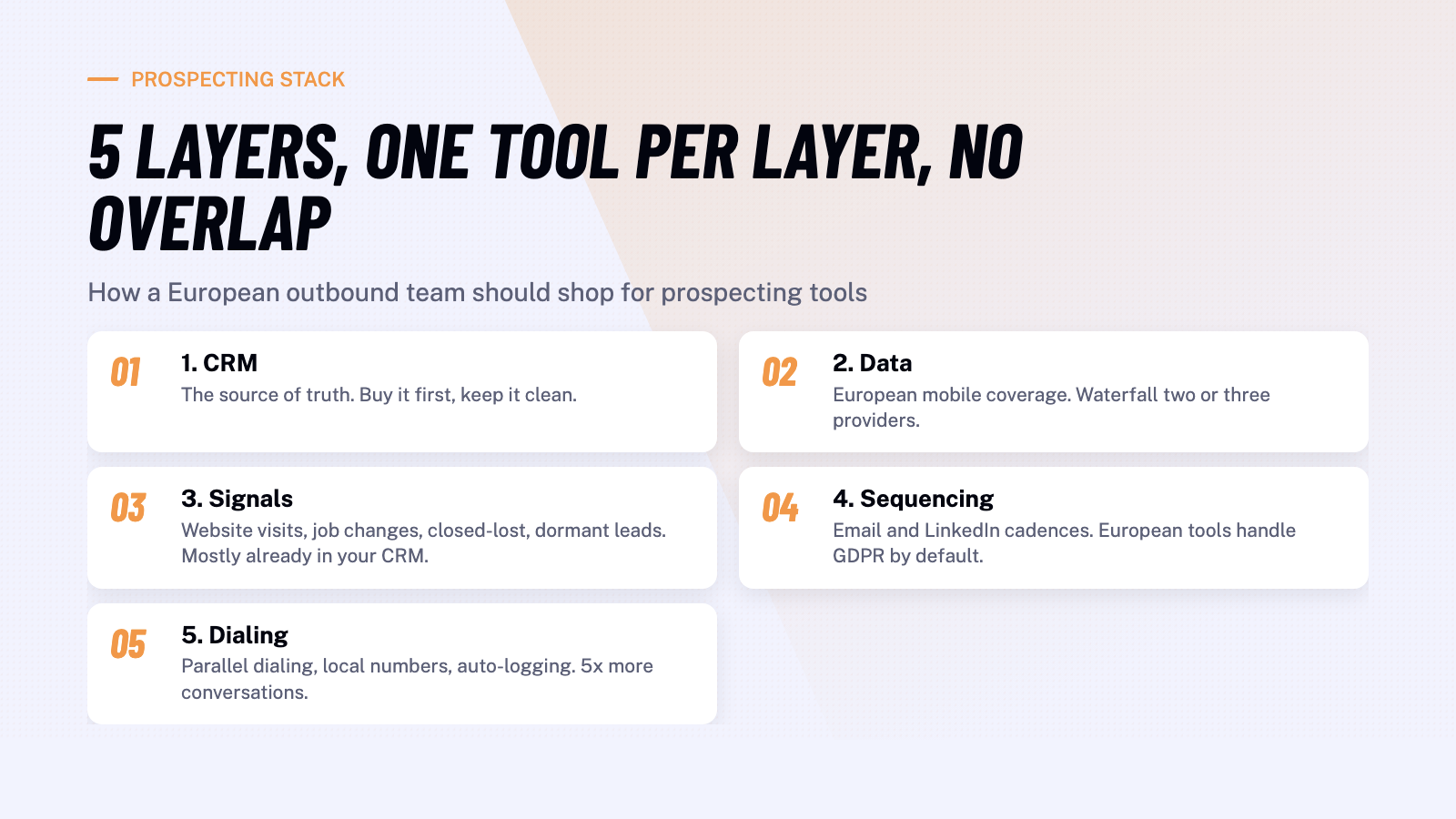
The best sales prospecting tools are not a ranked list. They are one tool per layer of a five-layer stack: CRM, data, signals, sequencing, dialing. Buy by layer and you avoid the two classic mistakes, which are paying three vendors for the same contact database and owning a sequencer, a dialer and a CRM that each think they own the contact. This guide is written for French and European teams, where data coverage and compliance change which tools are worth testing.
Every "top 10 prospecting tools" article online is written by one of the ten. Read enough of them and you notice the trick: tools from five different categories are compared as if they did the same job. A contact database, an email sequencer and a parallel dialer do not compete. They stack.
The useful question is: which layer is my bottleneck today? A founder with 200 target accounts and no mobile numbers has a data problem. A team with 2,000 enriched contacts and five conversations a day per rep has a dialing problem. A team with great connect rates and a 2% meeting rate has an opener problem, which no tool fixes.
Everything else reads from the CRM and writes back to it. For SDR teams in Europe the choice usually comes down to a CRM with a generous free tier and native sequences, the enterprise standard with a large app ecosystem, or a pipeline-first CRM built for small sales teams. Pick on adoption and integrations, not features. Then set one rule in writing: no other tool creates contacts.
Before adding any layer, clean it. Duplicates and dead contacts get multiplied by every tool you connect.
This is the layer where US-centric advice fails. The big global databases have strong US coverage and thinner French, German and UK mobile coverage. European teams compensate with a mix of:
Test with 200 of your real target contacts and count mobiles found. That number decides whether your dialing layer will work at all. On GDPR: enrichment of professional contacts for B2B prospecting is workable under legitimate interest, but you need a documented basis, a retention policy and an opt-out path. Check how each provider handles it before you upload a list.
The signals layer tells you who to contact first. Vendors sell third-party intent data; we would start somewhere cheaper. Reps use only about 20% of the signals already in their CRM: closed-lost deals from last year, dormant leads, contacts who changed jobs, website visitors from target accounts, people who engaged on LinkedIn. Half of Sonik's own pipeline comes from signals that were already sitting in our CRM.
So before buying intent data, buy or build the plumbing that turns CRM events into a daily calling list. Website visitor identification and job-change tracking are the two signals we would add first. A cold call to a known contact opening with "How have you been?" reaches about 10% success in our data, against roughly 1.5% for a standard cold open.
European multichannel sequencers do this well: deliverability tooling, LinkedIn steps, GDPR defaults, pricing a three-SDR team can afford. CRM-native sequences are a fine alternative for small teams who want zero sync. Enterprise engagement platforms earn their price above roughly 15 SDRs with RevOps support.
Whatever you pick, the call step is the part to test. Most sequencers create a "call" task and stop there. If your team is phone-led, that task needs to hand off to layer 5.
A rep on a one-line dialer or a softphone makes 40 to 60 dials a day. Our analysis of 1,000,000 B2B cold calls in France gives an 11.3% average connect rate, so that rep has 5 to 7 conversations. A parallel dialer puts the same rep on 150 to 250 dials and 20 or more conversations, which is why we say it gives 5x more conversations and why 20 conversations a day is our north-star per SDR.
What to test in a dialer for Europe: local numbers in each country, caller ID reputation monitoring, voicemail detection, automatic dispositions to the CRM, GDPR-compliant recording, and whether it can build the day's list from CRM signals rather than from a static upload. Timing matters too: connect rates peak at 4pm (15.8%) and 10am (14%) in our data, and a good dialer schedules by persona and slot. Sonik is one option in this layer; there are others. Test them on your numbers and your list.
Conversation intelligence (call recording, transcription, coaching) is sometimes listed as a sixth layer. For SDR teams we would want it inside the dialer rather than as a separate subscription.
Build order: CRM, then data, then dialing if you are phone-led (or sequencing if you are email-led), then signals, then the other channel. Pay for one tool per layer. If two tools overlap on a layer, cancel one.
Sonik covers layer 5 and the plumbing of layer 3. It is an AI sales dialer that reads signals from HubSpot or Salesforce (website visitors, job changes, closed-lost, dormant leads, social intent), builds a prioritised calling list, dials in parallel with local European numbers, prepares the rep with the trigger on screen, and writes everything back to the CRM.

We deliberately do not sell data or email sequences. Teams pair Sonik with their existing enrichment and sequencing tools, which is the one-tool-per-layer principle applied to ourselves. Details on the dialer page and the signals page.
Shop for prospecting tools by layer, not by ranking. Clean the CRM, test European mobile coverage with your real contacts, mine the signals you already own, then fix the dialing layer where most European teams leave 5x on the table. This week, map every tool you pay for to one of the five layers. Any layer with two tools is a cancellation; any layer with none is your next purchase.

