Get started
Still unsure of the impact of Sonik?
See it for yourself and ask for your free trial


Buying signals differ across industries in three ways: the event that opens a budget, the person who picks up the phone, and the hour they pick it up. A funding round means something in SaaS and nothing to a construction firm; a building permit is the reverse. Across the 100+ industries in our benchmark of 1,000,000 B2B cold calls in France, the signals that work in one sector mostly do not transfer, while the mechanics of the call do.
What stays constant: the average connect rate is 11.3%, 4pm is the best slot at 15.8% and 10am the second at 14%, and a trigger-based opener reaches 7-10% meetings per conversation against 2-3% pitch-first. Those numbers hold across sectors because they describe the phone, not the industry.
What changes is the trigger. Each sector has two or three public events that reliably precede a purchase, a persona who owns that purchase, and a slot where that persona answers. Below are the six sectors we see most, with the three signals that work, the persona who picks up and when.

The clearest signals in software are hiring and money. A job post for SDRs or a Head of Sales means a team is being built and the stack is open. A funding round or a capital increase means the budget exists for the next two quarters. A CRM migration, visible in job posts and on LinkedIn, means every tool plugged into the old one is up for review.
Who picks up: the founder or the VP Sales. Founders answer most around 10am in our data, and sales leadership connects above 15% overall. Open with the signal: "You posted for three SDRs last week, how are you planning the first month?"
Staffing firms are themselves signal machines. The volume of mandates they publish is the signal: a jump in open roles on their own site means more consultants on the phone and more pressure on their tools. A new office or a new regional branch is the second. The third is a new managing partner, because partners bring their own stack.
Who picks up: the agency director or founder, around 10am, before the day's client calls. Recruiters themselves are hard to reach in the afternoon because they are calling candidates. Do not open with your product; open with their volume: "You have 40 more open mandates than in June, how are the consultants keeping up?"
Here the signals are physical and public. Listing volume on the portals tells you an agency is growing or struggling. Building permits, which in France are posted publicly at the town hall, tell you a project is funded and staffed. A new agency opening, or a franchise changing hands, tells you a decision-maker is choosing everything from scratch.
Who picks up: the agency head or the site manager, and they are on the road most of the day. In our experience they answer early, before site visits, even though 8am is the weakest slot overall at 9.8%. Keep the morning block short and precise, and keep the 4pm block for the office-based decision-makers.
Industrial buyers move on capacity. A plant extension, a new warehouse, a second shift announced in the local press are the strongest signals we see. A new certification (quality, safety, environmental) means a process has just been rewritten and the tools around it are open. A public tender won means a delivery deadline and a hiring wave.
Who picks up: the operations director or plant manager, mid-morning after the production meeting, and the purchasing lead in the early afternoon. The opener names the capacity event: "You announced a second line in Nantes, how is the team planning the ramp?"
Brokers buy when the rules change. A regulatory deadline, a new reporting obligation, a product line that has to be re-documented: each one is a reason to call every broker in the segment the same month. A new branch or a merger between two brokerages is the second signal, and a broker recruiting advisers is the third.
Who picks up: the broker owner or the branch director, often late afternoon after client appointments. Keep the compliance angle qualitative unless you are sure of the text; the opener is "How are you handling the new reporting deadline?", not a legal summary.
Agencies announce their signals themselves. A new client win on LinkedIn means a team is being staffed for it. An award or a ranking means the agency will pitch harder for six months and needs more pipeline. A new business director hire means outbound is becoming a function.
Who picks up: the founder or managing partner, around 10am, and the marketing lead around 4pm, where marketing connects best in our data. Open with the win: "Congratulations on the account you announced Tuesday, how are you staffing it?"
When we built the benchmark I expected SaaS signals to generalise. They do not. A funding round is the strongest signal in software and is ignored by a plant manager, who has never raised a round and does not read the press that reports them. A building permit is useless to a SaaS founder. A new office matters to a staffing firm and to a brokerage, and means almost nothing to a manufacturer, who expands by machine, not by address.
I sold to one sector for five years as an AE at Google Cloud, where my quota went from 1.5 million to 10 million euros, and I assumed the triggers I knew were universal. The first months of Salespresso, selling to agencies and staffing firms, corrected that quickly: the openers that worked on a CTO fell flat on an agency founder until the event in the first sentence was theirs.

Two things transfer everywhere. The opener structure: name the event, ask a "how" question, stop talking. Discovery questions starting with "how" lift conversion by 190% in our data regardless of sector. And the slot logic: the persona decides the hour, and the persona is more stable than the industry.

Sonik reads the signals already in HubSpot or Salesforce (website visitors, job changes, closed-lost, dormant leads, social intent) and stacks them per account, so the sector-specific triggers above sit next to the first-party ones on the same list.
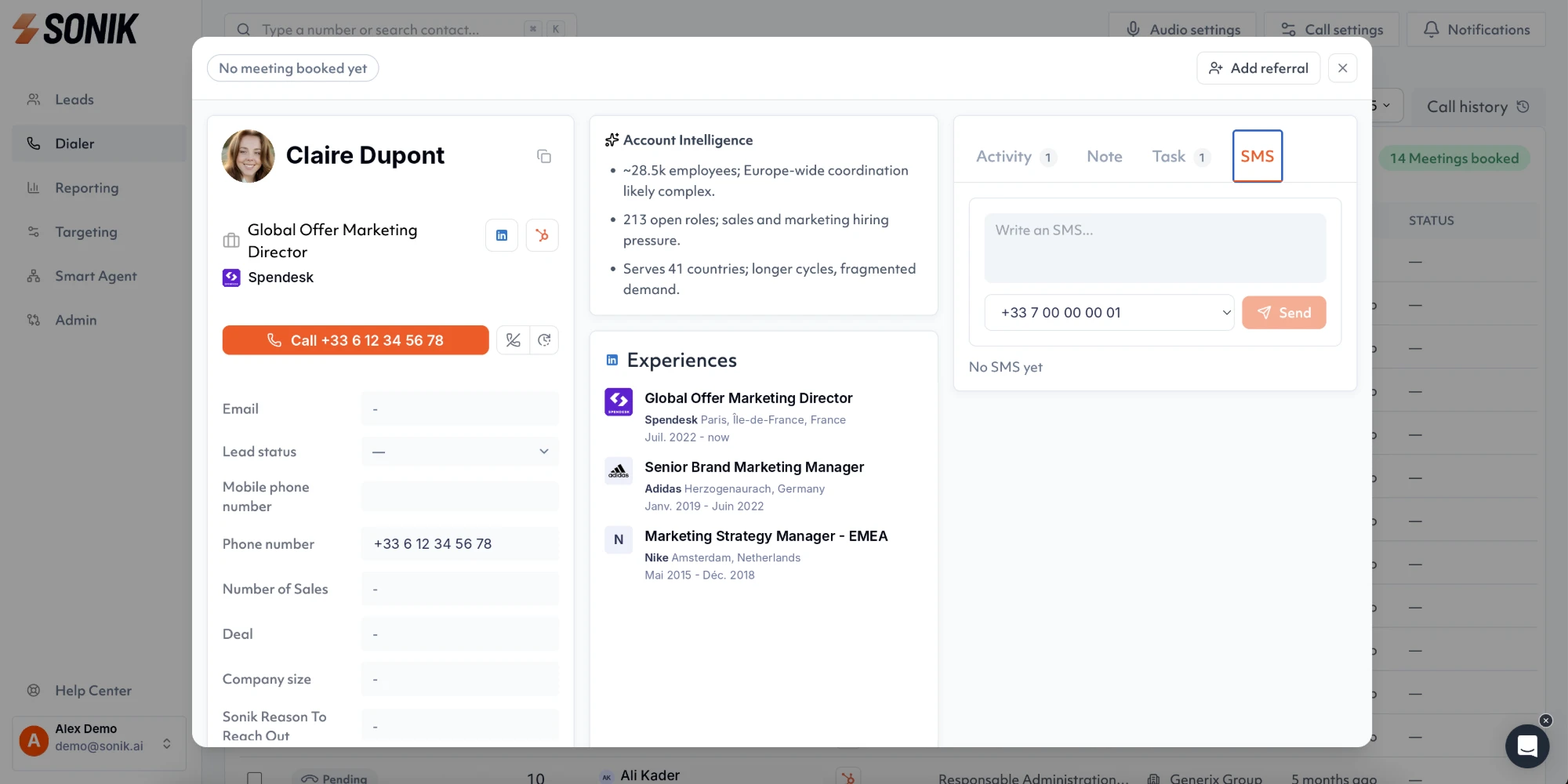
On the contact view, the account intelligence summarises the event, the persona and the suggested opener, so a rep switching from a SaaS list at 10am to a brokerage list at 4pm does not have to re-learn the sector between calls. The parallel dialer then runs the slot, at around 16 conversations an hour.
Our own floor sells to one sector, SaaS, and 50% of Sonik's pipeline comes from signals that were already in the CRM; the customers we onboard in staffing, real estate and industry see the same mechanism with different triggers.
SaaS and tech, because hiring, funding and tool changes are all public and dated. But "strongest" means easiest to detect, not easiest to convert: the same signal is seen by every vendor the same day. Sectors with quieter signals, such as manufacturing, reward the team that reads the local press and the public registers.
The signal types are similar; the persona and the decay differ. In an SMB the founder owns the decision and answers the phone, so a signal is actionable within the week. In an enterprise the signal points to a department, the buying group is larger, and it takes two or three stacked signals to justify the call.
Call the persona, not the industry. In our benchmark founders answer most around 10am, marketing around 4pm and HR around 1pm, and 4pm is the best slot overall at 15.8%. Field personas such as site managers answer early, so a short 8am block works for construction even though 8am is the weakest slot overall.
One structure, several trigger lists. The opener, the "how" question and the two-slot close transfer; the events do not. Keep a page per sector with its three signals, its persona and its slot, and let the call structure stay the same.
Buying signals differ by sector because budgets open on different events and different people answer the phone at different hours. The call itself does not change: trigger, "how" question, slot. This week, pick the sector you sell to most, write its three signals on one page with the persona and the hour, and run one calling block on that page only.

