Get started
Still unsure of the impact of Sonik?
See it for yourself and ask for your free trial


Robert Cialdini's six principles of influence, commitment, social proof, authority, liking, reciprocity and scarcity, work on a cold call, but not the way the sales-training version says. On the phone you have 20 seconds, no slides and a prospect who did not ask to be influenced. The principles that hold up are the ones that fit in a question. Here is each one translated into a cold-call move, checked against what we measured on 1,000,000 B2B cold calls in France.
Cialdini himself spends the last part of his book on how people defend themselves against these principles. B2B buyers in 2026 have read the same book. Any move that feels like a move backfires. The test for every technique below: would you be comfortable if the prospect could see your notes? If not, do not use it.
The principle: people act consistently with what they have already said. The cold-call application is not "get them to agree to three small things". It is one open question that makes the prospect describe their situation. Once a prospect has said "we handle it with a spreadsheet and it is a mess", a meeting to fix the mess is consistent with their own words.
Discovery questions starting with "how" lift conversion by 190% in our benchmark. "How are you handling follow-ups on inbound leads today?" is commitment and consistency in one sentence, and it does not feel like a technique because it is a real question.
The training version is "name your biggest customers". On a cold call to a 40-person company in Nantes, a Fortune 500 logo is not proof, it is distance. Social proof works when the peer is close: same size, same city, same role, same problem. "We work with three sales teams in Lyon of about your size" lands; "we work with [global bank]" invites "we are not a global bank".
Be exact and be true. Named references only with permission, and never a customer the prospect competes with, which in a small market like France is a real risk.
"I am an expert in outbound" is a claim and it costs you credibility. Authority on a cold call is demonstrated by the trigger: knowing that they opened a second site, hired four SDRs in September, or lost a key account. Trigger-based openers reach a 7 to 10% meeting rate in our data against 2 to 3% for pitch-first openers, and part of that gap is authority: the rep who knows the trigger sounds like someone worth 20 minutes.
The second authority signal is a number. "Teams of your size usually lose a quarter of their afternoon to voicemails" shows you have seen this before. Keep numbers to ones you can defend.
The book says we say yes to people we like, and the training version turns that into "smile while you dial, use their name". Fine, but the strongest liking signal on a cold call is being genuinely interested in the answer. The single highest-converting move we have measured is asking "What do you mean?" before answering an objection: +197% conversion. It works because it is the opposite of a pitch. The prospect feels heard, and people like being heard far more than they like being charmed.
Use the first name once at the start and once at the end. Three times is a technique and they can hear it.
Reciprocity on the phone is giving something useful before asking for anything. Not a brochure. A number, a comparison, a thing they did not know: "4pm has the best pickup rate across personas in our data, 15.8%, most teams call at 9". Twenty seconds of real value, then the ask. In our experience a rep who gives one insight per call books more than one who holds everything for the demo.
What does not count as reciprocity: "I would love to show you", free trials offered before any problem is agreed, and any gift that creates obligation rather than interest.
Fake scarcity, "the price goes up Friday", is the technique that burns the most trust in B2B, and it is the one most training pushes. Real scarcity is on the prospect's side: a renewal in March, a hiring plan that lands in Q2, a peak season starting in September. The move is to surface it with a question ("what happens on your side if this is not sorted by then?") and let the prospect say the deadline out loud. We covered the honest version in how to create urgency without being pushy.
"Bonjour Marie, Camille from Sonik. I saw you hired three SDRs in September (authority). Teams at that stage usually find the new reps spend most of the afternoon on voicemails, about a quarter of the day in our data (reciprocity). How are you handling that today? (commitment)." Then listen. When the objection comes: "What do you mean?" (liking). Social proof and scarcity come later, when the prospect has described their situation and you know which peer and which deadline are relevant.
We do not teach reps six principles; we put the raw material for them on the screen. Before the pickup, Sonik shows the trigger (authority), the peers in the CRM who look like this account (social proof), the contact's history and experiences, and an AI qualification of why now (the deadline for scarcity).
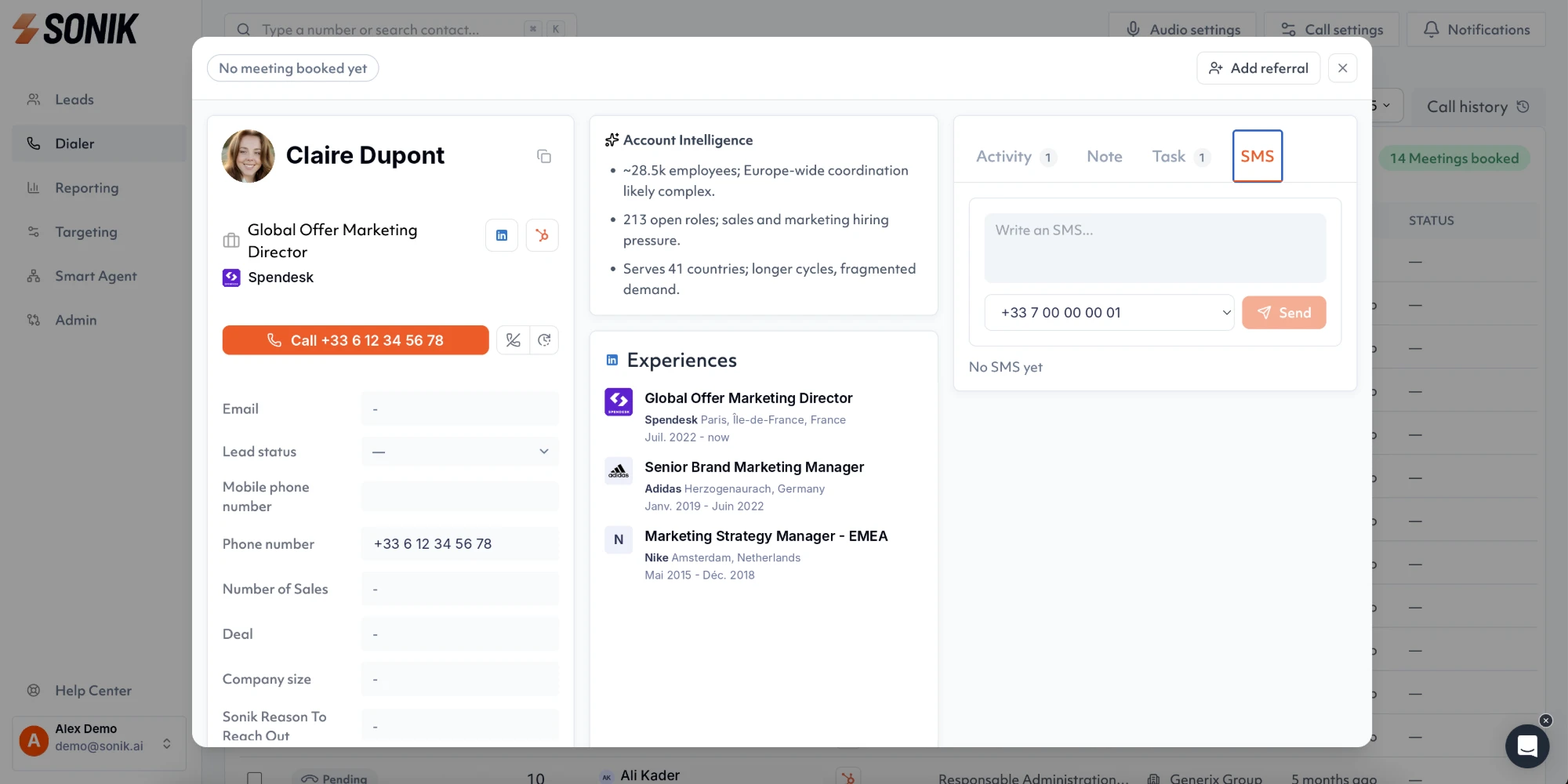
During the call, the live coach watches for the two moves that carry the most weight in our data: the how-question after the opener and "What do you mean?" after the objection. Reps who make both convert several times better than reps who pitch, and neither requires reading a book, only a prompt at the right second.
Cialdini holds up on a cold call when each principle becomes a question or a fact, and fails when it becomes a trick. This week, rewrite your opener with one trigger, one number and one how-question, and answer every objection with "What do you mean?" first. That is four of the six principles, and it is also just a good call.

