Get started
Still unsure of the impact of Sonik?
See it for yourself and ask for your free trial

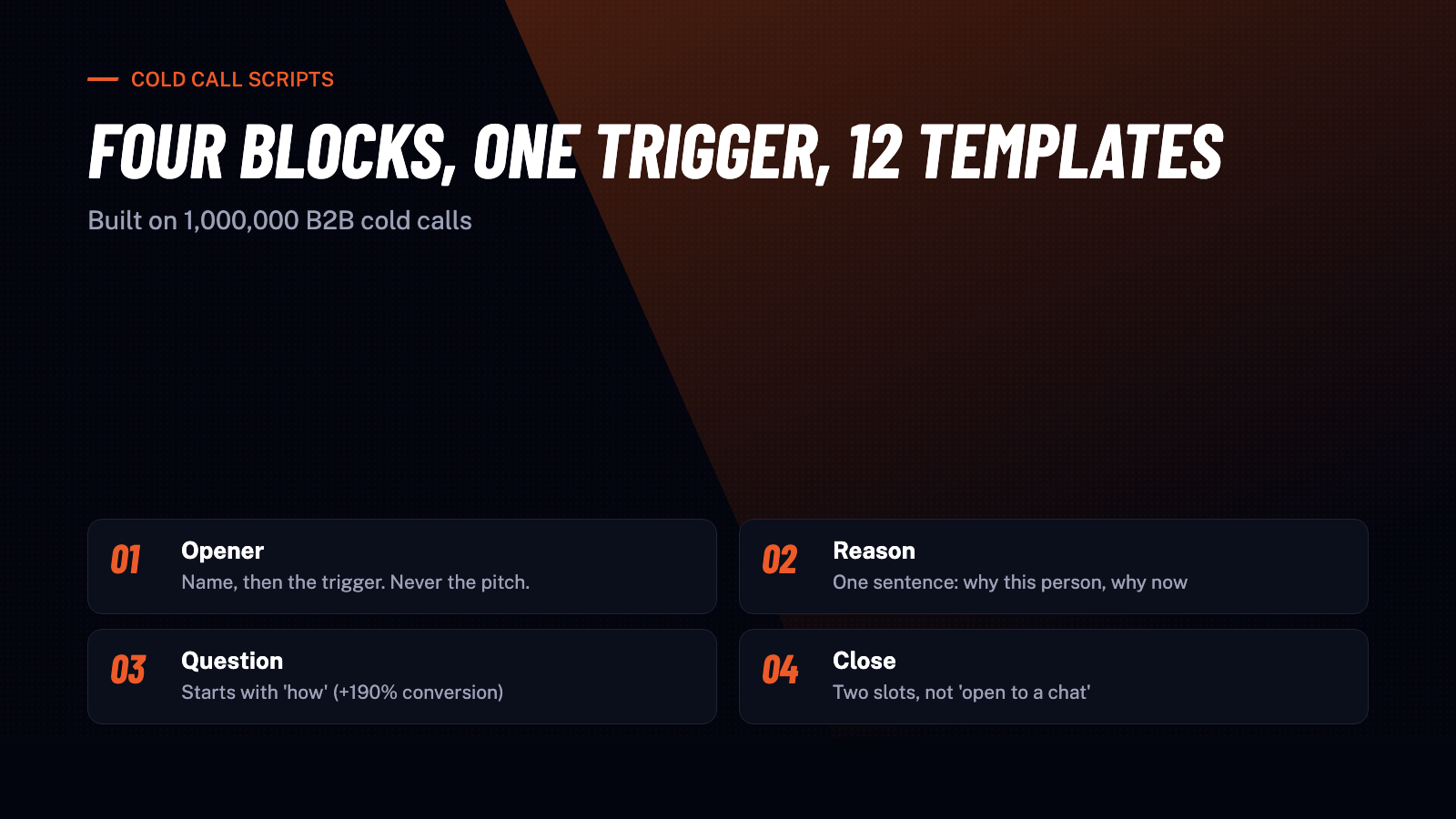
A cold call script template is a structure, not a text to read. The scripts that book meetings in 2026 share four blocks: a trigger-based opener, a reason for calling, one "how" question and a small close. Below are 12 templates built from Sonik's analysis of 1,000,000 B2B cold calls in France, with notes on adapting them to French and European prospects.
A script has one job: to stop you improvising the parts that do not need improvising. The opener, the reason for the call and the close are the same on every call. What changes is the trigger and the answer you get.
Our benchmark shows why this matters. 65% of reps open by explaining what they sell. Trigger-based openers reach a 7-10% meeting rate, against 2-3% for pitch-first openers. The difference is not talent. It is the first sentence.
So a good script is short. Four blocks, each under 15 seconds, and a long list of triggers you can plug into block one.
Everything below slots into one of these blocks.
1. The hiring trigger. "Hi [first name], [you] from [company]. I saw you are hiring two SDRs in Lyon, which usually means the outbound target just went up. That is why I am calling."
2. The website-visit trigger. "Hi [first name], [you] from [company]. Someone from [their company] spent time on our pricing page yesterday. I am not assuming it was you, but I wanted to ask who is looking at this topic."
3. The known-contact opener. For a dormant lead or an old prospect: "Hi [first name], it is [you] from [company]. How have you been?" In our benchmark, this opener reaches about 10% success on known contacts, against roughly 1.5% for a standard cold open.
4. The job-change reason. "You started as Head of Sales three months ago. Most people in your seat rebuild the outbound motion in the first six months, and that is the moment we are useful."
5. The closed-lost reason. "We talked to [their company] last year and the timing was wrong. A lot has changed on our side since. I wanted to check whether the problem is still there."
6. The peer reason. "We work with three other Series A SaaS teams in Paris on the same problem: too many dials, not enough conversations." Only say this if it is true.
7. The "how" question on process. "How do your SDRs decide who to call first in the morning?"
8. The "how" question on volume. "How many real conversations does a rep get per day right now?"
9. The reframing question. When the prospect pushes back: "What do you mean?" Asking it before answering an objection lifts conversion by 197% in our data. It is the cheapest line in this list.
10. The two-slot close. "Let me show you what this looks like on your own CRM. Thursday at 10 or Friday at 4?"
11. The data close. "I will send you the connect-rate benchmark for your persona before we talk. Does Tuesday work?"
12. The honest close. "I am not sure yet we are a fit. Give me 20 minutes to find out, and I will tell you if we are not."
Most script libraries online are written for US buyers. Three things change when you call in France or Germany.
Vouvoiement by default. Use "vous" until the prospect switches. Switching first reads as a trick.
Less hype, more specifics. "We help companies 10x their pipeline" gets a polite hang-up in Paris. "We analysed one million cold calls and the best slot for marketing leaders is 4pm" gets a question back.
The slot matters more than the day. In our benchmark, 4pm connects at 15.8%, 10am at 14%, 8am at 9.8%. Founders pick up around 10am, marketing around 4pm, HR around 1pm. Build your call blocks around the persona, then plug the matching script in.
A script is a hypothesis. Test it on conversations, not on dials.
Fifty conversations at an 11.3% average connect rate means about 450 dials per variant. With a manual dialer, that is a week. With parallel dialing, it is a day.
We do not ship a script. We ship the trigger. Sonik pulls the signals already sitting in your CRM (website visits, job changes, closed-lost deals, dormant leads, social intent) and puts the right one on screen when the call connects, so block one is written for you.


The AI call prep adds a two-line brief per contact: who they are, why now, which question to ask. The rep keeps the four-block structure and changes only the trigger.
Parallel dialing gives reps about five times more conversations, which is what makes testing a script possible in a week rather than a quarter. See how the dialer works and which signals it uses.
A script that books meetings is four short blocks and a good trigger. Stop opening with what you sell, ask one question that starts with "how", and close on two concrete slots. This week, take your current opener, write two trigger-based variants, and run each one until you have 50 conversations. Keep the winner.

