Get started
Still unsure of the impact of Sonik?
See it for yourself and ask for your free trial

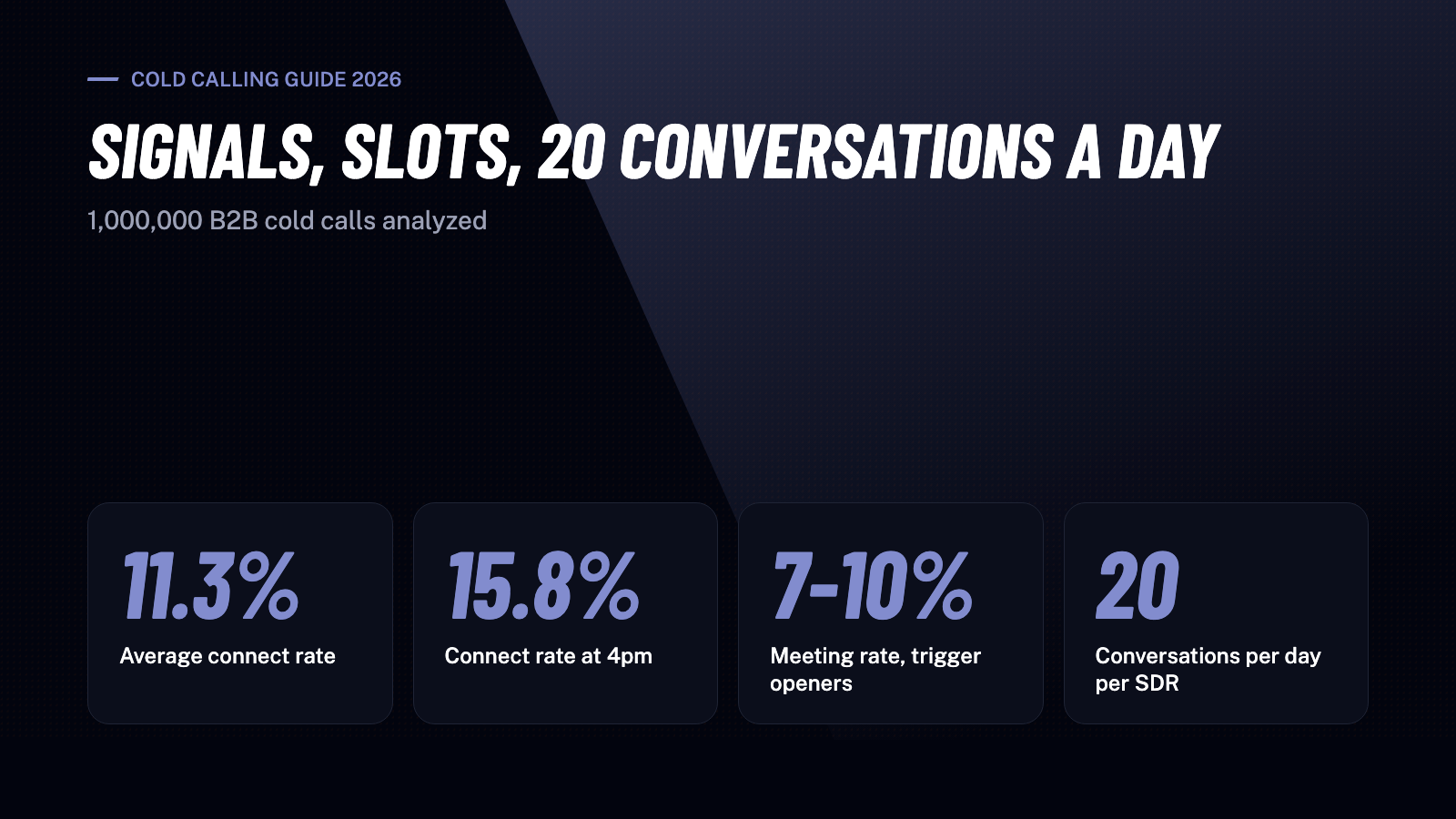
B2B cold calling in 2026 works when you treat it as a system: a list built from signals, calls placed when people pick up, enough dials to get 20 conversations a day, a trigger-based opener and one good question. This guide covers the whole process, from list to booked meeting, using what we learned from analysing 1,000,000 real B2B cold calls in France.
Yes, and the data is not ambiguous. Our benchmark of one million French B2B cold calls shows an average connect rate of 11.3%, rising to 15-20% for the right persona at the right time.
What stopped working is the old version: a list exported from a database, dialed by hand, with an opener that explains what you sell. That version produces 2-3% meeting rates and burned-out reps.
Cold calling is the only channel where a prospect can tell you in 40 seconds that you have the wrong problem. Email cannot do that. LinkedIn cannot do that. That is why the phone still sits at the centre of outbound in Europe.
The biggest lever in cold calling happens before anyone dials. Who you call decides your ceiling.
Reps use only about 20% of the signals already in their CRM. Yet 50% of Sonik's own pipeline comes from signals that were already there. The list is not missing. It is buried.
Five signals worth a call today:
A signal-based list of 50 contacts beats a 500-row export every time, because every call has a reason.
Across personas, 4pm connects at 15.8%, 10am at 14%, 8am at 9.8%. By persona: founders around 10am, marketing around 4pm, HR around 1pm. Sales and leadership roles connect above 15% overall.
So plan your blocks by persona. Founders in the morning block, marketing in the afternoon one. Do not call HR at 8am and conclude that HR does not pick up.
Our north-star funnel is 20 conversations per day per SDR. At an 11.3% connect rate, that is roughly 180 dials. By hand, that is the whole day. With parallel dialing, it is two blocks of 90 minutes.
Persistence matters too: in our experience most connects happen within the first three attempts. Three tries, spread across different slots, then move on. See what a real connect rate looks like.
65% of reps open by explaining what they sell. Trigger-based openers reach a 7-10% meeting rate against 2-3% for pitch-first openers. Your first sentence should be the signal that put the person on your list: "I saw you are hiring three SDRs" or "Someone from your team was on our pricing page yesterday".
For known contacts, "How have you been?" reaches about 10% success versus 1.5% for a standard cold open.
Discovery questions starting with "how" lift conversion by 190% in our data. "How do your reps decide who to call first?" invites a story. "Do you use a dialer?" invites a no.
Asking "What do you mean?" before responding to an objection lifts conversion by 197%. Most objections are reflexes. The question turns the reflex into information.
The moment the prospect shows interest, propose two concrete slots. Then send a one-line recap within the hour. Over-explaining after a yes is how a yes becomes a maybe.
European cold calling has rules that US playbooks skip. In B2B, calling a professional at their professional number about a professional topic is generally allowed in France and most of the EU, on the basis of legitimate interest under GDPR. Three things to get right:
Rules differ by country. Germany is stricter on B2B calls than France. Check with counsel before launching a cross-border campaign.
Sonik is built on this exact system. The signal engine surfaces website visitors, job changes, closed-lost deals, dormant leads and social intent from your CRM, and turns them into a daily call list with a reason for every call.


The parallel dialer gives reps about five times more conversations, which is how a rep gets to 20 conversations a day without working evenings. AI call prep puts the signal and a suggested question on screen as the call connects.
Our mission is two times more meetings via five times more conversations with the right contacts. The one-million-call benchmark above is the data behind that claim.
Cold calling in 2026 is a system, not a talent. Build the list from signals, call by persona at the right slot, dial enough to get 20 conversations, open with the trigger and ask one "how" question. This week, pull every closed-lost deal older than six months from your CRM and call the contacts at 10am. Count the conversations.

