Get started
Still unsure of the impact of Sonik?
See it for yourself and ask for your free trial

Data quality for outbound is a minimum bar a record must clear before a rep dials or an email goes out: the right person, a reachable number, a valid email, no duplicate, fresh enough to trust. You verify what can be checked, validate the rest against your rules and deduplicate before routing. Skip one of the three and your reps pay for it in lost conversations, not in a dashboard.
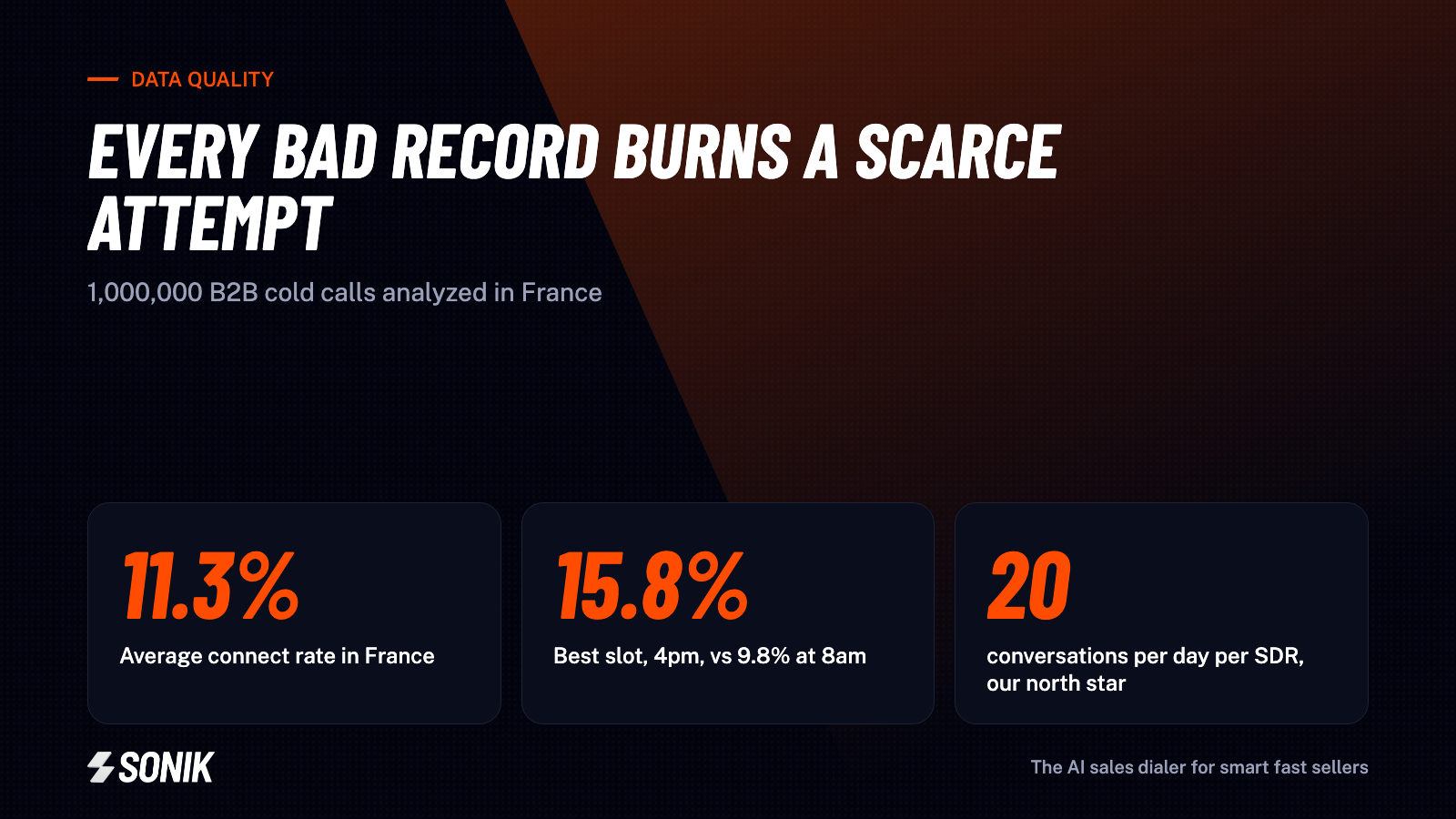
In our analysis of 1,000,000 B2B cold calls in France, the average connect rate was 11.3%. Nine dials in ten end without a conversation even when the number is good. A dead number, a wrong person or a duplicate does not just fail. It burns one of very few useful attempts.
Timing raises the price. Our best slot, 4pm, connects at 15.8%, against 9.8% at 8am. A rep who spends the best hour of the day on a bad record has wasted the most expensive time they have. And in our experience, most connects happen within the first three attempts. You get about three tries per contact, so they should go to contacts that exist.
Count it the way a rep feels it. If a rep places 100 dials a day and 15 of them hit a dead line, a wrong person or a contact already being worked by a colleague, that rep has lost 15 of their best chances before the first word. Multiply by the team and by the week, and the cleanup project pays for itself quickly.
We do not claim to have isolated data quality as a cause of connect rate. We claim something simpler: every bad record spends attempts you cannot get back.
Teams often use these words as synonyms. They answer different questions.
A record can pass one and fail another. A perfectly formatted number that belongs to someone who left the company is valid and not verified.
Write the bar down so that "good enough" stops being an opinion. A record is dialable when it has all of these.
Records that fail go to a hold queue, not to a rep's list. Reps should never have to guess whether a record is trustworthy.
Give the bar an owner, usually sales ops, and a weekly number: the share of records entering the CRM that pass on the first try. When that share drops, you know a source or an import went wrong while the damage is still small. A bar nobody reviews turns back into an opinion within a month.
People change jobs, companies restructure and domains disappear. Published decay rates vary widely and depend on persona, so we would not build a process on a single figure.
Measure your own instead. Take 50 contacts per segment, split them by age of the record (under 3 months, 3 to 12 months, over 12), and check each one by call or by looking at the current title. The share that fails in each bucket is your decay rate, and it tells you how old a record can be before it needs re-verification. Job change signals give you a cheaper trigger than a calendar: re-verify the moment a contact moves.
Expect the segments to differ. Contacts in fast-moving teams and young companies will probably age faster than contacts in large, stable organizations, but guess nothing: the 50-contact sample takes an afternoon and replaces the guess with your own number.
Sonik works from the contacts and signals already in your CRM, so the quality of that CRM sets the ceiling for what a dialer can do. Our mission is 2x more meetings through 5x more conversations with the right contacts, and the right contacts is where data quality starts.
Our method is to treat every call outcome as a free verification. A "wrong number" or "left the company" outcome should update the record the same day, not at the next quarterly cleanup. Parallel dialing surfaces these outcomes faster, simply because reps place more calls, which makes the feedback loop shorter. See how our signals use data you already hold.
Dirty data is expensive because attempts are scarce, not because dashboards look untidy. Write the minimum bar, enforce it with a hold queue and let call outcomes correct the record. This week, pull your last 50 dials and mark each one as good, dead number, wrong person or duplicate. That percentage is your cost of dirty data.

