
How to Follow Up Event Leads by Phone Within 48 Hours

Follow up event leads by phone, and do it within 48 hours of the last day. Sort the list into three tiers on the way home, call the people you actually spoke to first, open with the conversation you had on the stand, and support each call with one short email. After a week, an event lead is a cold lead with a badge scan attached.
Why the phone, and why 48 hours
Everyone who exhibited at the same event sends the same email on Monday morning. "Great to meet you at the show" lands in an inbox next to twenty copies of itself. A call does not have that problem.
The phone also fits the situation. You met this person face to face. A voice continues that conversation. A templated email restarts it at zero.
On timing, the best public reference is the Harvard Business Review study "The Short Life of Online Sales Leads": companies that contacted a lead within an hour were nearly seven times as likely to qualify it as those that waited longer, and more than 60 times as likely as those that waited 24 hours or more. That study covered web leads, not event leads, and nobody expects a call an hour after a trade show closes. The direction is what matters: interest decays quickly.
In our experience, 48 hours is the realistic window. The prospect is back at their desk, still remembers the stand, and has not yet been buried by the week.
Sort the list before the event ends
A badge scanner produces one flat list. Your follow-up should not treat it as one.
- Tier 1: real conversations. They described a problem, asked about price or asked for a demo. Call within 24 hours.
- Tier 2: short exchanges. Right company, right role, two minutes of talk. Call within 48 hours.
- Tier 3: scans only. They took a pen. Check them against your target profile and treat the good ones as ordinary outbound with one extra line in the opener.
The tiering only works if notes are taken on the stand. One line per conversation is enough: the problem mentioned, the tool they use today, anything personal they said. Type it into the scan app or the CRM between two visitors. On the train home it is already too late to remember who said what.
Before any call, do two checks. Does the contact already exist in the CRM, with an owner or an open deal? And do you have a mobile number? Badge data often carries a switchboard line or nothing. Enrich tier 1 and tier 2 first.
A word on consent. How badge scans may be used for follow-up depends on what attendees agreed to when they registered and when they were scanned. Check that with the organiser's terms and with whoever owns compliance in your company before loading the list anywhere.
The call: a 30-second script and the right slot
The opener is the easiest you will ever have, because the trigger is real and shared.
For tier 1: "Hi Claire, it is Thomas from [company]. We spoke on Tuesday at the show, you told me your SDRs spend their mornings on voicemail. How have you been since?" Then one question about the problem they described.
In our benchmark of 1,000,000 B2B cold calls in France, calls to a known contact that open with "How have you been?" reach about 10% success, against roughly 1.5% for a standard cold open. An event conversation makes you a known contact. Use it.
For tier 2: "We met briefly at the stand on Wednesday. I did not get the chance to ask: how are you handling [problem] today?" Questions starting with "how" lift conversion by 190% in the same data.
For tier 3, be honest: "We did not get to talk at the show, your badge was scanned at our stand. I am calling because [trigger about their company]." Do not pretend a conversation happened. The prospect knows it did not.
What to avoid in all three: pitching. 65% of reps open by explaining what they sell. After an event the temptation is stronger, because you assume they remember the demo. They saw forty stands. Ask before you present.
When to call
The day after an event is a catch-up day for attendees, so pick your slots carefully. In our benchmark the average connect rate is 11.3%, with 4pm at 15.8%, 10am at 14% and 8am at 9.8%. Founders pick up more around 10am, HR around 1pm and marketing around 4pm.
A practical plan for a two-day event ending on a Wednesday: tier 1 on Thursday in the 10am and 4pm blocks, tier 2 on Friday morning and the following Monday, tier 3 folded into normal outbound the week after.
One European detail. Large shows in Paris, Lyon, Barcelona or Berlin draw visitors from several countries. Group the list by country and time zone before the session, and call each prospect in the language you spoke on the stand.
A 10-day sequence: calls first, email in support
- Day 1: call. If no answer, a two-line email that mentions the conversation and says you will call again. No brochure.
- Day 2: second call at a different slot.
- Day 4: third call, plus a LinkedIn connection request with one sentence of context.
- Day 7: an email with the one thing they asked for on the stand: the case study, the pricing range, the integration answer.
- Day 10: last call. If there is still no contact, stop the event sequence.
Most connects happen within the first three attempts in our experience, which is why the calls are front-loaded.
After day 10 the contact is not thrown away. It goes back into the CRM with the event as a note, and the next real signal on the account, a website visit, a job change, a hiring post, becomes the new reason to call.
Measure the event in meetings, not scans
Scans are a vanity number. Track four things per event: contacts called within 48 hours, conversations, meetings booked and pipeline created. Divide the cost of the stand by the meetings booked and compare it with your normal outbound cost per meeting.
That comparison usually changes how the next event is staffed. A team that books meetings on the stand and calls the rest in two days gets a very different return from the same square metres.
How Sonik approaches event follow-up
For us an event list is a signal list with an expiry date. It is loaded into the parallel dialer and called in one session per tier, at the slots where each persona picks up. Parallel dialing gives reps about five times more conversations, which is what makes 48 hours achievable for a list of a few hundred contacts.

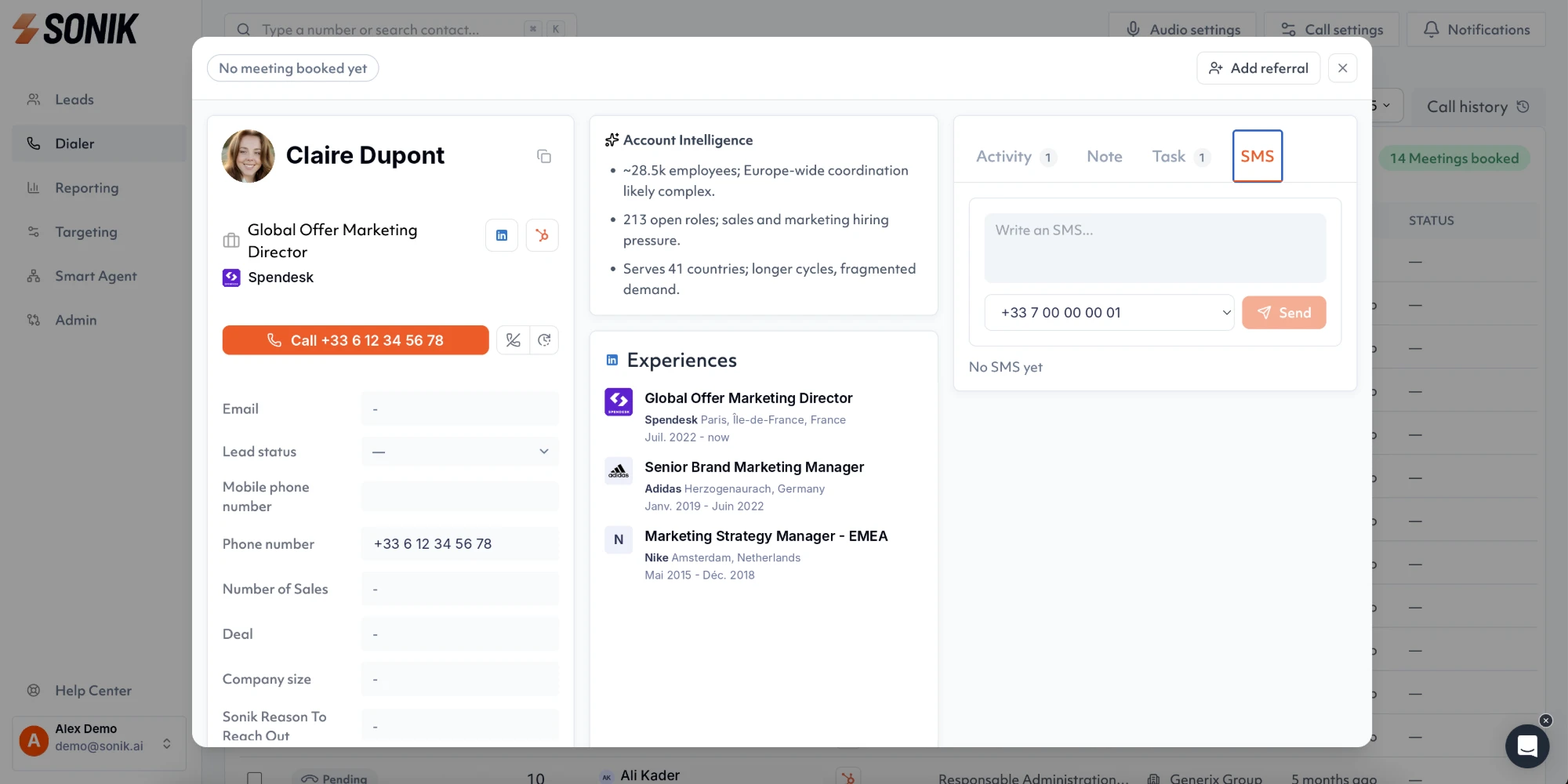
Before each pickup, AI call prep shows the account context and the contact's experiences, so the rep can open with the right reference instead of a generic "we met at the show".
Contacts who do not answer in the window stay in the CRM, and the signal engine brings them back when the account shows a new sign of interest.
Conclusion
Event leads are warm for about two days. Sort them on the way home, call the real conversations first, open with what was said on the stand and keep email in a supporting role. For your next event, decide before it starts who calls tier 1 on the morning after, and block the 10am and 4pm slots in their calendar now.