Get started
Still unsure of the impact of Sonik?
See it for yourself and ask for your free trial


General sales coaching works on what applies to every rep and every deal: mindset, time management, pipeline hygiene and deal strategy. Specialised sales coaching works on one skill at one moment of the sales motion: the first 20 seconds of a cold call, the discovery question, the negotiation, the demo. The difference is scope, and the useful consequence is that a rep's numbers tell you which one they need before you book a single session.
A general coach asks: how is the quarter going, and what is in the way. A specialised coach asks: play me the last call where the prospect said "send me an email", and let's rebuild the ten seconds before it.
General coaching is led by the manager, runs weekly, and uses the pipeline and the calendar as evidence. It covers how a rep chooses which accounts to work, how the day is cut up, how a deal is planned and how a rep reacts to forty refusals in a row.
Specialised coaching is led by whoever knows the skill best, which is sometimes the manager and often a senior rep or an outside coach. It runs on recordings and roleplay. The evidence is a call, not a forecast.
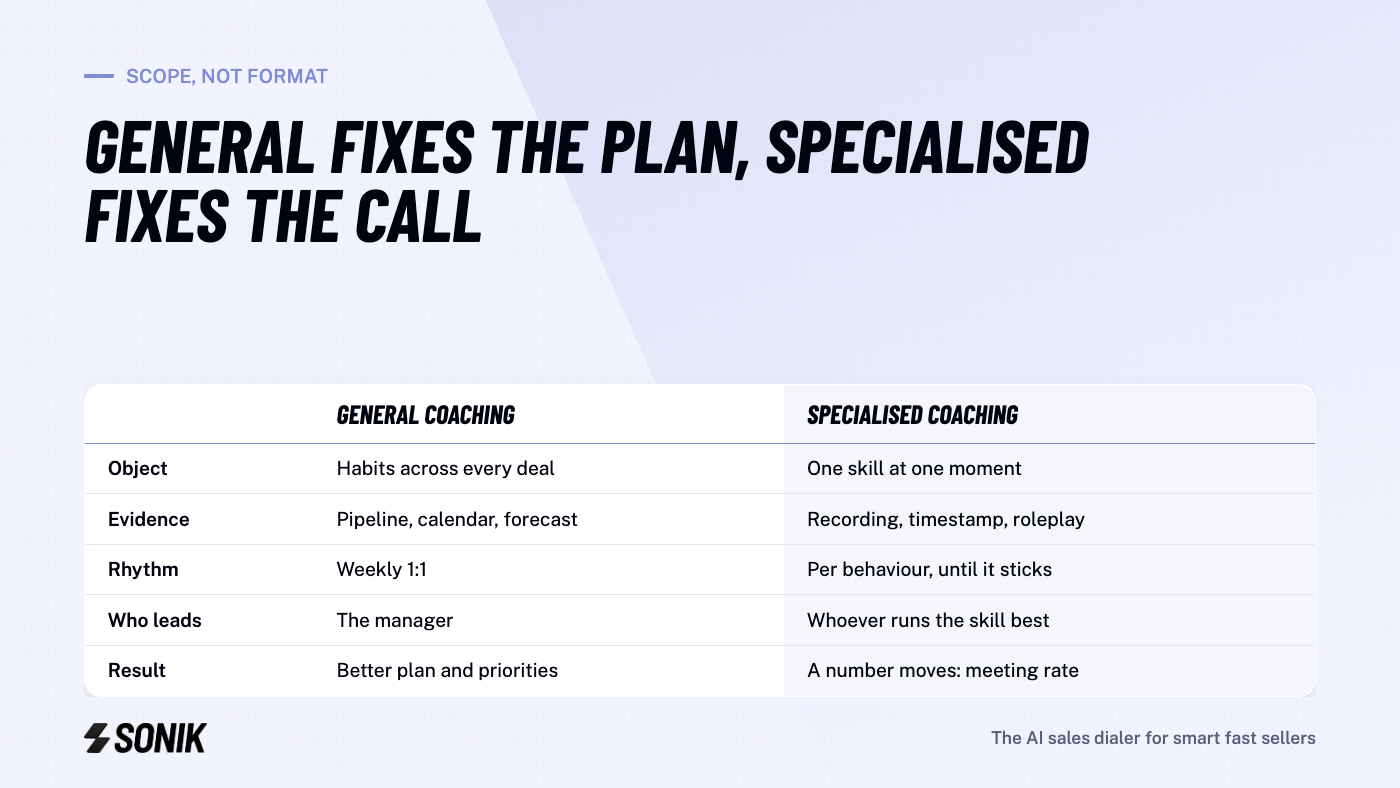
Both are coaching, not training. Training hands over knowledge once, in a room or a module. Coaching changes one behaviour over several weeks and checks that it stuck. The distinction matters because most sales teams we talk to in France do a lot of training, some general coaching and almost no specialised coaching, then wonder why the meeting rate does not move.
Monday, 9am, a sales manager in Paris opens the pipeline with an AE who carries 14 open deals and closed one last quarter. That meeting is general coaching, done well or badly.
Done well, it covers four things. Mindset: how the rep handles a lost deal or a bad week without changing what works. Time management: where the calling blocks sit in the week, and whether the rep protects them. Pipeline reviews: which of the 14 deals are real, which have a dated next step, which should be marked closed-lost today so they stop hiding the number. Deal strategy: who the economic buyer is, who else needs to be in the room, what the competing priority is.
Its strength is that it transfers. The habits apply to an SDR, an AE and a manager, in SaaS or in industry. Its limit is just as clear: it never touches what happens in the 20 seconds after a prospect says hello. A manager can tell a rep to make more calls. A pipeline review cannot tell them that they opened every one of those calls by pitching.
Specialised coaching takes one skill and works it until the numbers move. In B2B outbound there are four that matter: cold calling, discovery, negotiation and the demo. Each has its own evidence, its own drills and usually its own coach.
Cold calling is the clearest case, because we have measured it. Sonik analysed 1,000,000 B2B cold calls in France, across more than 100 industries, and five behaviours separate the calls that book from the calls that do not.

65% of reps open by explaining what they sell. The reps who open on a trigger instead (a hire, a job change, a visit to the pricing page) reach a 7 to 10% meeting rate against 2 to 3% for the pitch-first opener. Discovery questions that start with "how" lift conversion by 190%. Asking "What do you mean?" before answering an objection lifts it by 197%. On a contact who already knows you, "How have you been?" books around 10% of the time against roughly 1.5% for a standard cold open. And the slot: 15.8% connect rate at 4pm, 9.8% at 8am.
None of these show up in a pipeline review. They show up in a recording, at a timestamp, and they are fixed one at a time. That is why cold calling is a specialised skill and not a sub-item of "activity".
Pull four weeks of a rep's dialer and CRM data and compute three ratios. Each one points to a different kind of coaching, and one of them points to no coaching at all.
Connect rate (conversations divided by dials). Our benchmark average is 11.3%, 14% at 10am and 15.8% at 4pm. A rep at 6% does not have a skill gap. They have a list problem, a mobile-number problem or a timing problem. Fix the inputs before you coach anything. We detailed the numbers in the real cold call connect rate in B2B.
Conversation-to-meeting rate. Trigger-based openers run at 7 to 10%, pitch-first at 2 to 3%. A rep with a normal connect rate and a 2% meeting rate has a cold-calling gap. Specialised coaching, on their own recordings, on the opener first.
Meeting-to-opportunity rate. Meetings that happen and then die point to discovery: the questions were closed, the pain was assumed, nothing was qualified. Specialised again, but a different skill and a different drill.
Opportunity-to-close and cycle length. Deals that stall after a good discovery point to deal strategy and multithreading. This is general coaching territory, with a specialised session on the negotiation call when the discount conversation is the thing that stalls.
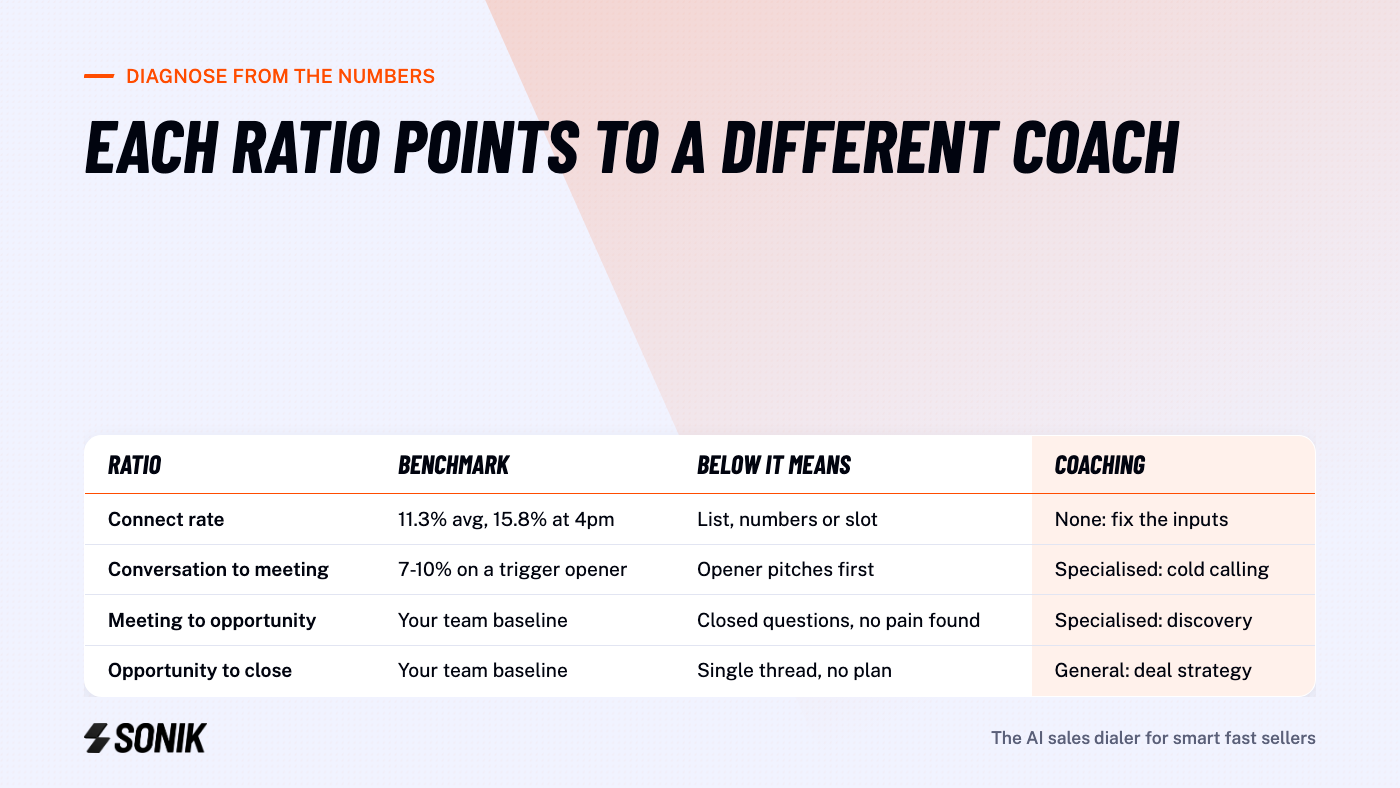
Work from the top of the funnel down. Every ratio downstream is computed on a smaller sample, so a rep with 20 conversations a week has a meeting rate you can trust and a close rate you cannot. Coach the earliest broken ratio first.
I spent five years as an account executive at Google Cloud, and my quota went from 1.5 million to 10 million euros over that period. The coaching I got was general, and it was good: territory plans, deal reviews, how to run a steering committee with a CIO. Nobody ever listened to one of my cold calls, because at that stage I barely made any.
Then I left to build Salespresso, and later Referly, and I was the SDR. My first weeks of calling were bad in a way no deal review could have fixed. I opened with what we did, every single time. I was one of the 65%. The fix came from listening to my own recordings, one behaviour at a time. That is specialised coaching, and it is the reason the benchmark exists.
A team needs both when it has both stages in-house, which is most B2B teams above five people. The split is not fifty-fifty. For SDRs, most of the coaching time should be specialised (calling and discovery), with a thin general layer for calendar discipline and for the head after a bad block. For AEs, reverse it. For a new rep, specialised first, because ramp is measured in conversations that become meetings, not in forecast accuracy.
The trap we see most often: a manager runs general coaching for everyone, because it fits the weekly 1:1 slot and needs no recordings. The SDRs get pipeline reviews on a pipeline they do not own yet.
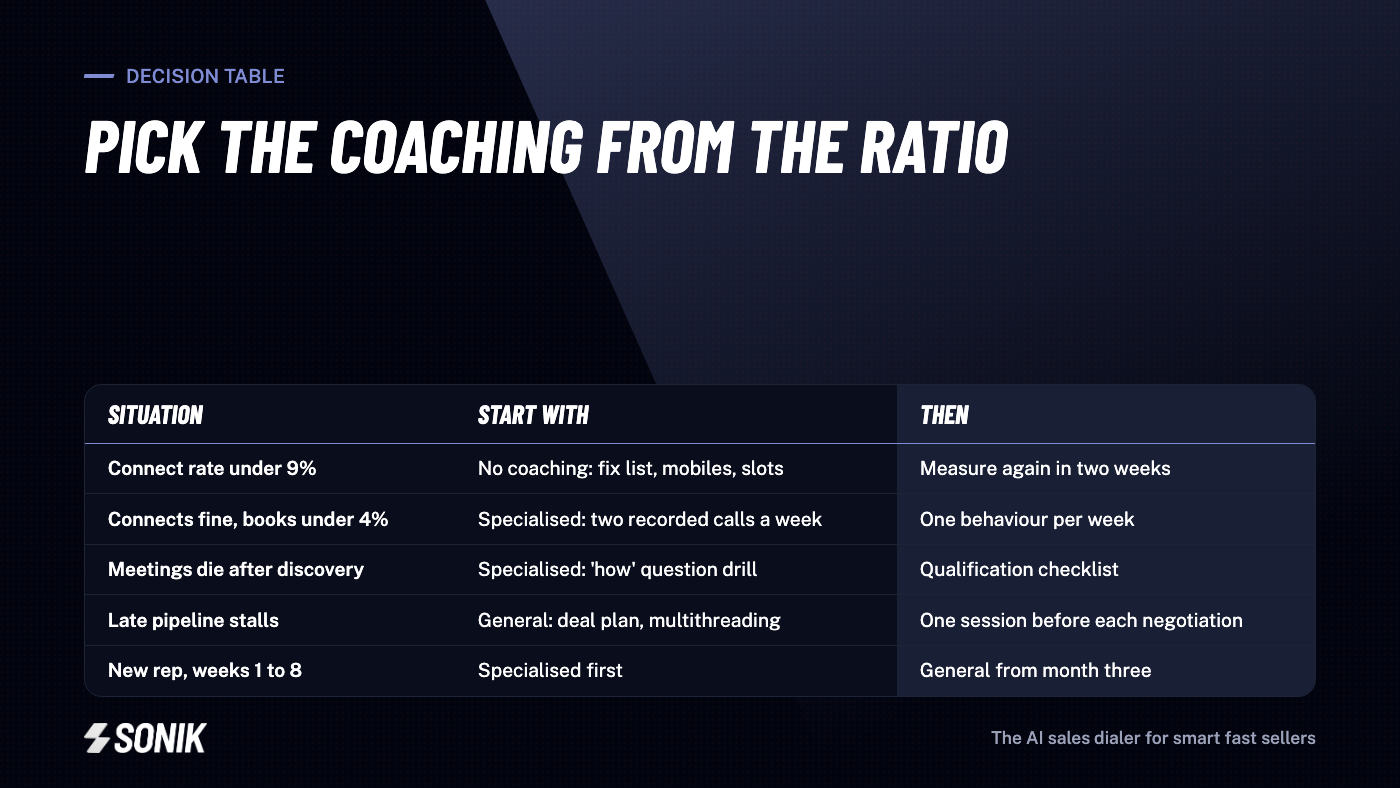
Five situations cover most teams. A rep below 9% connect rate: no coaching, fix list, numbers and slots, then measure again. A rep connecting fine but booking under 4% of conversations: specialised cold-calling coaching, two recorded calls a week, one behaviour at a time. A rep whose meetings do not turn into opportunities: specialised discovery coaching, with "how" questions as the first drill. An AE with a healthy top of funnel and a stalled late pipeline: general coaching on deal strategy, plus one specialised session before each negotiation. A new rep: specialised for the first eight weeks, general from month three.
Read the table from the metric, not from the rep's tenure. A five-year AE who starts self-sourcing pipeline usually needs the SDR row for a month.
Sonik is an AI sales dialer, so the coaching layer is built around the call rather than around the 1:1. Every call is recorded, transcribed and scored against the behaviours from the benchmark: trigger opener or pitch, "how" questions, the objection move. A manager sees which rep is pitching first without listening to 300 calls.

During a call block, the manager watches live statuses across the team (ringing, connected, voicemail, meeting booked) and can open a live call to listen. The side-by-side moment that used to need an office works from a kitchen in Nantes.
Our own sales team is partly remote across France and trains three times a week: one roleplay session, one review of recorded calls, one live block with the manager listening in. The general coaching stays where it belongs, in the weekly 1:1, with the ratios above on screen.
No. Training transfers knowledge in one session to many people: the product, the method, the CRM. General coaching is one-to-one, repeated, and works on how the rep plans, prioritises and reacts. A team can be well trained and badly coached, and in our experience it usually is.
Yes, if the manager still calls or has called recently, and if the calendar separates the two. The weekly 1:1 stays general. Specialised coaching needs its own slot, a recording and one behaviour per session. Managers who have never cold called should bring in a senior SDR or an outside coach for the calling part and keep the pipeline part.
Weekly at minimum for SDRs, with two recorded calls reviewed each time and one behaviour carried for the week. Our own team does three sessions a week. The test is simple: a behaviour that was coached on Monday should be audible in Thursday's calls.
The ratio you diagnosed on. Cold-calling coaching should move conversation-to-meeting within three weeks, from the 2 to 3% range toward 7 to 10%. Discovery coaching should move meeting-to-opportunity over a quarter. If the ratio does not move, either the behaviour did not change or you coached the wrong one.
General coaching builds the habits that carry across every deal. Specialised coaching fixes one skill at one moment, and cold calling is the skill with the clearest evidence. The numbers tell you which one each rep needs. This week, compute connect rate and conversation-to-meeting rate for every rep over the last four weeks, and give the rep with the lowest meeting rate one recorded call and one behaviour to change.

