Get started
Still unsure of the impact of Sonik?
See it for yourself and ask for your free trial

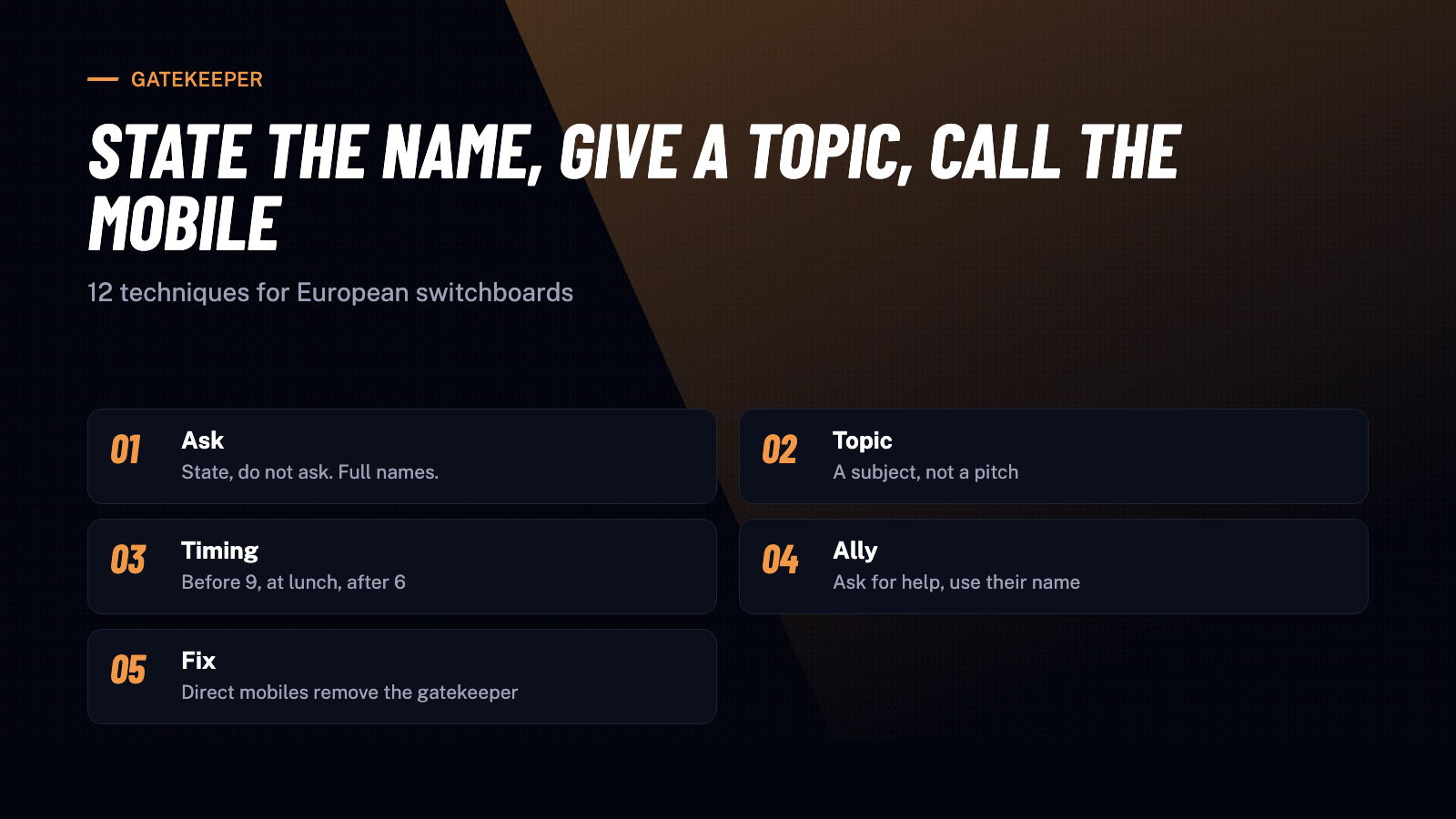
Getting past the gatekeeper is mostly a formulation problem and a data problem. Formulation: state who you want, by full name, as if the call is expected. Data: call the mobile and there is no gatekeeper. Below are 12 techniques that work on French and European switchboards, what not to do, and why the structural fix is better than any trick.
An assistant or a switchboard operator has one job: protect the decision maker's time. They are not judging your product. They are sorting calls into "expected" and "not expected" in a few seconds, and the cost of letting a cold caller through is higher for them than the cost of blocking a real call.
So the gatekeeper responds to signals of expectedness: full names, calm tone, no sales vocabulary, no hesitation. Everything in the 12 techniques below is a way to send those signals honestly.
In our experience, gatekeepers are mostly a landline problem. Mid-size French companies with a "standard" and a receptionist, large accounts with executive assistants. Startups and scale-ups rarely have one, and mobiles never do.
The best gatekeeper technique is not having one. A direct mobile number removes the switchboard, the assistant and the "c'est à quel sujet ?" entirely.
This is a list-building decision, not a call technique. Enrich your target list with direct mobiles before the call block, and check the data quality. In our experience a good enrichment source finds a usable mobile for many French B2B decision makers but not for all, and the number must be a professional one. Calling a personal number is a different legal situation in most of Europe.
The rest of this article is for the contacts where you could not get a mobile.
1. State, do not ask. "Marie Dupont, s'il vous plaît" beats "Could I possibly speak to Mrs Dupont?" The first sounds expected. The second sounds like a request to be screened.
2. Full name, both ways. Give your full name and the decision maker's full name. First name only sounds like a trick. Surname only sounds like a cold caller reading a list.
3. Drop the company word. "Benoit Miegeville, de Sonik" rather than "from the company Sonik". Natural phrasing signals an existing relationship without claiming one.
4. Answer "what is it about" with the topic, not the pitch. "The SDR roles she posted last week" is a topic. "We help sales teams book more meetings" is a pitch, and it is the sentence that gets you sent to the generic email.
5. Call outside the gatekeeper's hours. Assistants work 9 to 6. Decision makers often pick up their own line before 9, at lunch and after 6. Our benchmark shows 8am connects at 9.8% across personas, which is low, but on a landline before the assistant arrives it is the decision maker who answers.
6. Try the extension pattern. If the decision maker is on extension 412, the one who answers 413 is often a colleague who transfers you without screening.
7. Use the persona slot. Founders pick up more around 10am, marketing around 4pm, HR around 1pm. The HR assistant is at lunch at 1pm. The HR lead often is not.
8. Ask for help, not for a transfer. "I need your help: who on Marie's team handles outbound tooling?" Gatekeepers are helpful by profession. Asking for help flips the role.
9. Reference a real prior contact. "We spoke in March, I am following up" works if it is true. It also works with the gatekeeper's own name on the second call: "Hello Sophie, it is Benoit again."
10. Qualify the gatekeeper. Sometimes the assistant is the decision maker's filter for exactly your topic. Ask them one "how" question. In our experience, an assistant who understands the topic transfers you with context, which is better than a blind transfer.
11. Send a LinkedIn message first. A short note the day before means "I sent her a message yesterday about the SDR roles" is true, and the gatekeeper hears a thread, not a cold call.
12. Make the third call the one that gets through. In our experience, most connects happen within the first three attempts. By the third call, the gatekeeper knows your name. Use it.
Do not claim a relationship you do not have. "She is expecting my call" when she is not gets you through once and blacklisted for a year.
Do not invent a referral. French mid-market is small. The fake referrer will hear about it.
Do not hide the company. Refusing to say where you are calling from is the fastest way to be classified as a cold caller.
Do not argue. A gatekeeper who says no twice has decided. Thank them, note their name, and come back at a different slot.
Three things that differ from US playbooks. First, "vous" always, with the gatekeeper and with the decision maker. Second, many French mid-size companies route everything through a "standard" that does not know the decision maker's calendar, so technique 4 (topic, not pitch) and technique 6 (extension) matter more than the ally-building ones. Third, executive assistants in large French groups often own the agenda outright, which makes technique 8 (ask for help) the one that works, over several calls.
We treat the gatekeeper as a list-quality signal. If a target segment keeps landing on switchboards, the list needs direct mobiles, and we flag it.

The signal engine prioritises contacts with a reason for the call (a job change, a website visit, a closed-lost deal), which gives the rep a real topic for technique 4. The parallel dialer runs blocks by persona at the slot where that persona picks up their own phone, and logs the gatekeeper's name for the next attempt.
Parallel dialing also changes the economics: a rep gets about five times more conversations, so a switchboard that blocks one call costs minutes, not a morning.
Getting past the gatekeeper is a formulation problem until it becomes a data problem. State the full name, give a topic rather than a pitch, call outside assistant hours, and never lie. Then fix the list: direct mobiles remove the gatekeeper entirely. This week, count how many of your last 50 dials hit a switchboard. If it is more than 10, enrich the list before you change your script.

