Get started
Still unsure of the impact of Sonik?
See it for yourself and ask for your free trial

An SDR coaching program is a weekly routine, not a quarterly event: one metric per rep, real calls reviewed against a shared scorecard, one behaviour changed at a time. You can launch one in two weeks with the eight steps below. The hard part is not the design, it is protecting the 30 minutes a week when the quarter gets loud.
Managers coach what they can see. What they can see is the dashboard: dials, connects, meetings. So feedback becomes "make more calls" or "book more meetings", which is a target, not coaching.
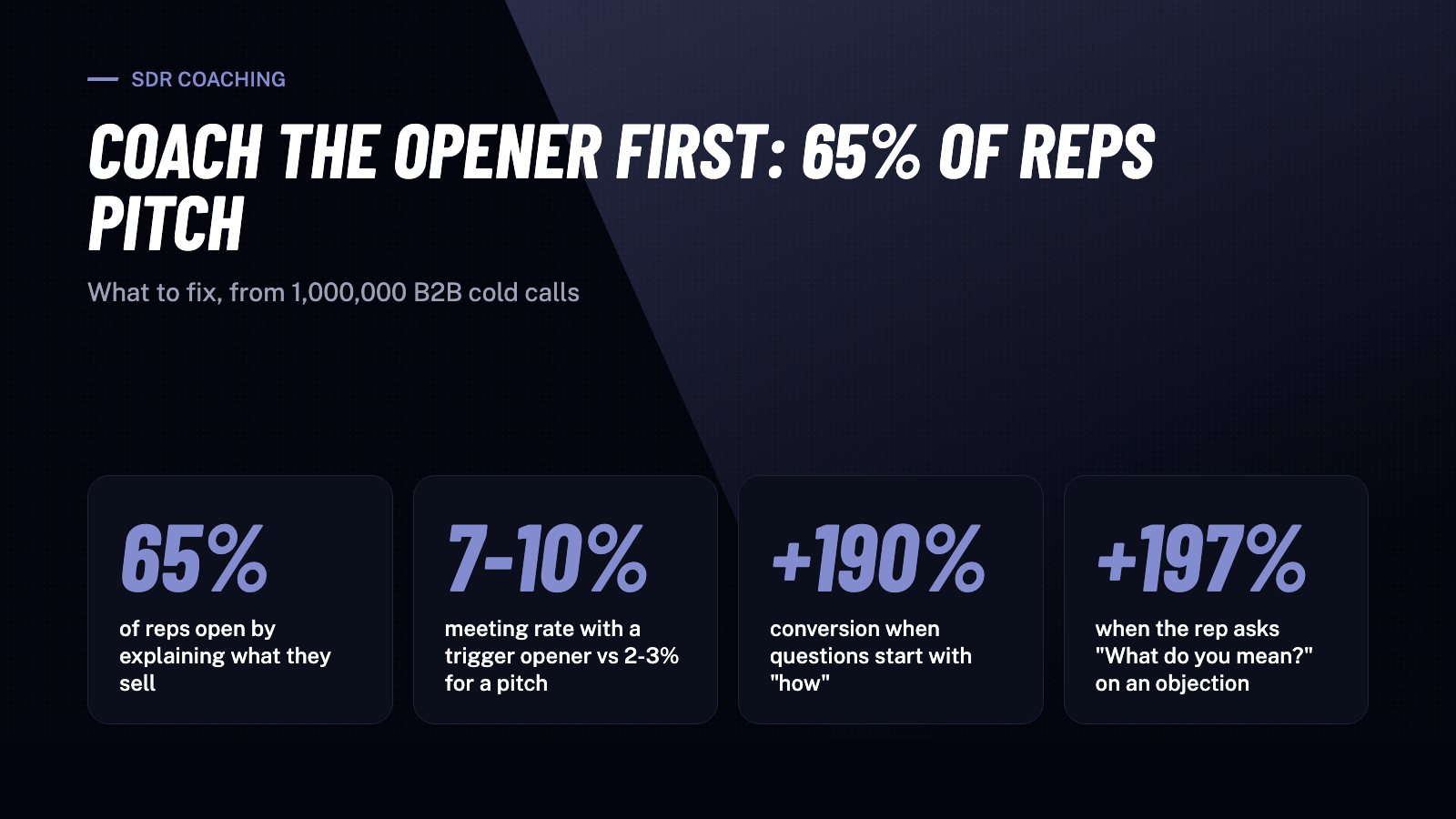
The behaviour that drives the number lives inside the call. In our analysis of 1,000,000 French B2B cold calls with Quentin Despas (Katana), 65% of reps open by explaining what they sell. No dashboard shows that. Only listening does.
A coaching program exists to make listening systematic, so the manager spends their scarce time on the one thing that will move each rep's number this week.
Not five. One. For a rep with a healthy connect rate but few meetings, it is conversation-to-meeting rate. For a rep who books but whose meetings no-show, it is show rate. Write it on the rep's page and leave it there for a month.
Before any session, the manager listens to the rep's last 20 connected calls and tags each one at the stage where it died: opener, discovery, objection, close. Twenty calls take about an hour with recordings and summaries. The tags become the diagnosis.
A call is four layers stacked: the first 20 seconds, the questions, the objection, the ask. Most reps leak in one layer, not four. Coaching the wrong layer is the most common waste we see; we wrote about the order to fix them in cold call performance: 4 layers to fix in order.
Openers are fixed by roleplay, ten reps in a row, two minutes each. Discovery is fixed by one-on-one call review. Objections are fixed in a group session where the team builds the answers together. Closing is fixed by live listen-in, because the moment is too short to recreate afterwards.
Five lines, scored 0 to 2. Did the opener state a trigger, not a pitch? Did the rep ask at least one question starting with "how"? Did the rep ask "What do you mean?" before answering the first objection? Did the rep propose a specific slot? Did the rep confirm the next step by email before hanging up? Ten points, posted on the wall.
A first-time manager promoted from the floor will coach the way they sold. Give them the scorecard, have them score three calls alongside a senior manager, and compare scores until they agree within one point.
Thirty minutes per rep per week, same slot, never cancelled for a pipeline review. One group call review of 45 minutes on Friday. Roleplay blitz of 20 minutes on Monday morning before the 10am calling block.
Four weeks in, re-pull the rep's 20 latest calls and re-tag them. The metric chosen in step 1 either moved or it did not. If it did not, the diagnosis was wrong, not the rep.
If you only have time for two behaviours this quarter, the benchmark is unambiguous.
First, the opener. Trigger-based openers (a job change, a website visit, a closed-lost deal, a mutual contact) reach a 7-10% meeting rate in our data, against 2-3% for pitch-first openers. Since 65% of reps pitch first, this is the biggest single lever on the team.
Second, the questions. Discovery questions that start with "how" lift conversion by 190%. And asking "What do you mean?" before answering an objection lifts it by 197%. Both are coachable in one session and visible in the next day's calls.
Timing is the third, and it needs no coaching at all: connect rates hit 15.8% at 4pm and 14% at 10am, so schedule the roleplay around the calling blocks, never inside them.
The program dies the first time a manager skips the 30 minutes because of a forecast call. Two rules protect it.
Rule one: the rep prepares. They pick two calls (one they are proud of, one that hurt), score them on the scorecard before the session, and bring one question. The manager's prep drops to ten minutes.
Rule two: one change per week. The session ends with a single sentence written by the rep: "This week I will open with the trigger before saying what we do." Next week starts by checking that sentence against three calls. Nothing else.
Sonik records and transcribes every call made through the dialer, then writes an AI summary tagged with the stage where the call ended and the objection raised. The scorecard above lives inside the call view, so a manager can score 20 calls in the time it used to take to find them.
Because signals and AI call prep write the trigger-based opener before the call rings, the opener layer is coached by the product as much as by the manager. Managers can listen in live on the parallel dialer and whisper during the close. The result is that coaching time goes to discovery and objections, where the human judgement still matters most.
A coaching program is one metric, 20 tagged calls, one leaking layer, one format, one scorecard, a cadence nobody cancels. This week, pick your weakest rep, listen to their last 20 connected calls, and count how many opened with a pitch. That number is your first coaching session.

