Get started
Still unsure of the impact of Sonik?
See it for yourself and ask for your free trial


To compare different approaches to detecting buying signals, score each one on the same five criteria: accuracy on your own closed deals, freshness and decay, coverage of your ICP, cost, and delivery into the tool your reps dial from. Then run the same two-week test on each approach: 100 accounts, called the same way by the same reps, and compare conversation and meeting rates. We ran that scorecard on the three approaches most B2B teams in France choose between (first-party signals in the CRM and on the website, third-party intent data, and live signals on the call itself), and this article gives the criteria, the results and the protocol.
The mistake is to compare on the number of signals. A vendor deck with 40 signal types is not better than a CRM report with four.

Accuracy on your own deals. Take your last 50 closed-won deals and ask, for each signal, how many of those accounts showed it in the 90 days before the first meeting. A signal that was present on 30 of 50 wins is worth more than one present on 3.
Freshness and decay. Every signal expires. A pricing page visit is worth calling on today and worth little in two weeks; a job change stays warm for about a quarter in our experience; a funding round is public to every competitor within a day. Score how fast the approach delivers the signal relative to how fast it decays.
Coverage of your ICP. If you sell to 50 to 200 person companies in France, an approach that mostly sees large US enterprises covers little of your list. Measure the share of your target accounts on which the approach produces any signal at all in a month.
Cost. Count the subscription, the enrichment, the rep time to read the signal, and divide by meetings booked from it. Cost per signal is meaningless; cost per meeting is the number.
Delivery into the dialer. A signal in a dashboard nobody opens is not a signal. Reps use only about 20% of the signals already in their CRM. Score whether the approach ranks the list and shows the trigger on the contact when the rep picks up the phone.
These are the signals you already own: closed-lost deals coming up on their anniversary, dormant leads nobody has touched in six months, contacts who changed jobs, website visitors identified at the account level.
On our scorecard this approach wins on accuracy, because the signal is literally your own history, and on cost, because the data is already paid for. 50% of Sonik's pipeline comes from signals that were already in the CRM. The "How have you been?" opener to a known contact reaches about 10% success in our benchmark against roughly 1.5% for a standard cold open; that gap is the value of a first-party signal, measured on the call.
Where it loses: coverage of accounts you have never spoken to, and freshness when the CRM is badly maintained. A website signal also covers only the visitors you can identify, and only about 5% of B2B visitors fill a form.
This is the data you buy: topic surges on publisher networks, technographics (which tools an account runs), hiring signals from job posts, funding announcements, reviews on comparison sites.
Its strength is coverage of accounts you have never touched, and timing on public events. A company that posts three SDR job ads in a month is building a sales team; a company that just raised is spending.
Its weaknesses, in our experience with French mid-market lists: coverage of smaller European companies is thin compared with US enterprise; topic-level intent arrives at the account rather than the person, so the rep still has to guess who to call; and the public signals (funding, hiring) are visible to every competitor on the same day, which compresses the window. Cost is the highest of the three.
The third approach is the signals a prospect gives you in the first two minutes of a conversation. The question they ask ("does it connect to HubSpot?"), the objection they raise ("we already have a dialer"), the detail they volunteer ("we are hiring four SDRs in January").
These are the freshest signals that exist, and the most accurate, because the buyer is telling you directly. Our benchmark of 1,000,000 cold calls measures them: discovery questions starting with "how" lift conversion by 190%, and asking "What do you mean?" before answering an objection lifts it by 197%. An objection is a buying signal if you treat it as one.
At Google Cloud I spent too long in my first year treating "we are already on another cloud" as a closed door. It is the opposite: a prospect who names their current setup has just told you what they compare against. My quota went from 1.5 million to 10 million euros over five years, and a large part of that was learning to hear the signal inside the objection.
The weakness of live signals is obvious: you need a conversation first, so coverage equals your connect rate (11.3% on average, 15.8% at 4pm).
Here is how the three approaches score on the five criteria, from our own tests and from our customers in France. The labels are qualitative on purpose; your accuracy column should come from your own closed deals.

Read the table as a stack, not a ranking. First-party signals decide who is on the list. Third-party data adds the accounts you have never met, where budget allows. Live signals decide what happens in the conversation.
Scorecards are opinions until you call. This protocol takes two weeks and three lists.

In our experience the first-party list wins on meeting rate and cost per meeting almost every time, which surprises teams that paid for intent data and never pulled their closed-lost report. The third-party list wins on net-new accounts, and whether it pays depends on how much of your ICP it actually covered: check the coverage number before the meeting rate.
The live-signal tags are where the coaching starts. When a rep's conversations on list A book meetings at 10% and on list B at 4%, the transcripts usually show why: on A the opener names the trigger; on B it does not.
For the criteria to apply when you then shop for a tool, see Buying signal tools 2026: what to check before you buy. For what each signal means once you have it, see How to interpret buying signals: a field guide from 1M calls.
Sonik starts from the first-party approach because that is where our own pipeline came from: half of it from signals that were already in the CRM, which reps were using 20% of. The dialer connects to HubSpot or Salesforce and to the website, ranks every morning's list by job changes, closed-lost anniversaries, dormant leads and identified visits, and shows the trigger on the contact before the pickup.
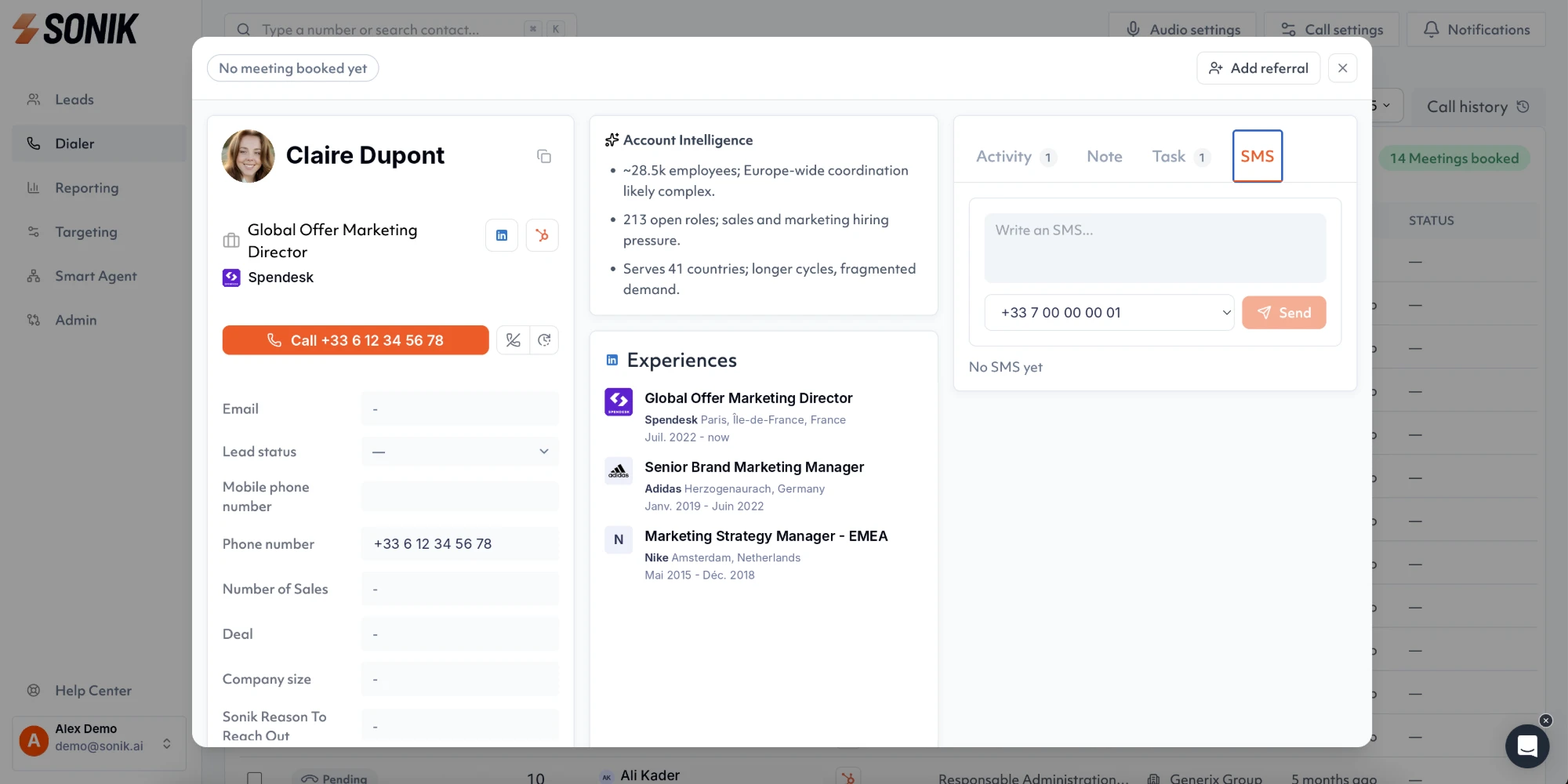
The contact view puts account intelligence, the contact's experiences and the signals that qualify them on one screen, so the opener names the trigger instead of the product.
The live signals are handled by the coaching layer: every transcript is tagged for the question asked, the objection raised and whether the rep asked "what do you mean?" before answering.
On your own deals, first-party signals: closed-lost anniversaries, job changes and dormant leads come from accounts that already knew you, and the "How have you been?" opener's 10% success rate against 1.5% for a cold open shows the gap. Third-party intent is the least accurate per account and the only one that covers accounts you have never met.
100 per approach, called through three attempts over two weeks, is enough to see the difference between a 7-10% meeting rate and a 2-3% one. Keep a control list with no signal so you measure the lift, not the absolute number.
It depends on coverage. Run the coverage check first: what share of your target accounts in France produced any signal last month? In our experience the first-party and live approaches pay first, and third-party data is the third layer, added when the first two are running.
Fast for behaviour, slower for events. A website visit or a pricing question is worth a call the same day. A job change stays warm for roughly a quarter in our experience. Public events such as funding are visible to everyone within a day, so the window is set by your competitors' speed, not by the signal.
Compare approaches to detecting buying signals on five criteria (accuracy on your deals, freshness, coverage, cost, delivery into the dialer), then test them on 100 accounts each for two weeks. First-party signals in your CRM usually win on cost per meeting, third-party data adds reach, live signals decide the conversation. This week, pull your closed-lost deals from 10 to 14 months ago and call them at 4pm, opening with "How have you been?".

