
How to Run a Sales Dialer Pilot: A 2-Week Checklist

A sales dialer pilot should answer one question in two weeks: does this tool give our reps more conversations and more meetings on our own list, with clean CRM data and no extra risk? Fix the question, the baseline and the scorecard before the first dial, split one list at random, and decide on raw call records instead of dashboards. Here is the checklist we would follow.
Decide what the pilot must prove
Most pilots fail before they start, because nobody wrote down what "it worked" means. Two weeks later, the reps like the interface, the manager likes the dashboard, finance asks what changed, and nobody can say.
Write one sentence, and make it measurable. For example: "On the same list and the same slots, reps on the new dialer get at least twice as many conversations per hour, and every call is logged in the CRM without typing."
That sentence decides everything else: who takes part, what you count, and what would make you say no.
Be honest about what two weeks cannot prove. A pilot shows conversations, meetings booked, data quality and friction. It does not show closed revenue. Do not promise finance a pipeline number from ten days of calling.
Before day one: baseline, list and definitions
The week before the pilot matters more than the pilot.
- Measure the baseline. One normal week on the current setup: dials, conversations, meetings booked, hours spent in call blocks. Without it you will compare the new tool with a memory.
- Build one list and split it at random. Same persona, same source, same age. Half goes to the current setup, half to the pilot. A fresh list on the new tool against a tired list on the old one is the most common way pilots flatter the vendor.
- Agree on definitions in writing. What is a conversation? We count a live exchange with the intended person that lasts past the opener. A gatekeeper is not one. A voicemail is not one. A wrong number is not one.
- Pick the reps. Two to four, mixed: one strong, one average, one recent hire. A tool that only works for your best rep does not work.
- Fix the slots. Same call blocks on both sides, for example 10am and 4pm.
- Connect the CRM first. Field mapping, dispositions, owners. A pilot run on a CSV export tests half the product.
The slot rule is not a detail. In our benchmark of 1,000,000 B2B cold calls in France, connect rates run at 15.8% at 4pm, 14% at 10am and 9.8% at 8am. Move the pilot group from mornings to afternoons and you will see a lift that has nothing to do with the tool.
The scorecard: four numbers and one control
Keep the scorecard short enough to fill in every evening.
- Conversations per rep per hour. The number a dialer exists to move. Parallel dialing gives reps about five times more conversations in our data, so a real effect is not subtle.
- Meeting rate per conversation. More conversations are worthless if they are worse. Watch for delay on pickup: a prospect who says "hello" twice into silence does not book.
- Share of calls logged correctly in the CRM without typing. Open twenty records by hand. Right contact, right outcome, right owner, callback task with the right date.
- Abandoned calls. Pickups where no rep was available. With parallel lines, this should read zero, or very close.
The control is connect rate. The average in our benchmark is 11.3%, with a range of 11 to 20% depending on persona and slot. A dialer does not make people pick up. If connect rate differs sharply between the two groups, look at the list split, the slots or the caller numbers before you credit the software.
The two-week checklist
Week one: make it work
- Day 1. Each rep makes five test calls to internal numbers. Check that each one lands on the right CRM record. Exclude these calls from every total.
- Day 2. First real blocks, on a low line count. Listen live to a few pickups for delay.
- Day 3. Call a French mobile, a French landline and a number in each other country you sell to. Check which caller ID the person sees.
- Days 4 and 5. Normal blocks. Fill in the scorecard every evening. Fix mapping errors as they appear and note each one.
Week two: measure it
- Days 6 to 9. No more settings changes. Same blocks, same list, same opener on both sides. This is the week that counts.
- Day 8. Ask one rep to share their screen and run a block while you watch. Friction that never reaches a scorecard shows up in five minutes.
- Day 10. Export the raw call records from both setups. Count on the export, with your definitions.
Run the same test with a European lens throughout. A demo that dials a US number tells you little about reaching a head of sales in Lyon on their mobile. Ask where call recordings are stored and how a contact's opt-out is handled, and have the answers in writing before the decision meeting.
The decision: reconcile the scorecards, then buy, extend or stop
When two scorecards disagree
It happens often. The vendor's dashboard says 31 conversations a day. The manager's sheet says 19.
Nobody is lying. The definitions differ. One side counts every pickup over ten seconds, the other counts conversations with the intended person. One counts in UTC, the other in Paris time. One includes the test calls from day one.
Do not argue from the summaries. Go back to the sentence you wrote before the pilot and the definitions you agreed, then:
- Compare the same export. Same dates, same time zone, same reps.
- Recount on the raw rows with the original definition, not a new one proposed after the results came in.
- Put unmatched calls in a separate bucket until someone traces them. Do not add them, do not delete them.
- Find the rows that change the decision. If the threshold was 2x and you sit at 1.9x or 2.1x, listen to the borderline calls.
- Write the agreed count down with both parties in the room.
If someone wants a different definition, that is a new test with a new name. It does not rewrite this one.
Buy, extend or stop
Three decisions are legitimate.
Buy when the sentence from day zero is true on the raw data and the CRM check passed. Then compute cost per meeting: rep time plus seat cost, divided by meetings booked, on each side.
Extend only with a named open question and an end date. "One more week to check logging on Salesforce custom objects" is an extension. "Let's see a bit more" is a slow yes that nobody decided.
Stop when conversations per hour did not move, or moved while meeting rate fell. Say why in writing. The next evaluation starts from that note.
How Sonik approaches a dialer pilot
We ask for the same thing we would want as buyers: your CRM connected, your list, your reps, and a baseline week to compare against. A pilot on our list would prove nothing about yours.
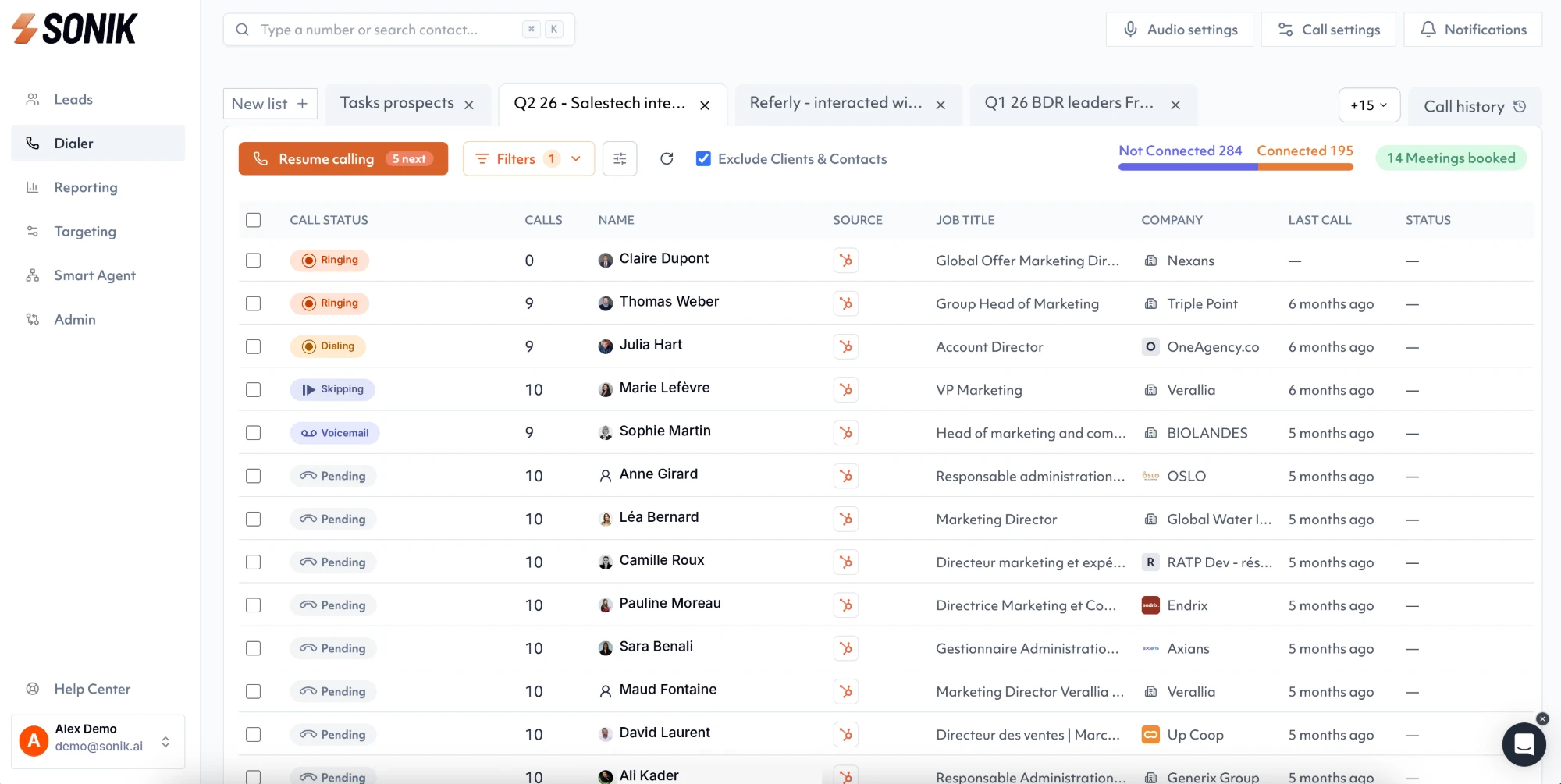
The Sonik dialer runs parallel calls and shows live statuses and the running count of meetings booked during the session, so the daily scorecard takes minutes. The target we measure against is 20 conversations per day per SDR.
The pilot list is built from the signals already in your CRM: website visitors, job changes, closed-lost deals and dormant leads. Reps use only about 20% of those signals today, so the pilot often tests two things at once: more conversations, and conversations with better-chosen contacts. Split them in your reading of the results.
Conclusion
A dialer pilot is a two-week experiment with a sentence to prove, a random list split, four numbers and one control. Count on raw call records with definitions agreed in advance, and decide buy, extend or stop against the sentence you wrote on day zero. This week, before you book a single demo, run the baseline: one normal week of dials, conversations, meetings and hours. Every vendor claim gets easier to judge once you have it.