
How to Structure a Sales Pitch on the Phone: 5 Parts, 30 Seconds

A sales pitch on the phone has five parts, in this order: the reason for the call, one problem, one proof, one question, one ask. Said well, the first four fit in 30 seconds. Most pitches get rejected because they start at part three, the product, and never reach part four, the question. Here is the structure, a worked example, and the six reasons pitches fail, with the numbers from our benchmark of 1,000,000 B2B cold calls.
Why structure beats wording
Reps rewrite their pitch every quarter and change the adjectives. The order stays the same: who we are, what we do, would you like a demo. In our data, 65% of reps open by explaining what they sell, and pitch-first openers book a meeting on 2 to 3% of conversations. Openers that start from a trigger, a reason specific to the person called, reach 7 to 10%.
The words in both groups are fine. The difference is what comes first. A prospect decides in the first seconds whether this call is about them or about you, and the structure makes that decision for them.
The five parts of a phone pitch
1. The reason: why this person, why today
One sentence that could not be said to anyone else. A hire, a funding round, a job change, a visit to your pricing page, a deal that was closed-lost a year ago. "You opened three SDR roles in Lyon this month, that is why I am calling." If you have no reason, you are not ready to pitch. Go back to the list.
2. The problem: one, in their words
Name the one problem that people in this role, at this stage, usually have. Not three. "Teams that hire SDRs this fast usually find the new ones spend their first two months getting voicemail." Use the vocabulary of the role: a head of sales talks about pipeline and ramp, a founder about cash and time.
3. The proof: one fact about a company like theirs
A number or a name that makes the problem credible. "We analysed a million B2B cold calls in France: the average connect rate is 11.3%, so a rep dialing by hand has five or six conversations a day." A proof is not a feature. "We have an AI-powered parallel dialer" is a claim about you. The connect rate is a fact about them.
4. The question: hand over the floor
This is the part most pitches are missing. After problem and proof, ask a question that starts with "how": "How are your new reps getting conversations today?" Discovery questions starting with "how" lift conversion by 190% in our benchmark. The pitch is over at this point. What follows is a conversation, and that was the goal.
5. The ask: a meeting with a purpose
Once the prospect has described their situation, propose the next step in terms of what they just said. "It would be worth 20 minutes to look at what 20 conversations a day would mean for those three new reps. Thursday at 10 or Friday at 2?" The ask comes last, and it is specific.
A worked example, timed
Read aloud, this takes about 28 seconds:
"Hello Claire, Thomas from Sonik. You opened three SDR roles in Lyon this month, that is why I am calling. Teams that grow this fast usually see new reps spend their first weeks on voicemail: across a million B2B calls we analysed in France, the average connect rate is 11.3%. How are your current reps getting their conversations today?"
Reason, problem, proof, question. No product description, no company history, no "we help companies like yours". The product enters the conversation when the prospect asks "and what do you do about it?", and they nearly always do.
Six reasons a pitch gets rejected
- It starts with you. Company name, founding story, product category. The prospect has heard it before the second sentence ends.
- It has no reason. The same pitch could be read to the next 200 names on the list, and it sounds like it.
- It lists features. Three features is three chances to hear "we already have that".
- It never stops. A 90-second monologue leaves the prospect one option: interrupt to say no. Thirty seconds, then a question.
- It asks too early. "Do you have 30 minutes next week?" before the prospect has said a word about their situation.
- It is read. Prospects hear a script in the rhythm. Learn the structure, not the sentences, and say it your way.
When the rejection comes as an objection ("not interested", "we have a tool"), do not defend the pitch. Ask "What do you mean?" first. That question alone lifts conversion by 197% in our data, and the answer tells you which of the five parts missed.
Same structure, different rooms
The five parts hold in other formats. Only the timing changes.
- Voicemail: reason and problem only, 15 to 20 seconds, no ask beyond "I will try you again Thursday".
- Gatekeeper: the reason, in one line, with the name of the person. Assistants pass on calls that sound expected and specific.
- First meeting: the same order over five minutes instead of thirty seconds, with the prospect's own words from the cold call as the reason.
In French, the structure is identical and the tolerance for preamble is lower. Skip "je me permets de vous appeler" and the apology that comes with it. The reason is the polite part.
How Sonik approaches the pitch
The reason is the hardest part to produce at volume. Writing one specific sentence per prospect, by hand, for 100 dials a day does not happen, so reps fall back to the generic pitch.
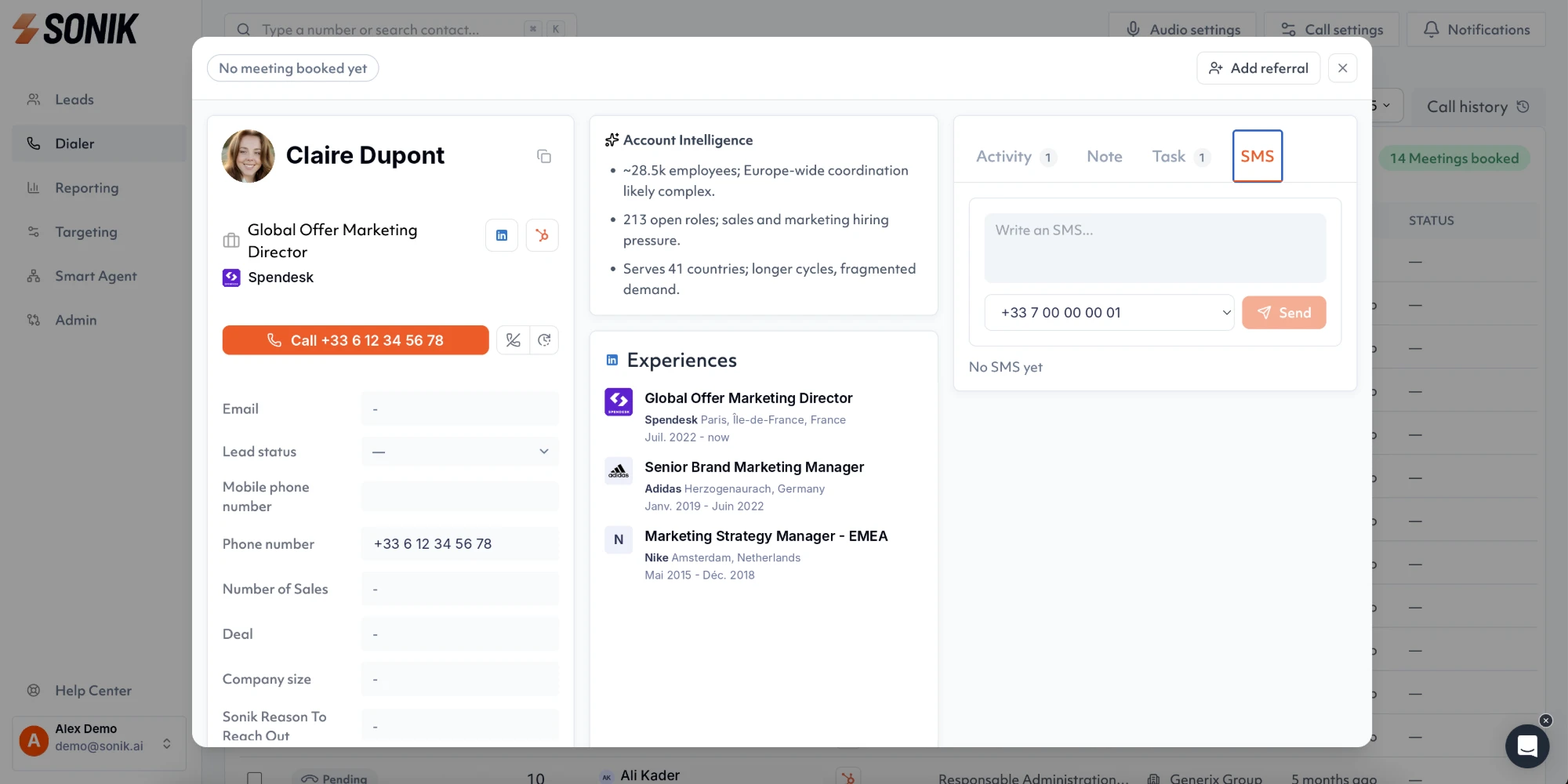
Sonik surfaces the reason before the pickup: the signal behind the call, the contact's role and past experiences, the account context. The rep reads one line and has part one. The rest is practice, and practice needs conversations: parallel dialing gives reps around 5x more of them, so a new structure can be tested on 50 conversations in a week rather than in a quarter. We compared opener families in detail in 15 first lines that survive the first five seconds.
Conclusion
A phone pitch is reason, problem, proof, question, ask, and the first four take 30 seconds. If yours gets rejected, check the order before the words. This week, record your pitch on your phone and time it. If it runs past 30 seconds or ends without a question, cut it until it does not.