Get started
Still unsure of the impact of Sonik?
See it for yourself and ask for your free trial


The difference between inbound and outbound sales strategies is who starts the conversation. In inbound, the buyer comes to you first (a form, a demo request, a trial, a reply to content) and your job is to answer fast and qualify. In outbound, you choose the account and reach out before anyone has raised a hand, most often by phone. Most B2B SaaS teams in France need both, and the phone is where the two strategies meet. Here is the comparison, when to run which, and a checklist to decide.
Put the two side by side on the six questions a sales leader actually asks, and the difference stops being philosophical.
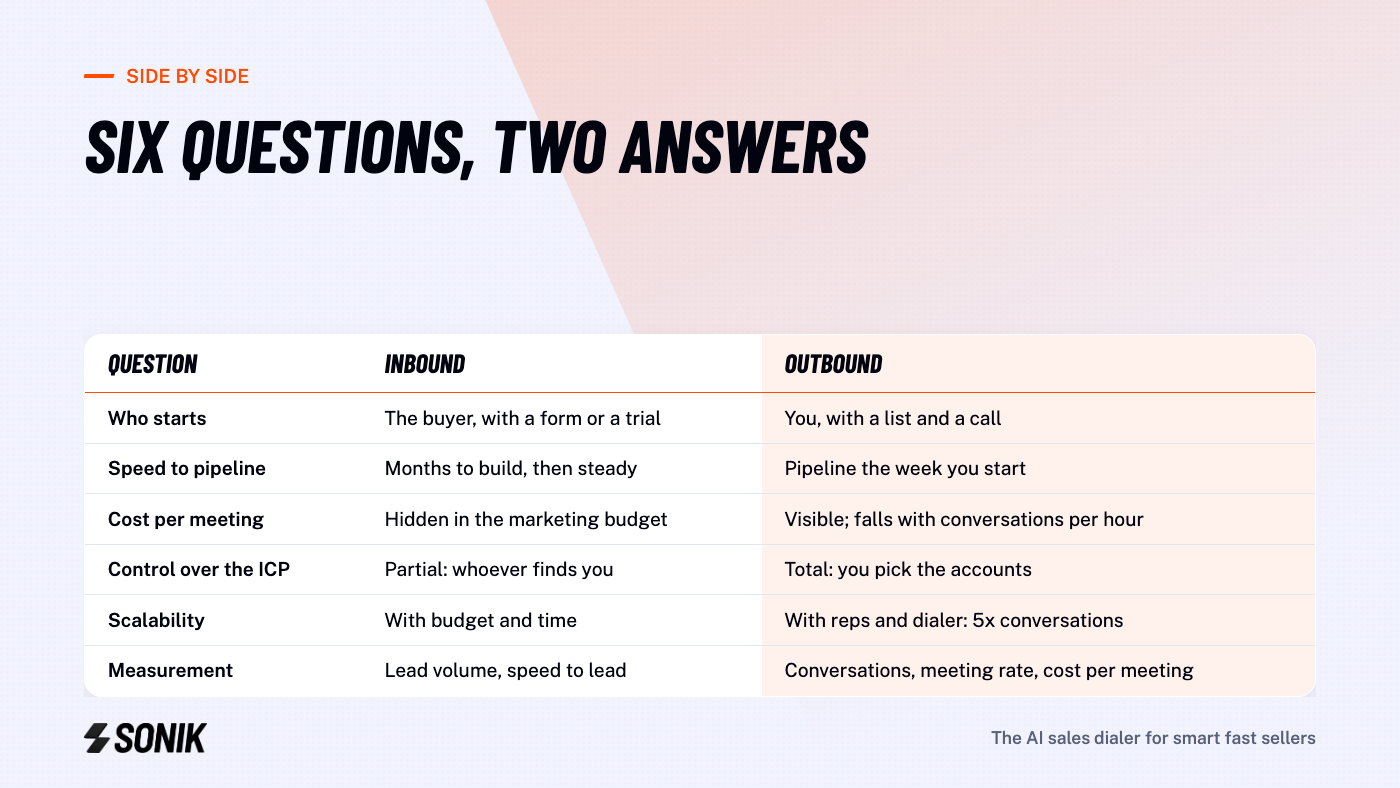
Who starts. Inbound: the buyer. Outbound: you. This one difference drives all the others.
Speed to pipeline. Outbound creates pipeline the week you start calling. Inbound takes months of content, search and brand before the forms arrive, and then keeps arriving after you stop.
Cost per meeting. Inbound meetings look free because the marketing spend sits in another budget. Count it honestly (content, ads, tooling, the SDR who qualifies the form) and the gap narrows. Outbound cost per meeting is visible and, with a dialer, falls as conversations per hour rise.
Control over the ICP. Outbound: total. You pick the 200 accounts. Inbound: partial. The form arrives from whoever found you, and in our experience a real share of inbound leads are students, very small businesses or vendors trying to sell to you.
Scalability. Inbound scales with budget and time; outbound scales with reps and conversations per rep-hour. Parallel dialing changed this: 5x more conversations per rep means outbound scales without a proportional hiring plan.
Measurement. Inbound is measured on lead volume, speed to lead and conversion by source. Outbound is measured on conversations, meeting rate per conversation and cost per meeting. The common mistake is measuring outbound on dials.
A demo request at 9:12 on a Tuesday is the best lead you will get all week. The person has a problem, has named it, and has given you their number. Inbound's strength is intent: the buyer has done part of your work.
It stalls in two places. The first is volume: only about 5% of B2B website visitors fill a form. The other 95% looked at your pricing page and left, and inbound as a strategy has nothing to say to them. The second is speed. A form that waits until tomorrow's SDR shift is a form that has also been sent to two competitors. Speed to lead is the whole game for inbound, which is why the phone matters there too, and we come back to it below.
Outbound's strength is choice. If your best customers are 50 to 200 person SaaS companies in Lyon and Paris with a new VP Sales, you can build that list on Monday and be talking to it by Wednesday. No inbound engine can promise that.
What it costs is conversations. At an 11.3% average connect rate (our benchmark of 1,000,000 B2B cold calls in France), a rep needs about nine dials per pickup, and with trigger-based openers around 7-10% of conversations turn into meetings. By hand that is 3.2 conversations an hour; on a power dialer 5.4; on a parallel dialer 16.2. The economics of outbound are the economics of your dialer.
I spent five years as an account executive at Google Cloud, with a brand that produced inbound every day. My quota went from 1.5 million to 10 million euros over that time, and what I learned is that the brand opens the door but the number moves when you call. Today at Sonik, founder-led cold calling brings 50% of our pipeline, and most of the rest comes from signals that were already in the CRM.
Three variables decide it: stage, deal size and how aware the market is of your category.

Stage. Before product-market fit, outbound only. You need 30 conversations with the right persona more than you need 300 visitors, and the founder should hold those conversations. After fit, add inbound as a second engine, not as a replacement.
Deal size. Below a few thousand euros of annual contract value, outbound by phone is hard to make pay unless the dialer pushes conversations per hour very high; inbound and product-led motions carry more of the load. From mid-market contract values upward, outbound pays comfortably and is usually the only way to reach the accounts you actually want.
Market awareness. If buyers in France search for your category by name, inbound will work and you should invest in it. If you are creating the category, nobody is searching; outbound is how the market finds out you exist.
In our experience, a Series A SaaS in France gets most of its new pipeline from outbound in the first years, and the ratio moves toward inbound as the brand grows. Teams that go inbound-only before that point simply wait longer.
The inbound-versus-outbound debate usually ends with "do both". That is correct and useless unless you say how. The how is the phone.
On the inbound side: a five-minute call on every new lead. The form arrives, the SDR calls within five minutes, qualifies in a short conversation and books the meeting on the spot. No email ping-pong, no calendar link that gets ignored.
On the outbound side: calls on signals rather than cold lists. The 95% of visitors who did not fill a form, the contacts who changed jobs, the closed-lost deals from a year ago. A call opening with "How have you been?" to a known contact reaches about 10% success in our data, against roughly 1.5% for a standard cold open.
Both lists sit in the same dialer and the same rep calls both. That is what we call allbound, and we wrote up the full model in Allbound sales: the phone at the centre of every lead.
Outbound burns lists if you call the same accounts every quarter with nothing new to say. It needs signals to stay fresh, and it needs a rep who can hold a conversation, which is a hiring and coaching cost. It also depends on pickup, and in our observation mobile pickup on cold lists has fallen from 20-30% to around 10% over the last years.
Inbound depends on channels you do not control. Email reply rates have fallen from around 5% to 1% over the same period, search is changing under AI answers, and a form is only as good as the response time behind it. It also brings the wrong people: a share of every inbound queue is not your ICP, and someone has to call to find out.
Neither is cheap. The choice is between a cost you can see (outbound) and a cost that sits in marketing's budget (inbound).
Run through these six questions before the next planning meeting.

Sonik treats inbound and outbound as two lists in one calling session. New inbound leads land at the top of the list for a call within five minutes; the rest of the session is signal-ranked outbound from the CRM and the website, dialled in parallel at the slot where the persona picks up (4pm reaches 15.8% in our benchmark, 10am 14%).

The rep sees one screen: live line statuses, the pre-call brief for whoever picks up, and the running count of meetings booked. The same coaching layer tags openers and discovery questions on both kinds of call, so an inbound qualification call and a signal-based cold call are measured the same way.
Our own floor runs this way, with 20 conversations per SDR per day as the north star, whatever the source of the lead.
Per meeting, often not once you count the full cost: content, ads, tooling and the SDR time spent qualifying forms that are not your ICP. Inbound looks cheaper because the spend sits in the marketing budget. Outbound's cost is visible and falls as conversations per rep-hour rise, which a parallel dialer does by a factor of about five.
Before product-market fit, we would not. Inbound takes months to build and brings whoever finds you, not the persona you need to learn from. Outbound by phone gives a founder 20 conversations a week with the exact persona, and that is where most of the early learning happens. Add inbound once the category is searched for.
They are not comparable on one number. For outbound we use connect rate (11.3% average, up to 15.8% at 4pm) and meeting rate per conversation (7-10% with trigger openers). For inbound the number that matters is speed to lead and the share of leads reached by phone within five minutes; in our experience that share predicts meeting rate better than any lead score.
In small teams, yes, in the same session, with inbound leads at the top of the list. In larger teams a split works if the inbound reps still call rather than email, and if the outbound reps get the website and CRM signals that the inbound queue does not capture.
Inbound and outbound differ on who starts the conversation, and that one difference sets speed, cost, control and measurement. Early-stage, high-ACV or category-creating SaaS teams in France lean outbound; teams with a searched-for category add inbound and keep calling. This week, time how long your last ten inbound leads waited for a call, and pull the ten CRM contacts who changed jobs most recently. Call both lists at 4pm.

