Get started
Still unsure of the impact of Sonik?
See it for yourself and ask for your free trial


Yes, software that analyses buying signals is worth it when the signal reaches the dialer and changes the first sentence of the call; it is not worth it as a dashboard. In our benchmark of 1,000,000 B2B cold calls in France, a trigger-based opener reaches a 7-10% meeting rate against 2-3% for a pitch-first opener, so the same 100 conversations produce 7 to 10 meetings instead of 2 or 3. That delta is the whole business case, and it only exists if a rep says the signal out loud.
Here is the honest version. Signal software does two things: it detects events (a job change, a pricing-page visit, a funding round, a closed-lost deal turning one year old), and it tells someone. The detection has become cheap. The value is entirely in what happens next.
When the signal lands in a report that an SDR manager reads on Monday, nothing changes on the phone. When it lands on the rep's screen at 10am with the suggested opener, and the rep calls the account that morning, the meeting rate triples.
So the question to ask a vendor is not "how many signals do you track" but "where does the signal appear when my rep is about to dial".
Take one SDR hitting our north star of 20 conversations a day. Over 20 working days that is 400 conversations a month.
With a pitch-first opener at 2-3%, those 400 conversations book 8 to 12 meetings. With a trigger-based opener at 7-10%, they book 28 to 40. The difference is 16 to 32 extra meetings per SDR per month, from the same dials, the same slots and the same rep.

Three things about this arithmetic. First, it assumes the conversations happen: 400 a month means a dialing block every day, which most teams do not have. Second, the delta scales with the share of calls that carry a signal, so a team where 30% of calls have a trigger gets roughly 30% of the delta, about 5 to 10 extra meetings. Third, we have not put a price on the meetings. Multiply by your meeting-to-opportunity rate and your average deal, then compare with the subscription. Treat that as an illustration and run it with your own numbers; for the teams we meet, the comparison is rarely close.
We have watched teams buy signal software and see nothing move. Every time, one of three things was missing.

Reps use about 20% of the signals already in their CRM, and 50% of Sonik's own pipeline comes from the other 80%: closed-lost anniversaries, dormant leads, job changes of past users, website visitors from known accounts. 75% of the SMB HubSpot users we meet have no intent data at all, which is fine, because only about 5% of B2B website visitors fill a form and the other 95% are a signal nobody has read. Start the software on your own CRM and your own site. Third-party intent is the second layer, not the first.
A signal is worth nothing if the rep answers it by email three days later. Dialing by hand gives about 3.2 conversations an hour, a power dialer 5.4, a parallel dialer 16.2. At 3 an hour, a rep cannot work through the morning's signals before they decay. The software pays for itself only when it feeds a daily block of parallel dialing.
65% of reps in our benchmark open by explaining what they sell, with the signal sitting on their screen. The opener has to be written per signal type and rehearsed: "You hired a new Head of Sales last month, how is the outbound set-up changing?" No signal in the opener, no delta.
I learned the third point before Sonik existed. In five years as an AE at Google Cloud, my quota went from 1.5 million to 10 million euros, and the accounts that moved were the ones where I could name the event in the first ten seconds: a migration announced, a new CTO, a lost deal from the year before. The CRM had the events the whole time. Nobody was saying them. That is the gap I built Salespresso, then Referly, then Sonik to close, and founder-led cold calling on those same signals still brings 50% of our pipeline.
Do not pilot on "signals detected". Pilot on four numbers, with the same reps and the same slots as the baseline month.

Signal-to-call delay is the one most teams skip. If the median is over 48 hours, the software is a reporting tool and the pilot will fail for reasons unrelated to the signals. Meeting rate per conversation, signal calls versus cold calls, is the number that decides the renewal. A typical Sonik session runs 127 dials, 10 conversations and 0.66 meetings an hour; your pilot should show the signal-sourced sessions clearly above your own baseline, not above a vendor's.
Say no if your team does not call. A signal that goes into an email sequence loses most of its value, because the sequence cannot hear the answer, and the one reply you get is "send me more information".
Say no if the signals cannot be written back into HubSpot or Salesforce as a field the dialer can filter on. A separate tab is a separate tool nobody opens.
Say no, for now, if you have not yet called your closed-lost list from a year ago. That list is free, it is a signal, and it will tell you in two weeks whether your reps can open with a trigger. If they cannot, software will not fix it.
Sonik does not sell signals as a report. The signals already in HubSpot or Salesforce (website visitors, job changes, closed-lost, dormant leads, social intent) are read, stacked per account, and turned into the day's call list inside the dialer.
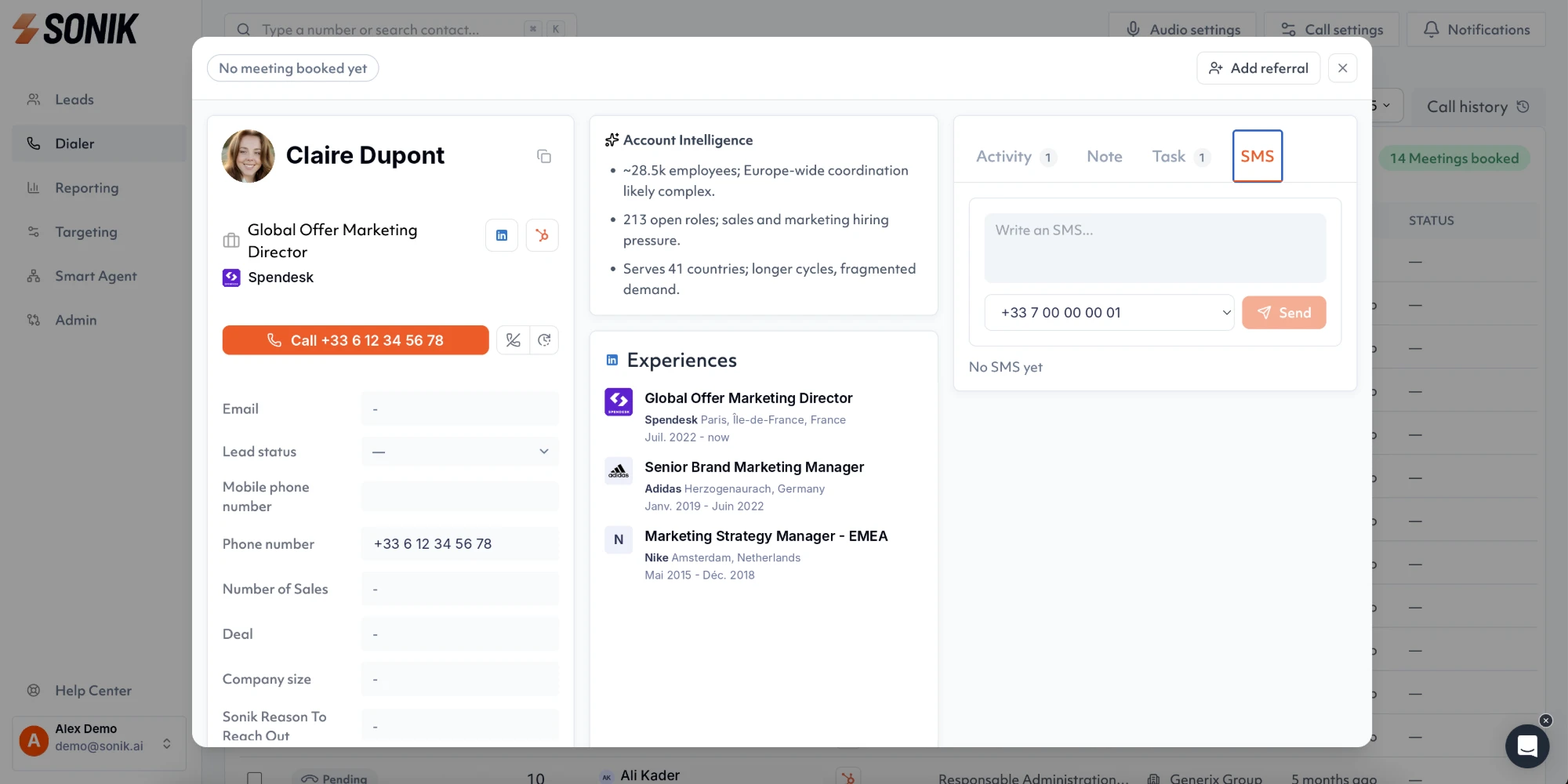
On each contact, the account intelligence and the qualifying signals sit next to the call button, with an opener line generated from the signal, so the rep's first sentence names the event. The parallel dialer then runs the block at around 16 conversations an hour, and every call is tagged with its signal so the meeting rate per signal type is a filter in the weekly report.
The pilot numbers above are the ones we track for our own floor, where signal-led calls bring half of the pipeline.
In our benchmark, opening with the trigger reaches 7-10% meetings per conversation against 2-3% pitch-first, roughly three times more. The software only delivers that when the signal reaches the rep before the dial and the rep uses it in the opener; as a dashboard it changes nothing on the phone.
A small team should start with the signals it already owns: closed-lost deals, job changes, dormant contacts, website visitors. Those are free to read and bring half of our own pipeline. Buy software when the manual version has proven the reps can open with a trigger and the volume outgrows a spreadsheet.
Intent data is one input: third-party behaviour, such as topic research on other sites. Buying signal software is the layer that collects inputs, first-party and third-party, scores them per account and routes them to a rep. The routing is where the value is; the data source is secondary.
Thirty days is enough if the signals feed a daily calling block. You will see the meeting rate on signal-sourced conversations diverge from the cold baseline within two weeks; the pipeline effect follows a sales cycle later. If nothing has moved in 30 days, check the signal-to-call delay before blaming the signals.
Signal software pays when it changes the first sentence of a call that happens the same day. The arithmetic is simple: 400 conversations a month per SDR, 2-3% versus 7-10%, 16 to 32 extra meetings. This week, before any demo, export your closed-lost deals from last year and have one rep call them with an opener that names the loss. That result is your real pilot.

