Get started
Still unsure of the impact of Sonik?
See it for yourself and ask for your free trial


BANT, CHAMP, GPCT and NEAT are four ways of asking the same four things: is there a problem, who decides, can they pay, and when. The difference is the order and the first question. For a three-minute cold call, pick a framework that opens on the problem (CHAMP or NEAT). For a 30-minute discovery, GPCT or a full BANT works. Here is how to choose, and the one question that outperforms all four.
Qualification is not scoring. Scoring is what the CRM does before the call, from firmographics and signals, to decide who to dial. Qualification is what the rep does during the call, to decide whether this conversation becomes a meeting.
The constraint that matters is time. An SDR cold call that books lasts three to six minutes in our experience; the prospect gives you two questions, maybe three, before they decide whether to keep talking. A framework with four dimensions cannot be fully run on a cold call. It can be started.
So the real choice is not "which framework" but "which dimension first". That is where the four differ.
The oldest and still the most used. Its weakness is the order: opening on budget with a stranger ends the call. Run it as Need, Authority, Timing, Budget and it works fine for transactional and mid-market deals with one or two decision-makers.
BANT reordered to open on the problem, with one addition that matters: prioritisation. "Where does this sit against what else you are doing this quarter?" filters out the polite "interesting, send me something" that fills pipelines with deals that never move.
Built for inbound, where the prospect has already raised a hand. It opens on the goal the prospect stated, then asks what plan exists to reach it, which surfaces the competition and the internal owner. On a cold call it needs a trigger to replace the inbound form.
Replaces budget with economic impact: not "do you have budget" but "what does this problem cost you". Replaces authority with access: not "are you the decision-maker" but "can you get me to the person who is". Honest about buying committees, which Gartner puts at six to ten people in a typical B2B purchase.
CHAMP or NEAT. Both open on the problem, both can be started in two questions and finished in the meeting.
The reason is in the data. Across the 1,000,000 French B2B cold calls we analysed with Quentin Despas (Katana), 65% of reps open by explaining what they sell, and the meeting rate for those calls is 2-3%. Calls that open with a trigger and a question reach 7-10%. A framework whose first dimension is "Challenges" or "Need" forces the rep to ask before pitching.
What to capture on the call: the problem in the prospect's words, who else cares about it, and whether there is a date attached (renewal, hire, board meeting). Leave budget for the AE. Three fields, filled in three minutes, is a qualified handoff.
GPCT, or BANT run in full in the modern order. With 30 minutes, the AE can afford to go wide: goals, the plan in place, challenges with the plan, timing, then authority and budget as the last ten minutes.
The handoff matters more than the framework. If the SDR captured the challenge and the date, the AE opens discovery on them ("you told my colleague the renewal is in March, what has to be true before then?") instead of restarting from zero. Prospects who have to repeat themselves no-show.
Whatever the acronym, the questions have to start with the right word. In our benchmark, discovery questions beginning with "how" lift conversion by 190%. "How are you handling X today?" beats "Do you have a tool for X?" because it cannot be answered with "yes".
And when the prospect pushes back ("we're fine", "not a priority"), asking "What do you mean?" before answering lifts conversion by 197%. That one question turns an objection into the Challenge field of whichever framework you use.
Write the "how" version of each dimension into your script. The acronym is for the CRM; the "how" is for the call.
Sonik's AI call prep pre-fills the framework fields before the call rings, from the signals in the CRM: a job change fills Authority, a closed-lost deal fills Challenge and Timing, a website visit on the pricing page fills Need. The rep opens on what is already known and spends the three minutes on what is not.
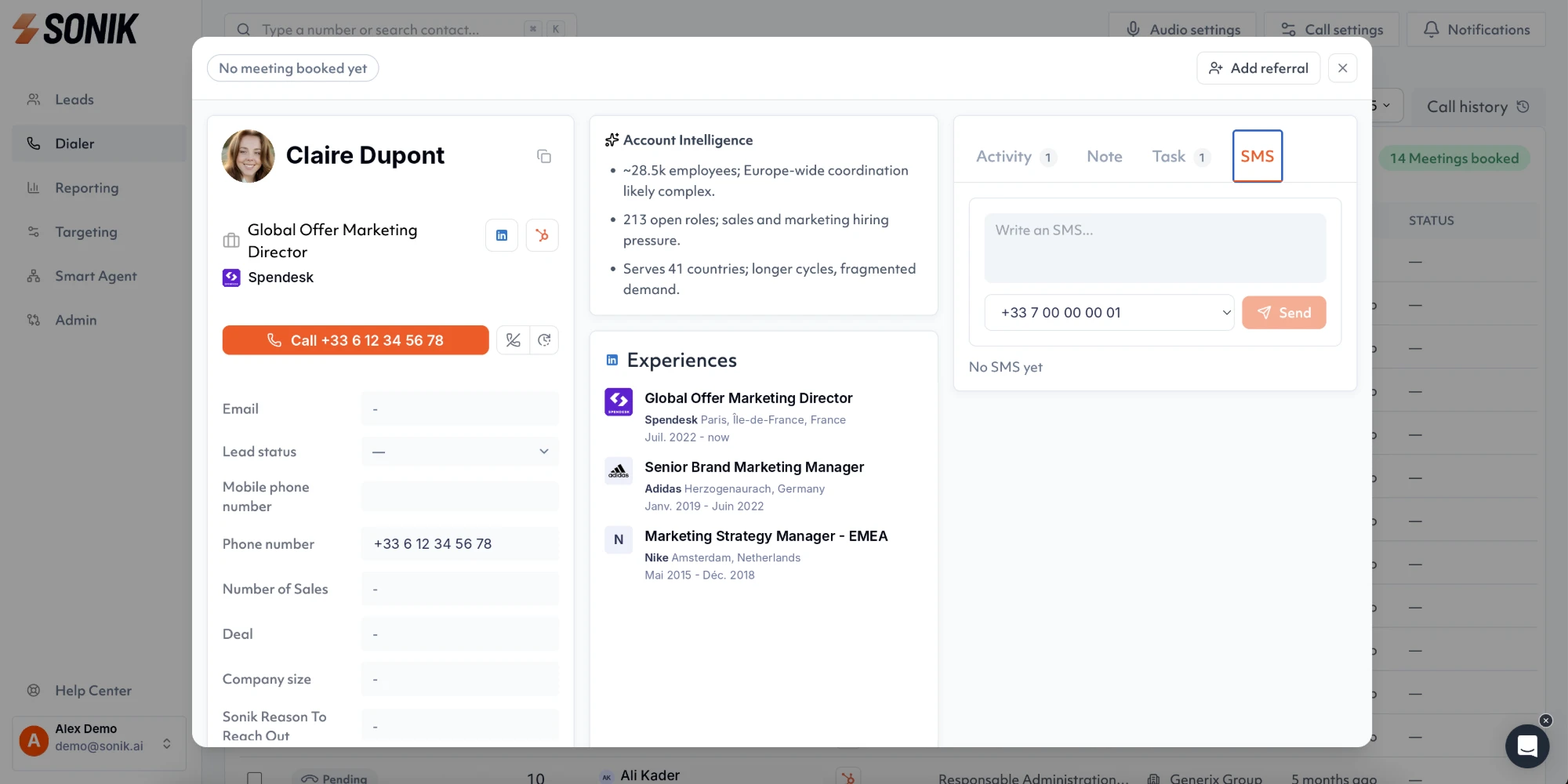
After the call, the AI summary maps what was said to the team's chosen framework (BANT, CHAMP, GPCT or NEAT, configured once) and writes the handoff note for the AE. The rep on the parallel dialer gets 5x more conversations to run it on, which in our experience is the real bottleneck on qualified pipeline, far more than the framework choice.
Pick the framework by the length of the call: CHAMP or NEAT for the cold call, GPCT or full BANT for discovery, and make the handoff carry three fields the AE can open on. This week, rewrite the first question of each dimension so it starts with "how", and count how many of your reps' openers still start with a pitch.

