
Miller Heiman Explained: Buying Roles, Blue Sheet, First Calls

Miller Heiman's Strategic Selling is a method for complex B2B deals where several people decide. Its core idea fits in one sentence: a deal has four kinds of buying influence (the economic buyer, the users, the technical buyers and a coach), and you have not covered the deal until you know who plays each role and how each one would personally win. The Blue Sheet is the one-page plan where you write that down. Here is the method in plain terms, and how SDRs and AEs can use it from the first call.
Where the method comes from
Robert Miller and Stephen Heiman published Strategic Selling in the 1980s, for salespeople managing large accounts with long cycles. A companion method, Conceptual Selling, covers how to plan and run each individual meeting. Together they are usually called "Miller Heiman".
The method is older than SaaS, and it shows in the vocabulary. The underlying problem has only grown: buying committees are larger than they were, and a deal driven through a single contact stalls when that contact goes on leave, changes job or meets a colleague who was never consulted.
The four buying influences
The economic buyer
The person who gives final approval and can release the money. There is one per deal. The title changes with deal size: a head of sales for a team tool, a CFO or CEO for a company-wide contract. Their question is the return on this spend compared with the other things they could fund.
The user buyers
The people who will use the product or manage those who do. For a dialer: the SDRs and their manager. They judge how it will change their working day. They rarely sign, and they can quietly sink a rollout.
The technical buyers
The gatekeepers who screen suppliers against criteria: IT, security, legal, procurement, and in Europe the data protection officer. They cannot say the final yes. They can say no. Meet them early, with the answers ready, rather than in the last week.
The coach
Someone who wants your solution to win and guides you: who decides, what worries them, which competitor is in the room. A coach can be inside the buying company or outside it. The test is whether they give you information you could not get otherwise. A friendly contact who tells you nothing new is not a coach.
One person can hold two roles, and one role can be held by several people. The work is to write actual names against each.
Red flags, wins and response modes
Three more ideas make the method practical.
- Red flags. Anything missing or uncertain in the deal: a role with no name, a buyer you have never spoken to, a recent reorganisation, a new person in the committee. The method treats a red flag as useful. It tells you where to work next.
- Results and wins. A result is what the company gets: lower cost, more pipeline. A win is what the person gets: a target met, less pressure, credit for the project. People buy when they see both. You find the win by asking.
- Response modes. Each buyer is in one of four states. Growth: they want more than they have. Trouble: something is broken. Even keel: all is fine, no reason to change. Overconfident: they believe things are better than they are. Only the first two are ready to buy. Pitching harder to someone on even keel wastes the call. You need to show a gap first, or come back when something changes.
The Blue Sheet, in practice
The Blue Sheet is the method's planning document, one page per opportunity. Reduced to its essentials, it asks you to write:
- The single sales objective. What you are selling, to whom, for how much, by when. One sentence, measurable.
- The buying influences. A name for each of the four roles, their response mode, and how well you have covered each one.
- The win for each person. In their terms.
- Red flags and strengths. What is missing, what you can build on.
- The competition. Including the most common competitor: doing nothing.
- Next actions. Each one tied to a red flag, with a date.
The value is in the blanks. An AE who fills in the sheet and finds no name for the economic buyer has learned more in five minutes than in a pipeline review. If your team uses MEDDIC, the two overlap: MEDDIC's economic buyer and champion map to Miller Heiman's economic buyer and coach. We compared qualification frameworks in MEDDIC and MEDDPICC explained.
How SDRs can use it from the first call
Strategic Selling was written for account managers, but the first cold call is where the map starts. Three uses for an SDR:
- Know which role you are calling. A head of sales is a user buyer and sometimes the economic buyer. An SDR manager is a user buyer and a possible coach. The opener changes with the role.
- Listen for the response mode. "We are hiring five SDRs" is growth. "Our connect rate has collapsed" is trouble. "We are fine" is even keel: do not push, find the trigger that will change it and call back then.
- Ask for the map. One question at the end of a good call: "When you last bought a sales tool, who else was involved?" Discovery questions starting with "how" or "who" keep the prospect talking. In our benchmark of 1,000,000 B2B cold calls, "how" questions lift conversion by 190%.
Then pass the map to the AE with the meeting: names, roles, what each seemed to care about. That handoff is worth more than a generic "qualified" tick box.
Where the method shows its age
Two cautions. The full process is heavy for small deals: a Blue Sheet for a three-seat contract is paperwork. Use it above a deal size you define. And the method assumes you can get meetings with all four roles. In practice you reach them by phone, one by one, which the original books say little about. We wrote that part in multithreading by phone.
In French mid-sized companies, add one reality: the managing director is often the economic buyer even for modest amounts, and procurement or the DPO can appear late with a formal veto. Put both on the sheet from the start.
How Sonik approaches buying roles
We think the buying committee should be visible before the first call, not reconstructed after the third meeting.
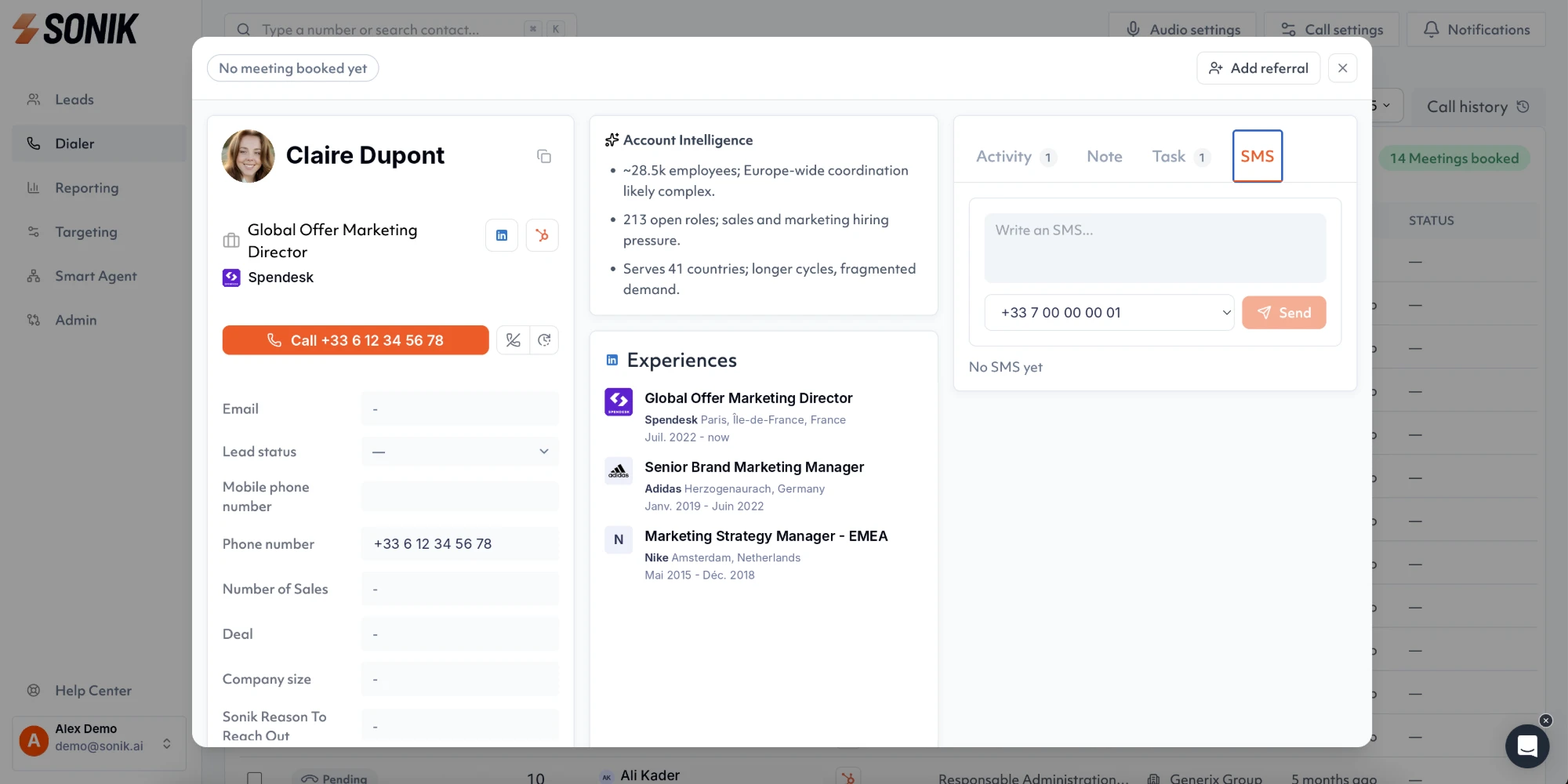
Sonik shows the rep who they are about to speak to: role, past experiences, and the signals on the account, such as a new executive, a champion who changed company or a visit to the pricing page. A new head of sales is a possible economic buyer in growth mode. A former customer who just joined is a ready-made coach. Sonik then makes calling several people in the same account practical, because parallel dialing gives around 5x more conversations per session.
Conclusion
Miller Heiman comes down to a question you can ask of any deal: who are the four influences, and what does each one win? This week, take your largest open opportunity and write one name against each role. Every blank is your next call.