Get started
Still unsure of the impact of Sonik?
See it for yourself and ask for your free trial


The fastest way to succeed as a new SDR is to stop measuring yourself on dials and start measuring yourself on conversations. Aim for 20 real conversations a day, call in the slots where people pick up, open with a trigger instead of a pitch, and ask questions that start with "how". Do that for 90 days and the meetings follow.
Here is what we tell every SDR who joins a Sonik customer, with the numbers from our analysis of 1,000,000 B2B cold calls in France.
Most new SDRs quit on themselves in week three because they expected cold calling to feel better than it does. It does not. The average connect rate in our French benchmark is 11.3%. Nine calls out of ten end in voicemail, a gatekeeper or a hang-up, and that is normal.
So set your expectations on the real funnel. At 11.3%, 20 conversations a day means roughly 180 dials. Hand-dialing, that is impossible. On a parallel dialer, it is a morning and an afternoon block.
In our experience, most connects happen within the first three attempts. Translation for a new rep: the second and third call are where your results live, not the first.
New SDRs call whenever they have a gap in the calendar. Top SDRs call when the prospect has a gap in theirs.
In our data, 4pm is the best slot across personas at 15.8% connect, then 10am at 14%. 8am is the worst at 9.8%. Founders pick up more around 10am, marketing leaders around 4pm, HR around 1pm. Sales and leadership roles connect above 15% overall.
Build your day around that. Prep lists and send emails at 8am. Dial at 10am. Research at 2pm. Dial again at 4pm. If your manager lets you keep one habit from this article, keep this one.
65% of reps in our benchmark open the call by explaining what their company does. It is the most natural thing in the world and it is the worst opener available.
Trigger-based openers (a job change, a hiring wave, a website visit, a closed-lost deal from last year) reach a 7-10% meeting rate. Pitch-first openers sit at 2-3%. Same rep, same list, three times the meetings.
A trigger opener is one sentence: the reason you called them today, specifically. Then a question. The pitch can wait until they ask.
Discovery questions that start with "how" lift conversion by 190% in our data. "How are you handling outbound today?" beats "Are you happy with your outbound?" every time, because the first one cannot be answered with "yes".
Same logic on objections. When a prospect says "we already have a tool", do not answer. Ask "what do you mean?" first. Reps who do this convert 197% better than reps who launch into a rebuttal. Half the time the objection was not an objection, it was a reflex.
Reps use about 20% of the signals already sitting in their CRM. The other 80% is where the easy meetings are: dormant leads, closed-lost deals, past website visitors, contacts who changed job.
A cold call to a known contact that opens with "how have you been?" reaches about 10% success, against roughly 1.5% for a standard cold open. At Sonik, 50% of our own pipeline comes from signals that were already in the CRM. As a new rep, you do not need a new database. You need a filter on the old one.
These are the milestones we see with European SDRs who ramp well on Sonik. Treat them as a guide, not a quota.
Three habits separate the reps who hit these from the ones who do not. They log every outcome honestly, including the bad calls. They ask for help in week one instead of week eight. And they protect their calling slots from meetings, Slack and "quick questions".
Benoit, our founder, started as an account executive at Google Cloud and took a quota from €1.5M to €10M over five years. His one regret about year one: he treated every "no" as information about himself instead of information about the call.
A "no" at 8am from an HR director is mostly a timing problem. A "no" after a pitch-first opener is mostly an opener problem. A "no" from a prospect who never visited your website is a list problem. Once you can name the problem, you stop taking it personally and start fixing it. That shift, more than any script, is what got him through the first year.
Sonik is built so that a new rep spends the day in conversations, not in the ringtone. The parallel dialer gives reps about 5x more conversations than manual dialing, which is how 20 conversations a day becomes realistic in week four instead of month six.

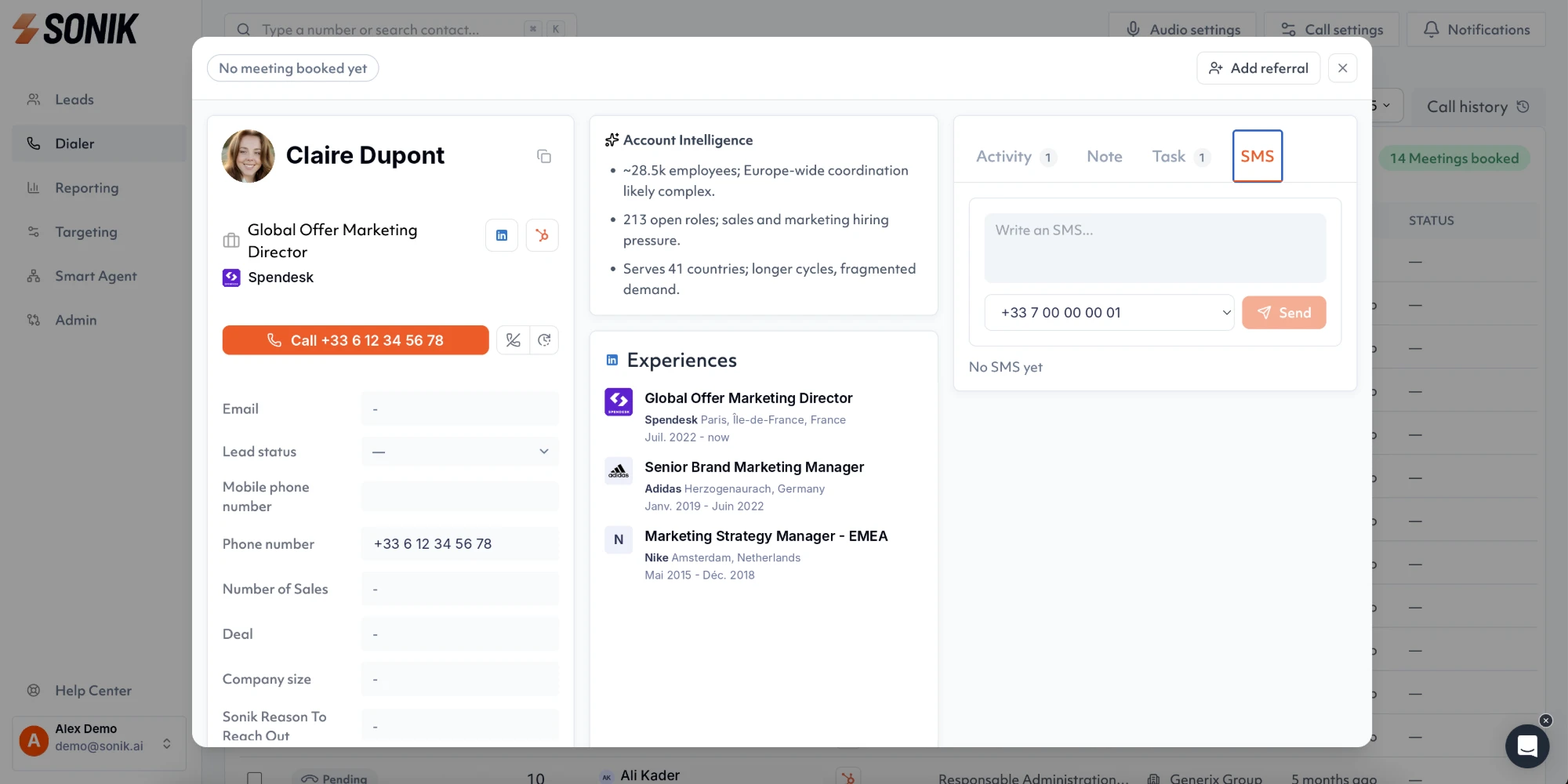
Before each session, the AI call prep summarises the account and the trigger, so the opener writes itself. Signals from the CRM (website visits, job changes, dormant leads, closed-lost) are surfaced as lists, so a new rep starts on the warmest contacts rather than the coldest. See how signals work.
After the call, the coaching layer flags the opener type and the question types used, which is exactly the feedback a new rep needs daily and a manager can only give weekly.
New SDRs do not fail for lack of effort. They fail because they measure the wrong thing, call at the wrong time and open with the wrong sentence. Fix those three and the first 90 days get much kinder. This week, pull your last 20 calls, count how many opened with a trigger versus a pitch, and rewrite the pitch ones.

