
'No Budget' and 'Bad Timing': Cold Call Answers That Work

On a cold call, "no budget" and "bad timing" rarely describe a budget or a calendar. They describe a prospect who has not yet heard a problem worth paying for or worth doing now. The answer is not to argue about money or dates: ask one clarifying question, sell the meeting and not the product, and leave with a dated callback tied to a real event.
Why these two objections are different on a cold call
In a late-stage deal, "no budget" is a negotiation. On a cold call, it comes in the first minute, before any price has been mentioned. The prospect cannot know whether they can afford something they have not seen.
So the sentence means one of three things. "I do not see the problem." "I see the problem, but it is not mine to fund." Or, more rarely, "we really have frozen spending until a known date."
"Bad timing" works the same way. It can mean "I am walking into a meeting", "we have a project that blocks everything until March", or simply "please go away politely".
You cannot answer correctly until you know which version you got. That is why the first move is always a question.
Ask before you answer
In our benchmark of 1,000,000 B2B cold calls in France, asking "What do you mean?" before responding to an objection lifts conversion by 197%. It is the single most profitable habit in objection handling, and it costs four words.
Adapted to these two objections, it sounds like this:
- Budget: "Understood. When you say no budget, is it that the line is closed for this year, or that this is not a priority that would get one?"
- Timing: "Fair. Bad timing this week, or is there something running until a certain date?"
Then stop talking. The answer tells you whether to continue, reschedule or leave. Most reps skip this step and launch into a return-on-investment speech for a prospect who only meant "I am late for a meeting".
Four ways to answer "no budget"
1. Remove the money from the conversation
"That makes sense, and I am not asking for budget today. I am asking for 20 minutes to see whether the problem exists on your side. If it does not, you will have saved the budget discussion entirely." A cold call sells a meeting. A meeting is free.
2. Ask how the problem is paid for today
"How are you handling it at the moment?" Every problem already has a cost: a tool, an agency, hours from the team. Discovery questions starting with "how" lift conversion by 190% in our data, and this one moves the discussion from new spend to existing spend.
3. Find the budget cycle
"When do you build next year's budget?" In our experience, many French and European companies on a calendar fiscal year draft budgets in the autumn and lock them before year end. A call in October that ends with "we are deciding in November, call me on the 5th" is a good call. The same call in February needs a different question: "What would have to be true for this to be in the next cycle?"
4. Check who owns the money
"If it were a priority, would the budget sit with you or with someone else?" Sometimes "no budget" means "not my budget". You have the right account and the wrong person, and the prospect can often tell you who to call. Thank them, ask whether you may mention their name, and dial.
Four ways to answer "bad timing"
1. Offer two dated slots
"No problem. Thursday at 10 or next Tuesday at 4?" A "later" without a date is a no. Two concrete slots turn it into a decision, and the prospect who chose the time usually shows up.
2. Name the blocking event
"What is the thing that needs to finish first?" A migration, a reorganisation, a funding round, a hiring plan. Once you know the event, you know when to call back and what to open with.
3. Shrink the ask
"Then one question and I let you go: how many real conversations does each of your reps get per day?" If the answer reveals a problem, the timing often improves on its own. If it does not, you have lost 20 seconds.
4. Leave cleanly
When the freeze or the project is real, do not push. "Understood. I will not chase you. I will call back when the migration is done in April." Log the date and the reason. A respectful exit is the first half of your next call.
When the objection is true
Sometimes there really is no money and no time. A hiring freeze, a company in the middle of a restructuring, a budget that was cut last month. Arguing here damages the relationship and wastes your calling block.
The test is simple. If the prospect gives you a specific reason and a specific horizon, believe them. If the answer stays vague after your clarifying question, it was a reflex, and one of the replies above is worth trying once. Once, not three times.
Hear both objections less often
Most "no budget" and "bad timing" responses are caused before the prospect speaks.
- The opener. 65% of reps open by explaining what they sell. A product pitch invites a purchase objection. Trigger-based openers reach a 7-10% meeting rate against 2-3% for pitch-first openers, partly because a prospect who hears their own situation does not reach for the budget excuse.
- The slot. Connect rates run from 9.8% at 8am to 15.8% at 4pm in our benchmark. Founders pick up more around 10am, HR around 1pm, marketing around 4pm. Someone reached at their natural slot is less likely to say "not now".
- The list. A company that just hired, raised or visited your site has a reason to act this quarter. A random account from a purchased list does not.
How Sonik approaches budget and timing objections
We treat both objections as a list problem first. The signal engine builds call lists from website visitors, job changes, closed-lost deals, dormant leads and social intent, so the first sentence of the call carries a reason that is about the prospect's quarter and not about our product.
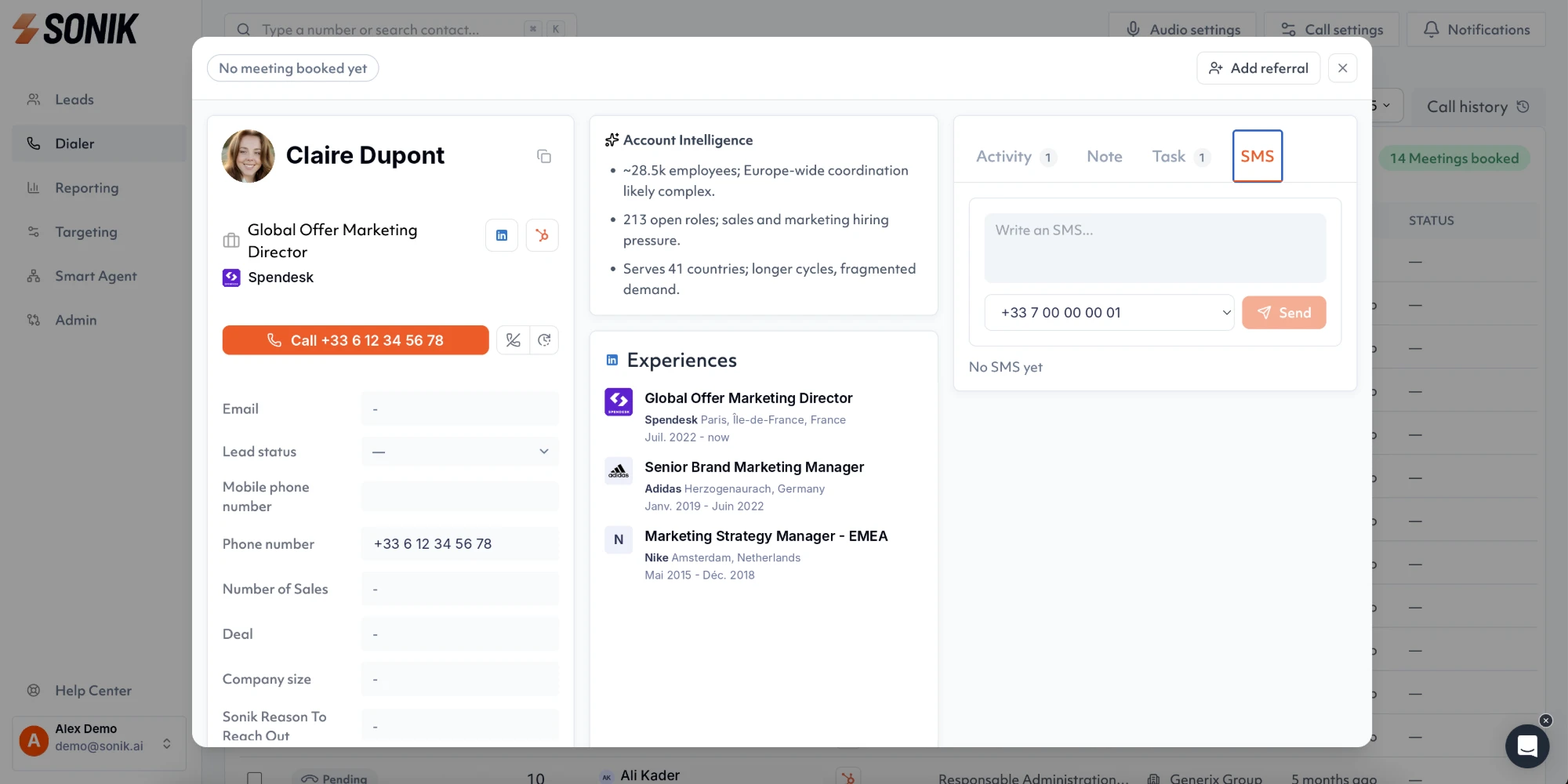
AI call prep puts the account context in front of the rep before the pickup, which is what makes a clarifying question specific. After the call, AI coaching lets a manager review how the rep reacted when the objection came: question first, or pitch first.
When "call me in the spring" is logged, the callback is not cold any more. Calls that open with "How have you been?" to a known contact reach about 10% success in our benchmark, against roughly 1.5% for a standard cold open. The dormant lead playbook starts with exactly these contacts.
Conclusion
"No budget" and "bad timing" on a cold call are usually reflexes, and a reflex is handled with a question, not a counter-argument. Ask what the prospect means, sell the meeting instead of the product, and leave with a date and an event. This week, pull your last ten calls that ended on one of these two objections and count how many times the rep asked a clarifying question before answering. That number is your starting point.