Get started
Still unsure of the impact of Sonik?
See it for yourself and ask for your free trial


An outbound sales strategy in 2026 is a system with five parts: a target list built from signals, a channel order that starts with the phone, a cadence that coordinates the channels, a daily conversation target per rep, and a weekly review of pipeline created rather than activity. In Europe, where cold email deliverability has fallen and GDPR shapes what you can send, the phone is the channel that still scales. Here is the plan we run and the math behind it.
Outbound used to be a volume game: more contacts, more sequences, more reps. That stopped working for three reasons.
Inboxes closed. Spam filters, AI-sorted inboxes and sender-reputation rules mean a cold email to a French director is more likely to land in a folder nobody opens than on a screen. Connect rates fell too, but less than people think: across 1,000,000 B2B cold calls in France we measured an 11.3% average, with persona and time slot pushing it to 15 to 20%. We detailed the numbers in the real cold call connect rate in B2B.
Lists got worse. The same few hundred thousand European SaaS decision makers are in every database, and everyone calls them. Fit alone is no longer a reason to call.
And in Europe, GDPR plus national rules (in France, B2B cold calling is legal under legitimate interest with a clear opt-out; consumer rules such as Bloctel do not apply to professional numbers) favour a channel where a human says who they are and why they are calling. The phone is compliant by design when run properly.
Fit tells you who could buy. A signal tells you who might buy this quarter.
The signals we use, in order of strength: a closed-lost deal reaching 6 to 12 months, a champion who changed jobs, a visit to your pricing page from a target account, a hiring post for the role your product serves, a new executive in the function you sell to, a dormant lead who went quiet after a demo.
Reps use about 20% of the signals already in their CRM. At Sonik, half of our own pipeline comes from the other 80%. Before buying intent data, mine the CRM you already pay for.
Channel order matters more than channel count.
Phone first, because it is the only channel where qualification happens in real time. A trigger-based opener ("I saw you are hiring three SDRs") reaches a 7 to 10% meeting rate per conversation in our benchmark, against 2 to 3% for a pitch-first opener. No email gets near that.
Email second, sent an hour before the call slot, so the name is familiar when the phone rings. LinkedIn third, for the contacts who did not pick up after three attempts. In our experience, most connects happen within the first three attempts; the cadence should be built around that number.
The number that drives the whole strategy is conversations per rep per day. Not dials, not emails sent.
Our north star is 20 conversations a day per SDR. With a manual dialer at 11.3% connect, that takes about 180 dials and most of the day. With parallel dialing, reps get about 5x more conversations per hour, and 20 conversations fit in two calling blocks: 10am and 4pm, the two best slots in our data at 14% and 15.8%.
The math from there: 20 conversations a day, a 7% meeting rate on trigger-based openers, 1.4 meetings a day, roughly 25 a month per rep. A team of four books 100 meetings a month without a new hire. The same team on pitch-first openers at 2.5% books 36. Opener quality is worth more than two extra reps.
A sequence sends touches on a schedule. A cadence changes the next touch based on the last one.
Our cadence for a signal-based list: day 1 email then call; day 2 call at a different slot; day 4 call plus a voicemail that references the email; day 7 LinkedIn note; day 10 last call; then nurture until the next signal. Every touch references the same trigger. A pickup on any day ends the cadence and starts a conversation; a callback is answered within the hour because it is the warmest contact you have.
Activity dashboards reward the wrong thing. Review four numbers every Monday, per rep:
When the fourth number is low and the first three are fine, the problem is the list. When the second is low, listen to ten openers. When the first is low, it is the dialer or the calendar. The strategy is the diagnosis loop, not the document.
Sonik is built around the five parts above. Signals from the CRM (website visitors, job changes, closed-lost anniversaries, dormant leads, social intent) feed lists that refresh themselves. The parallel dialer runs the calling blocks and gives reps the 5x conversations the daily target needs.

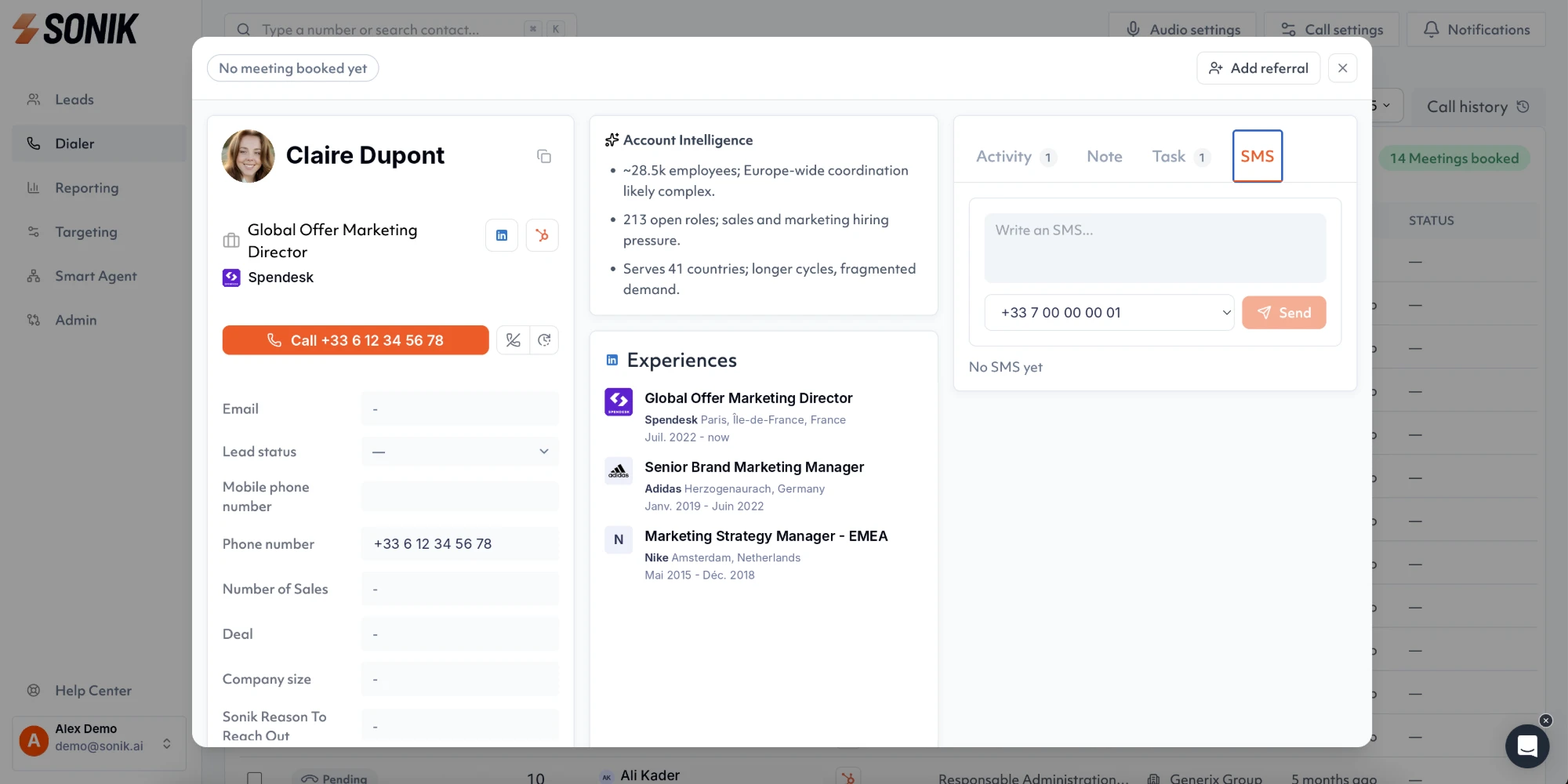
AI call prep puts the trigger and the last interaction on screen as the line connects, so the opener is trigger-based by default. Recordings, summaries and the weekly numbers above sit in one view, so the Monday review takes 20 minutes rather than a RevOps export.
We run our own outbound this way, in France first, and it is where half of our pipeline comes from.
An outbound strategy for 2026 is signals, phone first, a coordinated cadence, 20 conversations a day and a weekly pipeline review. The numbers favour conversation quality over headcount. This week, count your team's real conversations per rep per day. If it is under ten, that is the first thing to fix, before any new tool, list or hire.

