Get started
Still unsure of the impact of Sonik?
See it for yourself and ask for your free trial

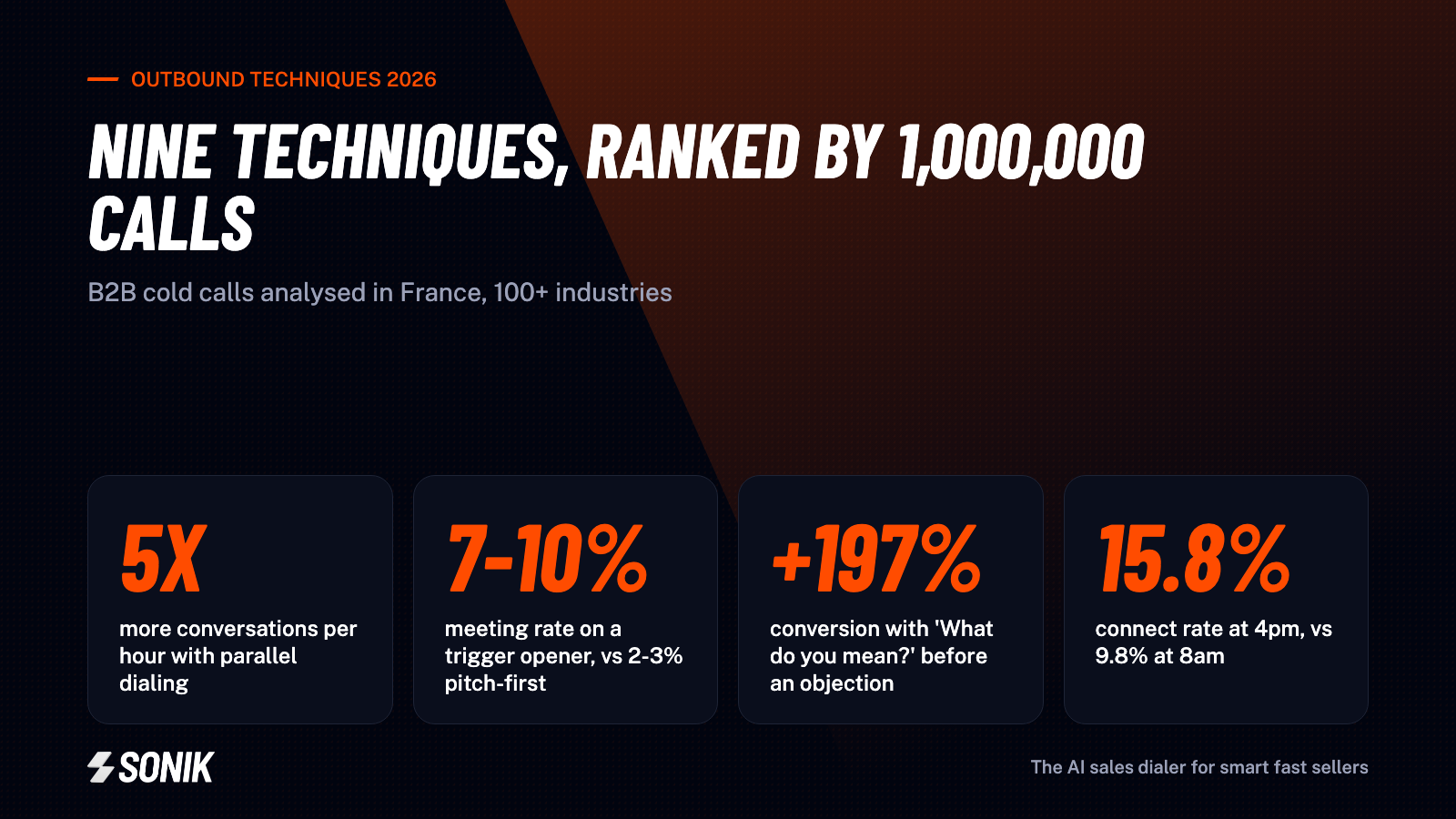
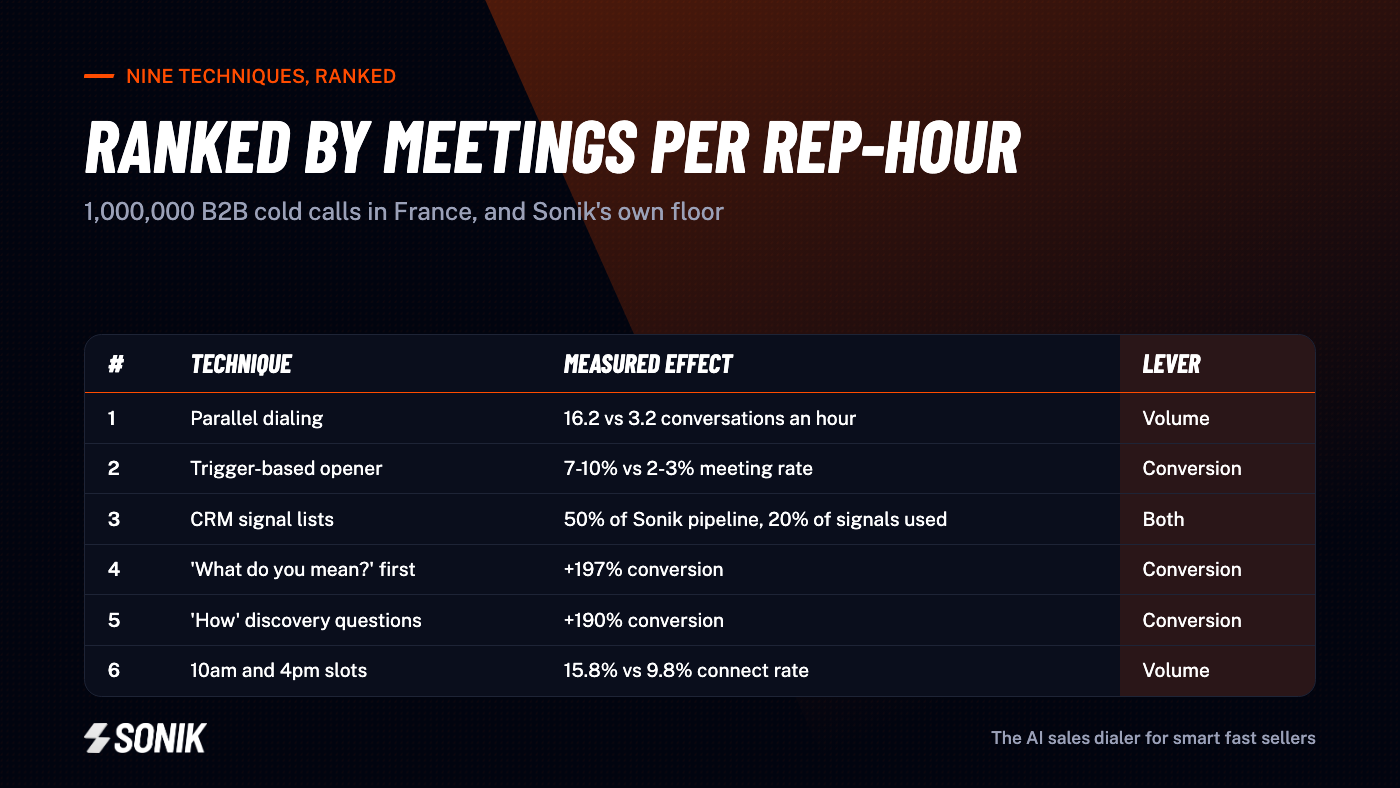
The most effective outbound sales techniques in 2026 are the ones that raise the number of real conversations and the share of those conversations that become meetings: parallel dialing, trigger-based openers, lists built from CRM signals, the "What do you mean?" objection move, "how" discovery questions, calling in the 10am and 4pm slots, callbacks on hot numbers, a phone-first cadence and multithreading. We ranked these nine by the effect we measured across 1,000,000 B2B cold calls in France and on our own floor. Each one comes with its number, how to run it and the trap that cancels it.
Two things changed the ranking. Email reply rates on cold sequences fell from around 5% to around 1% over the last few years, in our observation, and mobile pickup fell from 20 to 30% to around 10%. Techniques that depended on volume alone stopped paying. Techniques that create a conversation, or make a conversation count, moved up.
So we rank by one outcome: meetings per rep-hour. A technique climbs the list if it multiplies conversations (volume) or multiplies the share of conversations that book (conversion), on the whole list rather than on a subset. The first seven carry a Sonik benchmark number. The last two are ranked on our experience, and we say so.
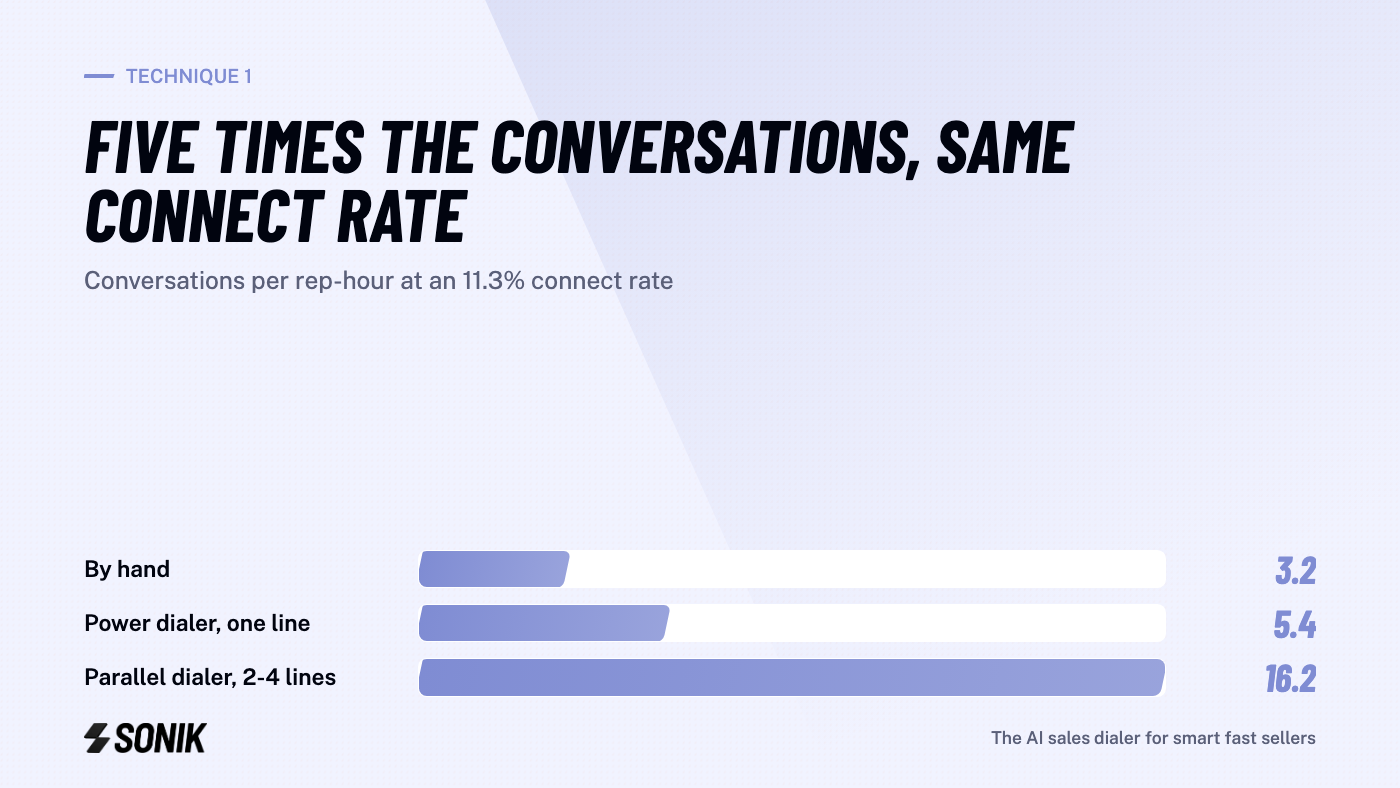
The number. A rep dialing by hand holds about 3.2 conversations an hour. A power dialer on one line gets 5.4. A parallel dialer on two to four lines gets 16.2, five times the manual figure, at the same 11.3% connect rate.
How to run it. Two to four lines on cold persona lists, one or two lines on signal lists where the opener must be personal. The four-line brief (name, trigger, last touch, one question) is on screen when the line connects.
The trap. Running four lines on a list of 40 named accounts and opening cold on a champion who changed jobs. Volume on the wrong list burns the list. The math is in how the Sonik dialer works.
The number. 65% of reps open by explaining what they sell. Those calls book 2 to 3% of the time. Opening on a trigger (a hire, a job change, a pricing page visit) books 7 to 10%.
How to run it. The first sentence names the trigger and nothing else. "I saw you hired two SDRs in September" is an opener. "We help companies like yours" is not.
The trap. A fake trigger. "I saw you're growing" is a pitch wearing a trigger's clothes, and prospects hear it at once.
The number. Reps use about 20% of the signals already sitting in their CRM. 50% of Sonik's own pipeline comes from signals that were already in the CRM: closed-lost deals at 6 to 12 months, champions who changed jobs, dormant leads after a demo, website visitors from target accounts.
How to run it. Before buying any intent data, build five saved views in HubSpot or Salesforce, one per signal, and call them every morning before the cold persona list. A signal list is small, 20 to 40 contacts, and it is called on one or two lines.
The trap. Treating a signal list like a cold list: parallel dialing it at four lines and opening with the pitch. The signal is the opener.
The number. Reps who ask "What do you mean?" before answering an objection convert 197% better than reps who answer it straight away.
How to run it. "We already have a tool" gets "What do you mean?", not a comparison. Often the real objection is different from the stated one, and it comes out on the second pass.
The trap. Using it on every objection as a reflex, including "I'm in a meeting", which is not an objection. It works on substance, not on timing.
The number. Discovery questions that start with "how" lift conversion by 190% against closed questions.
How to run it. "How do you handle outbound today?" rather than "Do you do outbound?". Three "how" questions in a two-minute cold call is the target. Write them on the brief before the block.
The trap. Asking a good question and answering it yourself when the prospect pauses. Count three seconds.
The number. 4pm connects at 15.8%, 10am at 14%, 8am at 9.8%, against an 11.3% average. Founders pick up most around 10am, marketing around 4pm, HR around 1pm. Sales and leadership run above 15% overall.
How to run it. Two fixed blocks a day for every rep, 10am and 4pm, in the calendar as meetings nobody can book over. Persona lists sorted by their slot.
The trap. Calling when it suits the rep: 8am before the day starts, or 6pm after it ends. Connect rate is an input you choose, not a result you suffer.
The number. A cold call that opens with "How have you been?" to a contact who already knows you books around 10% of the time, against roughly 1.5% for a standard cold open on the same persona.
How to run it. Every number that picked up once goes on a hot list, called back at the same slot within 48 hours. Every contact with a past conversation, a demo or a closed-lost deal gets the known-contact opener, never the cold one.
The trap. Letting hot numbers sit in the same sequence as cold ones, so a contact who spoke to you on Tuesday gets a stranger's opener on Thursday.
The number. We have no benchmark figure for cadence order, so this is experience. With email replies near 1%, the email's job is no longer to get a reply. Its job is to be referenced in the opener three hours later.
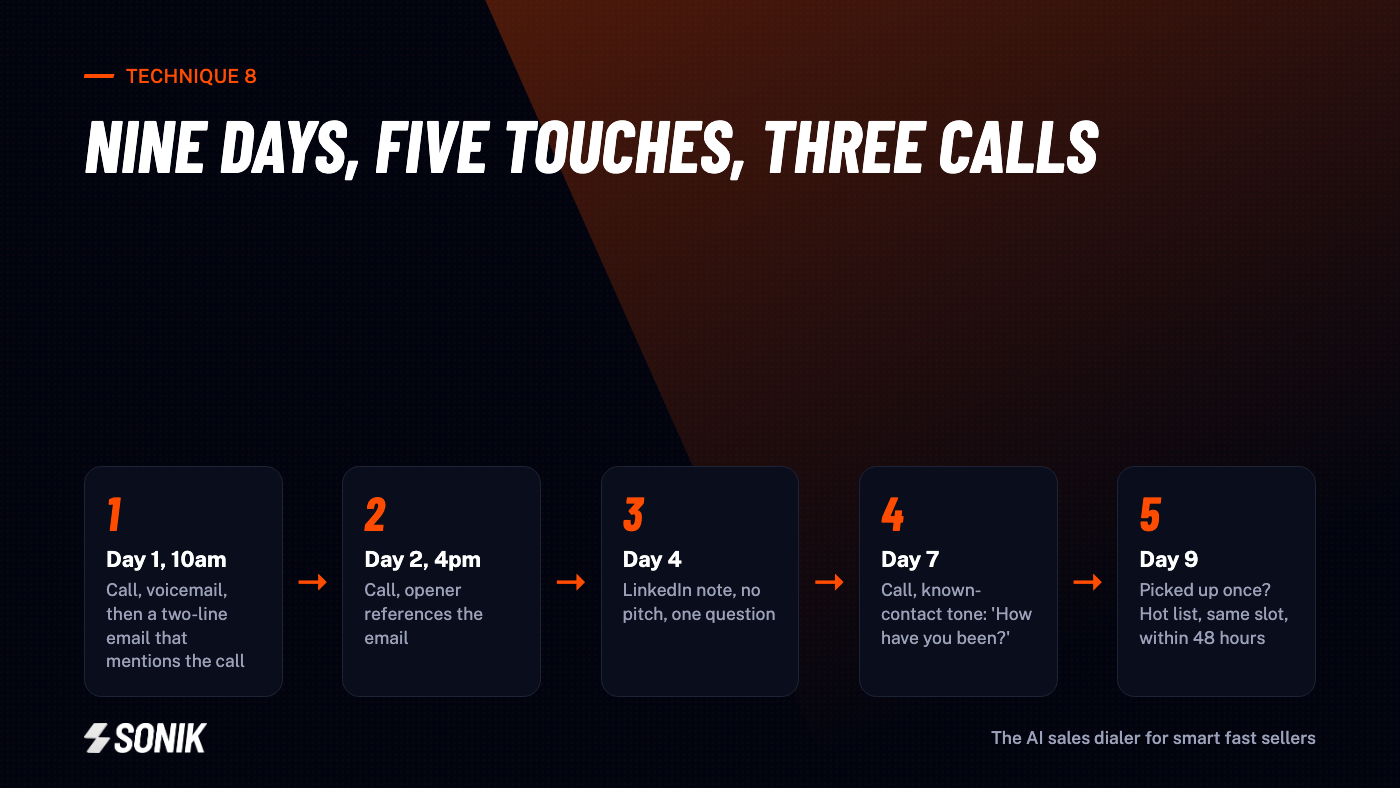
How to run it. Day one: call at 10am, voicemail, then a two-line email that mentions the call. Day two: call at 4pm, opener references the email. Day four: a LinkedIn note, no pitch. Day seven: call, known-contact tone. Nine days, five touches, three of them calls.
The trap. The email-first sequence with the call at step six, by which point the prospect has deleted five emails and the rep is the sixth stranger.
The number. Experience again, not benchmark. At Google Cloud my quota went from 1.5 million to 10 million euros in five years, and no deal above a million ever closed through one contact. The outbound version is the same rule applied earlier.
How to run it. For any account worth a meeting, call two people: the user of the problem and the owner of the budget. Different trigger, different question, two days apart. The second call opens with "I spoke to your colleague on Tuesday".
The trap. Three contacts, the same pitch, the same afternoon. They sit in the same meeting and compare notes.
A technique is only effective if it survives a Tuesday. Here is what a good block looks like on our floor: 127 dials, 10 conversations and 0.66 meetings per hour, on a parallel dialer, with the signal list called first on two lines and the persona list after on four.
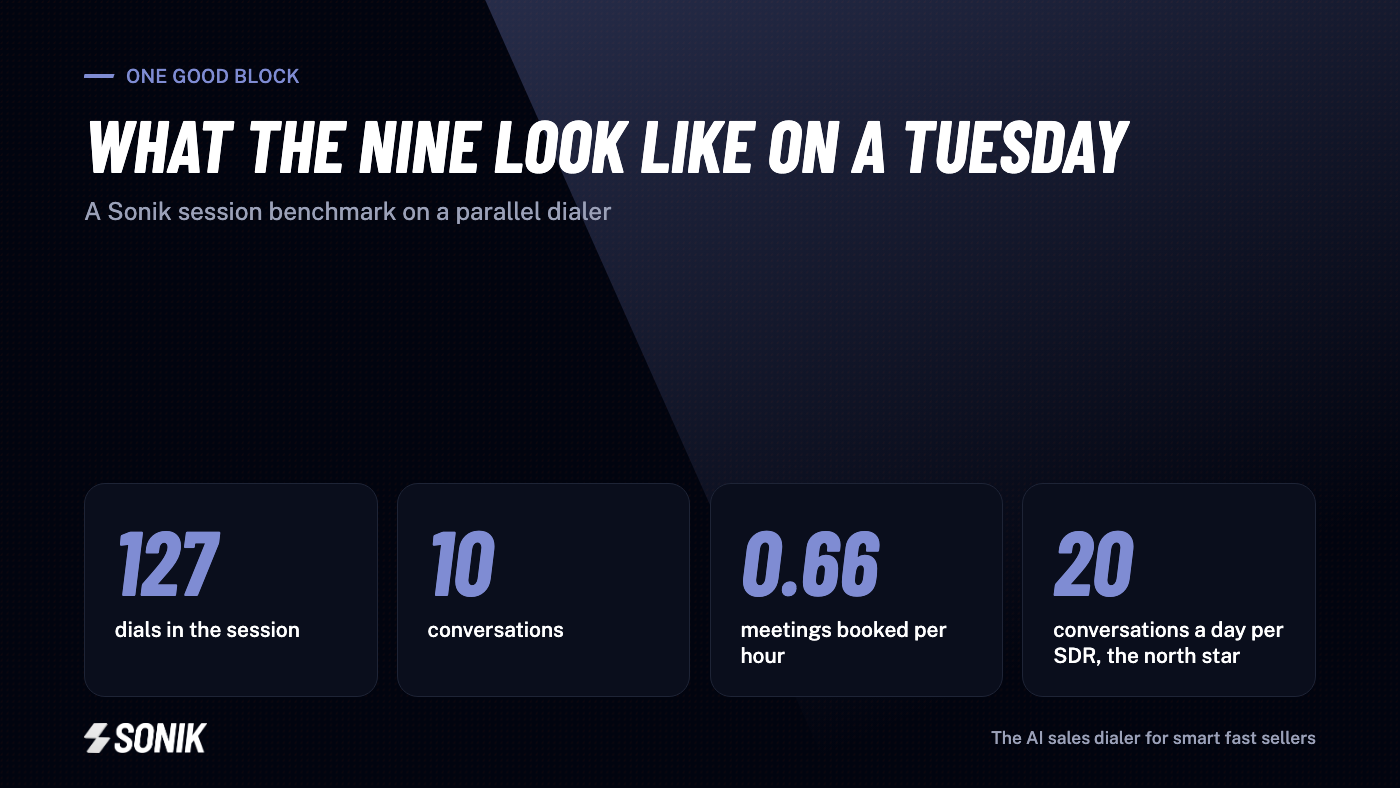
The north star for each SDR is 20 conversations a day, which two 90-minute blocks at 10am and 4pm deliver on a parallel dialer and never deliver by hand.
When I started calling for Referly after five years of running accounts, I ran that 127-dial session every week and booked badly for a month. The dials were not the problem. I was pitching first and asking closed questions, and the recordings showed it in a day. Techniques two, four and five fixed it.
Sonik is an AI sales dialer built around the ranking above. The list comes from the CRM signals first: closed-lost, job changes, website visits, dormant leads, surfaced from HubSpot or Salesforce rather than bought. At connect, the contact view shows the trigger, the account intelligence and the last interaction, so the opener is trigger-based by default and the "how" questions are on the brief.


The session itself runs in parallel, with live statuses and the running count of meetings, and the hot list (numbers that picked up, callbacks due) sits at the top of the next block. Every call is recorded and scored on the behaviours in this article, so a manager sees which rep is still pitching first without listening to 300 calls.
We run our own outbound this way, in France first, with a team that is partly remote and trains three times a week.
Yes, and in Europe it is the channel that held up best. Connect rates are 11.3% on average and above 15% for sales and leadership personas and for the 4pm slot, while cold email replies fell to around 1% in our observation. The phone is also the only channel where qualification happens in the same minute as the first contact.
We have no benchmark figure for touch count, so this is experience: five touches over nine days, three of them calls, with the email and the LinkedIn note written to be referenced on the phone. More touches on a list that does not pick up is a list problem, not a cadence problem.
The trigger-based opener, because it is the largest single lift on conversion (7 to 10% against 2 to 3%). Then "how" questions. Parallel dialing comes once the opener is right, because it multiplies whatever the rep does, good or bad.
The benchmark is French and B2B, and the slot and persona numbers will shift by market. The behaviours are about how people respond to a stranger on the phone, and the teams we work with in Belgium, Switzerland and Germany see the same direction. Measure your own slots for a month before copying ours.
The outbound techniques that work in 2026 either multiply conversations or multiply the share of conversations that book. This week, pick technique two: listen to ten of your team's openers and count how many name a trigger before they name the product.

