Get started
Still unsure of the impact of Sonik?
See it for yourself and ask for your free trial


A rep on a parallel dialer gets 16.2 live conversations an hour. On a power dialer, 5.4. Dialing by hand, 3.2. Those are the numbers from the 1,000,000 B2B cold calls we analyzed with Katana, and they say something uncomfortable: the dialer, not the script, decides how much of the day your reps actually spend selling.
When a cold calling team misses its number, most Heads of Sales reach for the same levers. A new incentive. A higher daily call target. Another cadence. Version 14 of the script.
We would start somewhere more basic: the tool reps use to place the calls. A script only works once someone picks up, and the dialer decides how often that happens in a given hour.
If your SDRs are still dialing one number at a time, you are sending them into a Formula 1 race on a bicycle, then wondering why they are not going faster.
Here is what the benchmark shows, per rep and per hour of calling. Same rep, same hour, same market. Only the machine changed.
That is roughly 5x more live conversations than manual dialing and 3x more than a power dialer. Over a 4-hour calling block, the difference is 13 conversations versus 65. Over a month of 20 calling days, it is 260 versus 1,300.
A conversation here means a live pickup by a person. Not a voicemail, not an IVR, not a ring-out. The number says nothing about the quality of what happens next. It only says how many times per hour the rep gets the chance to do their job.
Across the 1M calls, the average connect rate is 11.3%, with a range of 11% to 20% depending on persona and time slot. Teams calling colder lists often sit well below that. At a 5% pickup rate, 95% of attempts never turn into a conversation.
Picture what that means for a rep dialing manually. For every 100 numbers, 95 attempts are rings, voicemails and wrong numbers, and the rep sits through all of them. That is most of the day spent listening to nothing.
Software can handle that part. The rep's time is worth far more once someone answers. That is where they listen, challenge, handle objections and sell. A better script will not compensate for a dialing setup that keeps reps waiting for most of their shift.
The trend is not helping. In our experience, most connects happen within the first three attempts. Reaching one person takes several tries, and every try on a manual or power dialer is time the rep spends not talking. We go deeper on the connect rate itself in what is the real cold call connect rate in B2B sales.
Do not take our number on faith. Pull yours. It takes 20 minutes.
If your team is at 3 and the team down the street is at 15, you will see the difference in pipeline within a quarter. The question then is not how to motivate your reps harder. It is how long you can keep the same call target when competitors give their reps 5x more live conversations per hour.
Sonik is a parallel dialer built for B2B outbound teams, France and Europe first. It rings several lines at once, detects voicemails and IVRs, and only hands the call to the rep when a human picks up. That is where the 5x comes from, and it is the data we walk through with Quentin Despas in the benchmark.

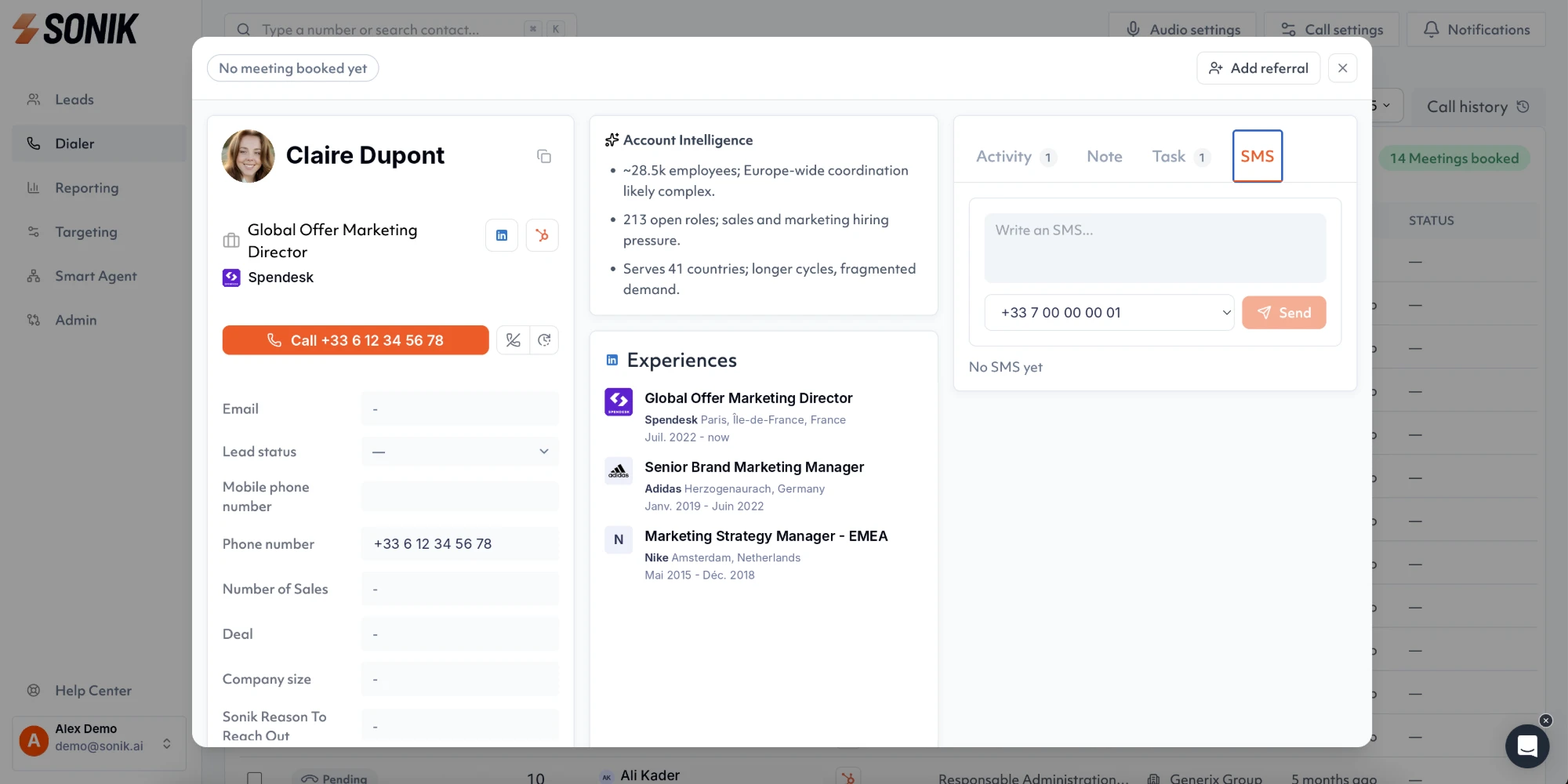
The dialer is fed by CRM signals: website visitors, job changes, closed-lost deals, dormant leads, social intent. 50% of our own pipeline comes from signals that were already in the CRM, so the 5x applies to contacts with a real reason to be called.
Before each connect, AI call prep puts the trigger and the account context on the rep's screen, so the pace of a parallel dialer does not turn into 16 rushed calls an hour. Our north-star funnel is 20 conversations per day per SDR, for 2x more meetings. Details on the Sonik dialer page.
The dialer sets the ceiling on how many times a day your reps can sell. Manual gets you 3.2 conversations an hour, a power dialer 5.4, a parallel dialer 16.2. This week, export one rep's call logs, count the live pickups and divide by calling hours. If the number starts with a 3, no script will fix it.

