Get started
Still unsure of the impact of Sonik?
See it for yourself and ask for your free trial

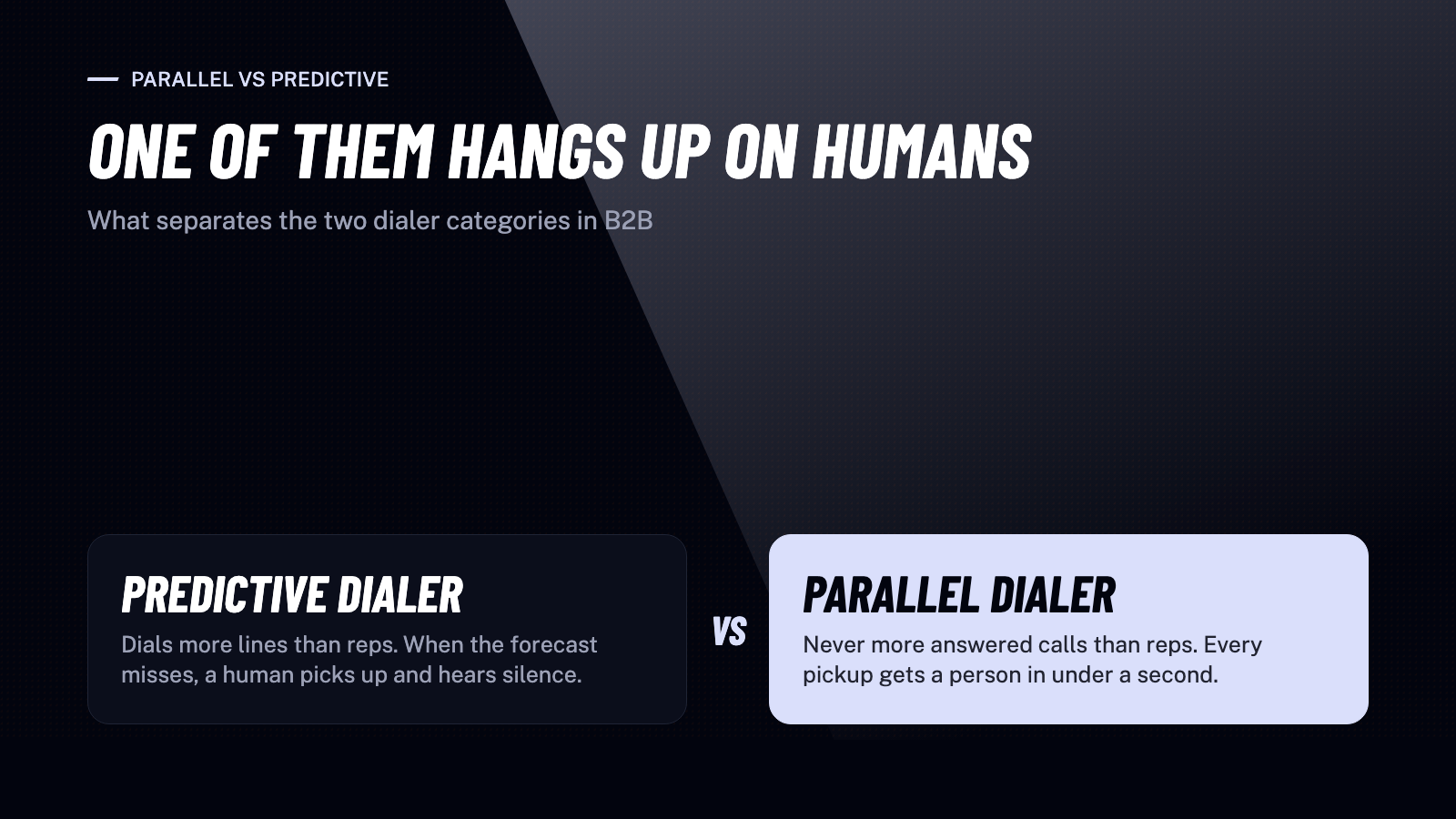
A predictive dialer places more calls than it has reps and drops the extra humans who answer. A parallel dialer never dials more answered calls than it has reps, so every pickup gets a person. That one design choice explains why B2B teams in France and Europe are leaving predictive dialing: the volume gap has shrunk to almost nothing, and the reputation and compliance gap has not.
Both dial several numbers at once. Both use voicemail detection. Both show a prospect's screen when a call connects. The difference is in the ratio of lines to reps.
A predictive dialer runs a forecast. It looks at the average answer rate, the average call length and the number of reps free, then dials enough lines so that, on average, a rep is free when someone answers. On average is the problem. When two people answer and one rep is free, the second person hears silence, then a click. That is an abandoned call.
A parallel dialer runs no forecast. One rep, 2 to 5 lines, and only that rep's lines. When a human answers, the rep is bridged in under a second. If a second human answers on another of the same rep's lines in the same instant, the dialer drops that line before the greeting finishes or schedules a callback. The rep is never double-booked, and no one is left waiting for a person who is not there.
Predictive dialing was built for contact centers with 50 reps reading the same script to consumer lists. With that many reps, the forecast is accurate: answers arrive in a smooth stream and a 2 or 3% abandon rate is the price of keeping every seat busy. For debt collection, surveys or appointment reminders, that trade-off still makes sense.
It breaks for a B2B team of 5 SDRs. With few reps, answers arrive in clusters, not streams. A 10am block to founders can see three pickups in the same ten seconds (founders pick up most around 10am in our benchmark). The forecast cannot smooth that, so the abandon rate climbs, and in our experience teams see it well above the 3% that US and UK regulators tolerate.
The historical case for predictive was volume: more lines than reps means more dials per hour. That advantage has mostly gone, because parallel dialers added lines.
Our analysis of 1,000,000 B2B cold calls in France puts the average connect rate at 11.3%. On a 4-line parallel dialer a rep gets through 150 or more dials an hour and holds 10 to 15 conversations, which is the limit of what one voice can do. A predictive dialer cannot push that rep past the same ceiling. It only changes who waits: the prospect instead of the rep.
Our north star is 20 conversations per SDR per day. Parallel dialing gets reps there, which is why we say parallel dialing gives 5x more conversations than manual dialing. Predictive adds nothing on top, except abandoned calls.
US guides quote the FCC's 3% abandoned-call cap per campaign and statutory damages per call. The French and European picture is different, and in some ways stricter.
Our view: the fine is the smaller risk. The bigger one is your number reputation. A flagged French mobile number can lose half its connect rate in a week, and that loss hits every rep on the team.
Put yourself on the receiving end. A predictive dialer gives a CFO a ring, a pause, a click. The next time your number shows, it is already a spam call in their mind. A parallel dialer gives the CFO a ring and a person who says their name within a second, with the trigger ready: "I saw you opened a Paris office last month."
That second scenario is where meetings come from. Trigger-based openers reach a 7 to 10% meeting rate in our benchmark against 2 to 3% for pitch-first openers. You cannot run a trigger-based opener if the dialer decides who talks to whom after the pickup.
Sonik is a parallel dialer by design: up to 4 lines per rep, never more answered calls than reps, and an abandoned-call counter visible to managers. We chose that architecture because our customers call French and European B2B decision-makers where the number reputation is the asset to protect.

Each pickup lands with the contact's CRM signals on screen (website visit, job change, closed-lost, dormant lead) and an AI summary goes back to HubSpot or Salesforce after the call. Numbers are genuine French and EU numbers the customer owns, which is what the 2024 caller authentication rules require.
More on the architecture on the dialer page.
Predictive dialing optimises rep utilisation and pays for it with abandoned calls. Parallel dialing optimises conversations and never hangs up on a human. For a B2B team calling European decision-makers, that is not a close call. This week, ask your current dialer vendor for your abandoned-call rate over the last 30 days. If they cannot give it to you, you have your answer.

