Get started
Still unsure of the impact of Sonik?
See it for yourself and ask for your free trial

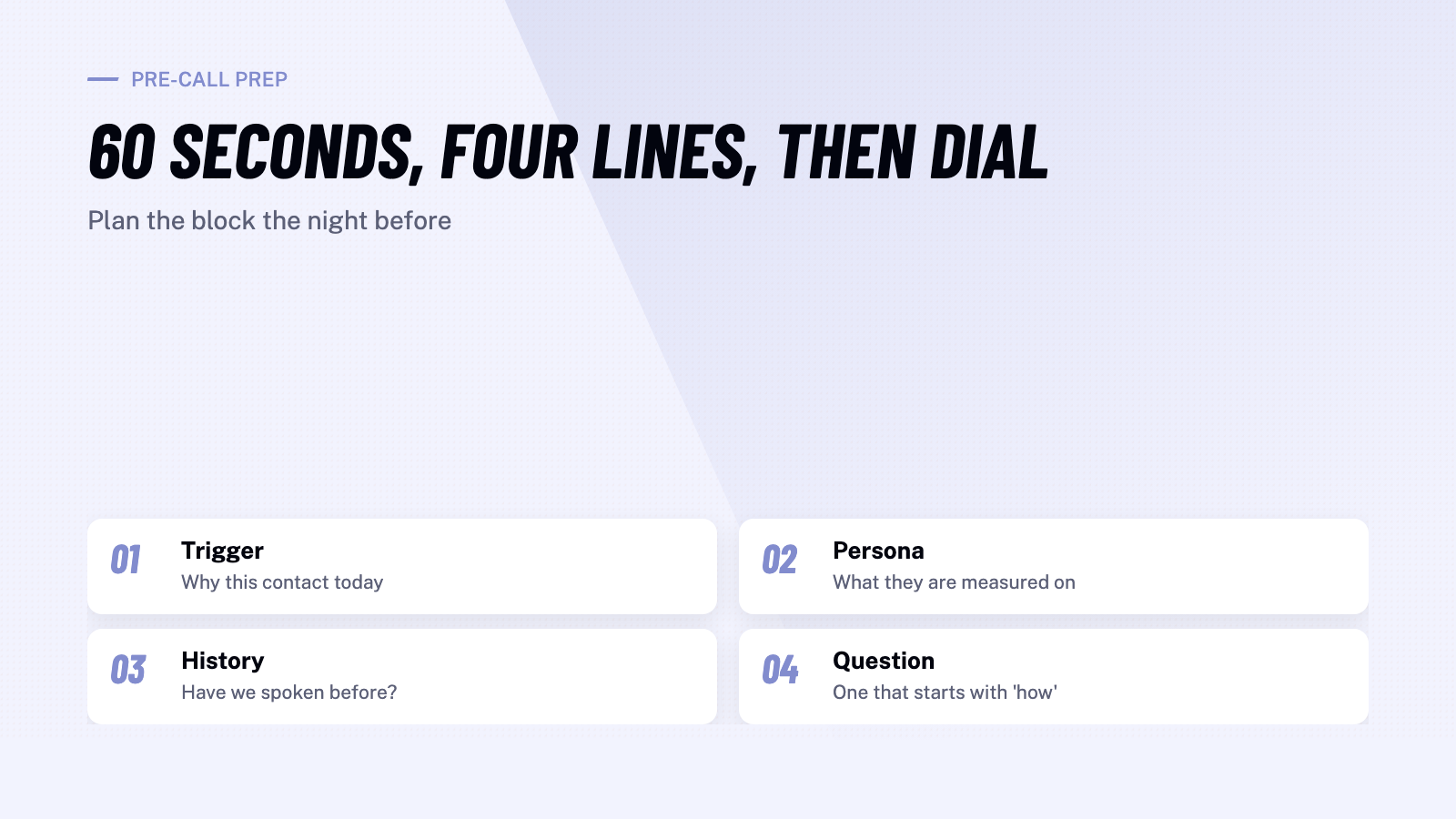
Pre-call preparation for cold calling should take 60 seconds, not 10 minutes. You need four things before you dial: the trigger, the persona, the last interaction and one question. Everything else is reading, not preparing. Here is the framework we use at Sonik, and how it changes when you dial in parallel.
Most pre-call advice is written for account executives running five calls a day. An SDR running 150 dials a day cannot spend 10 minutes on each. That is 25 hours.
So reps do one of two things. They skip prep and open with what they sell, which 65% of reps do and which produces a 2-3% meeting rate. Or they research deeply, call 30 people, and never reach the 20 conversations a day that build pipeline.
The way out is to prepare less, better. The research that matters on a cold call fits in four lines.
Prep starts the day before, at the block level.
With this done the night before, per-call prep becomes a glance, not a search.
Why is this person on today's list. If the answer is "they are in the database", move on. Trigger-based openers reach a 7-10% meeting rate, pitch-first openers 2-3%. The trigger is the opener.
Title and what they are measured on. A Head of Sales is measured on pipeline, a founder on runway, an HR lead on time-to-hire. The trigger has to connect to that number.
Have we spoken to this person or this company before? This is the single most valuable field in the CRM. "How have you been?" to a known contact reaches about 10% success, versus roughly 1.5% for a cold open. If there is a note from a previous call, read the objection, not the summary.
Write a question that starts with "how" and links the trigger to the persona's number. "How are you planning to ramp the two SDRs you are hiring before Q1?" Discovery questions starting with "how" lift conversion by 190%.
Four lines. Sixty seconds. If you have those four, you are better prepared than most of the reps who spent 10 minutes on LinkedIn.
Personal details. Alma mater, hobbies, the marathon they ran. In our experience it never comes up in a three-minute cold call, and when it does, it sounds like surveillance. Save it for a follow-up email if a relationship starts.
The full company history. Funding rounds from 2021 do not matter. The hiring post from last week does.
Rehearsing the pitch. There is no pitch on a cold call. There is a trigger, a question and a next step.
Checking the tech stack. Useful for the AE on the demo. On the cold call, "What do you mean?" after "we already have a tool" tells you more than any tech-stack database. That question lifts conversion by 197% in our data.
Parallel dialing changes the prep problem. Several numbers ring at once, and you do not know which one will connect first. You cannot read a 60-second brief for each of them while they ring.
Three adjustments:
Done this way, a rep gets about five times more conversations and still opens every call with a reason.
Sonik generates the 60-second brief automatically. The signal engine builds the block from CRM signals, so the trigger is known before the list exists.

When the parallel dialer connects a call, AI call prep displays the four lines: trigger, persona, last interaction, suggested "how" question. The rep reads them in the second the prospect says hello.
The brief is written from CRM data and public signals only. It does not pull personal details, because they do not help on the call.
Pre-call prep for cold calling is four lines: trigger, persona, last interaction, one question. Plan the block the night before by persona and signal, and the per-call prep takes 60 seconds. This week, before each call block, write those four lines for the first 10 contacts and skip everything else. Count how many conversations pass 30 seconds compared to last week.

