Get started
Still unsure of the impact of Sonik?
See it for yourself and ask for your free trial

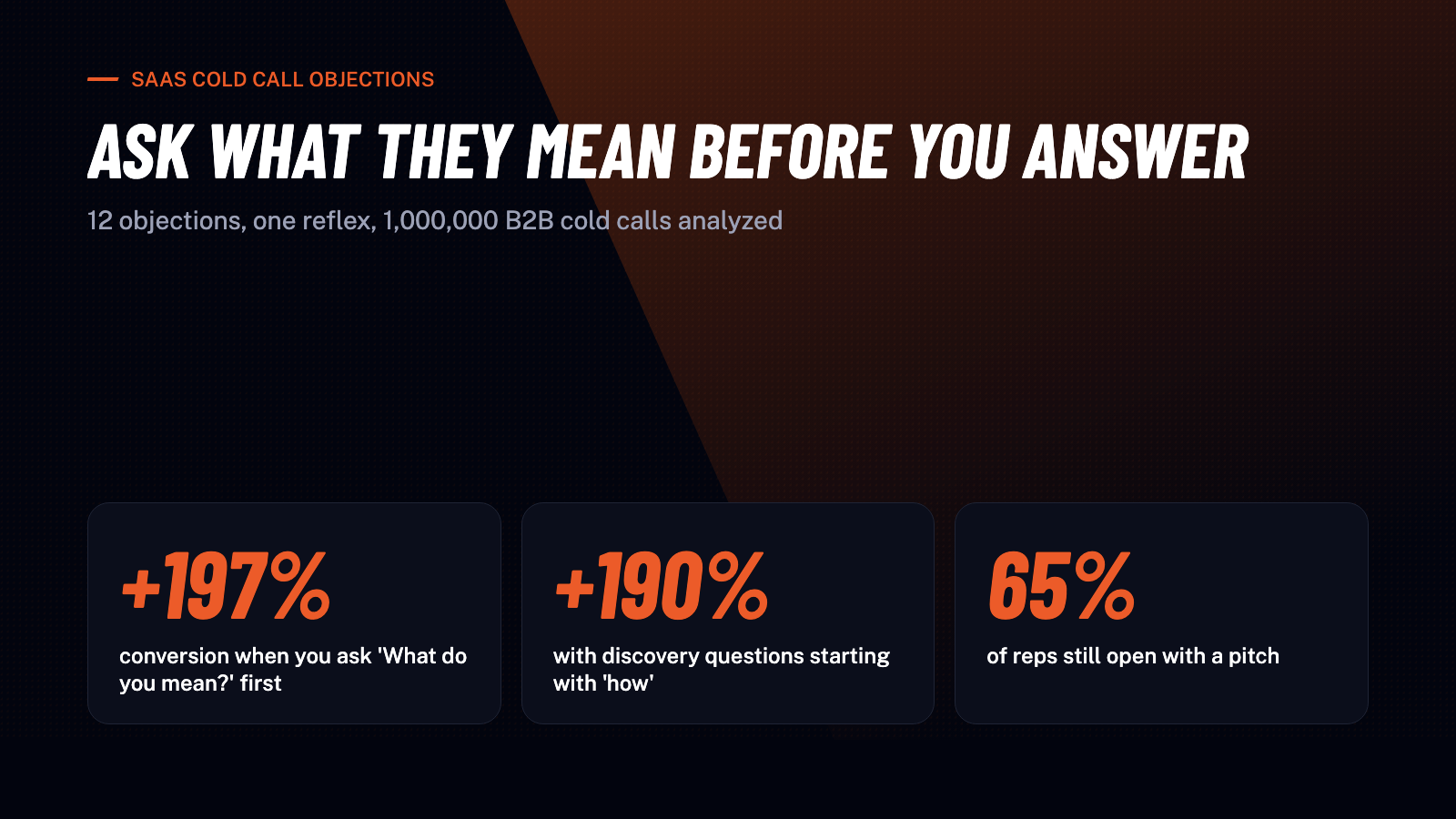
SaaS buyers are the most prospected people in B2B. The objections you hear on a cold call are mostly reflexes, not decisions, and the fastest way through them is one question asked before you answer: "What do you mean?" In our analysis of 1,000,000 B2B cold calls in France, that single move lifts conversion by 197%.
A VP Sales or Head of Marketing at a 200-person software company gets called by vendors every week. Their brain has built a shortcut: say the thing that ends the call politely.
So "we already use a tool" rarely means they love the tool. "Send me an email" rarely means they will read it. The words are a door closing. Your job is to put a foot in it without pushing.
Two numbers from our benchmark explain most of what follows. 65% of reps open by explaining what they sell, and pitch-first openers book meetings 2-3% of the time. Trigger-based openers, where you name something that happened at the account, reach 7-10%. The objection you get is often a reaction to a pitch you should not have made yet.
Most reps answer objections. Top reps ask about them first.
"What do you mean?" works because it is neutral. It does not argue. It forces the prospect to turn a reflex into a sentence, and the sentence usually contains the real situation: which tool, which budget line, which person decides.
Discovery questions that start with "how" lift conversion by 190% in the same dataset. Combine the two: "What do you mean by no budget? How are you funding the current tool?"
Then, and only then, reply.
1. "We already use [tool]." Means: there is an incumbent, and switching sounds like work. Reply: "Good, that means the problem is real for you. How long have you had it, and what would you change if you could?" Then listen for the gap. Do not compare features on a cold call.
2. "We built it in-house." Means: an engineer owns it, and nobody wants to admit it costs money. Reply: "How many people maintain it today?" Internal builds are rarely free; the cost is just hidden in a sprint backlog.
3. "We just renewed." Means: a real timing constraint. Reply: ask for the renewal month, log it as a signal, and book a 20-minute call 90 days before. This is not a lost call. It is a dated one.
4. "No budget this year." Means: no budget for something new. Replacement budget usually exists. Reply: "What do you mean, no budget at all, or no new line? What are you paying for today that does the job badly?"
5. "We're too small for this." Means: they assume enterprise pricing. Reply with a fact, not a discount: who your smallest customer is and what they got out of it. Then qualify whether they are a fit at all.
6. "Just tell me the price." Means: they want to disqualify you fast. Reply with a range and a condition: "Between X and Y per seat, and it depends on two things. Can I ask them?" Price without context loses; price with two qualifying questions keeps the conversation going.
7. "I'm not the right person." Means: often true, sometimes a dodge. Reply: "How do decisions like this usually get made here?" You get the org chart and a name. A mid-market SaaS deal involves several stakeholders, so the second contact is a bonus, not a detour.
8. "Everything goes through procurement and security." Means: there is a process, which means they have bought software before. Reply: "That's fine, we go through it every week. Before that, is the problem worth a 20-minute look?"
9. "I need to ask my team." Means: no internal sponsor yet. Reply: offer to be the one who presents to the team, and ask who should be in the room.
10. "Send me an email." Means: hang up politely. Reply: "Happy to. So I don't send you the generic one, what would be useful: the pricing, or how a company like yours runs this?" Then set the follow-up call before you hang up.
11. "We're not adding tools right now." Means: tool fatigue, often after a consolidation project. Reply: "What do you mean? Are you reducing the number of tools, or freezing spend?" A consolidation is an opening if you replace two tools with one.
12. "You're the fifth vendor to call this week." Means: exactly that. Reply with honesty and brevity: "Probably true. Here is the one reason I called you and not someone else." Then say the trigger. If you do not have one, you should not have dialed.
Pull your last 10 recorded calls that ended on an objection and count three things.
The French market adds a twist. Buyers here are polite on the phone and rarely say a hard no. "Envoyez-moi un mail" is the national reflex. Treat it as objection 10 every time, never as interest.
Scripts help with structure, not with words. Memorize the question you will ask for each of the 12; improvise the rest. Buyers hear a read script in two seconds.
We built Sonik for B2B SaaS teams in France and Europe, so these 12 objections are our daily diet.
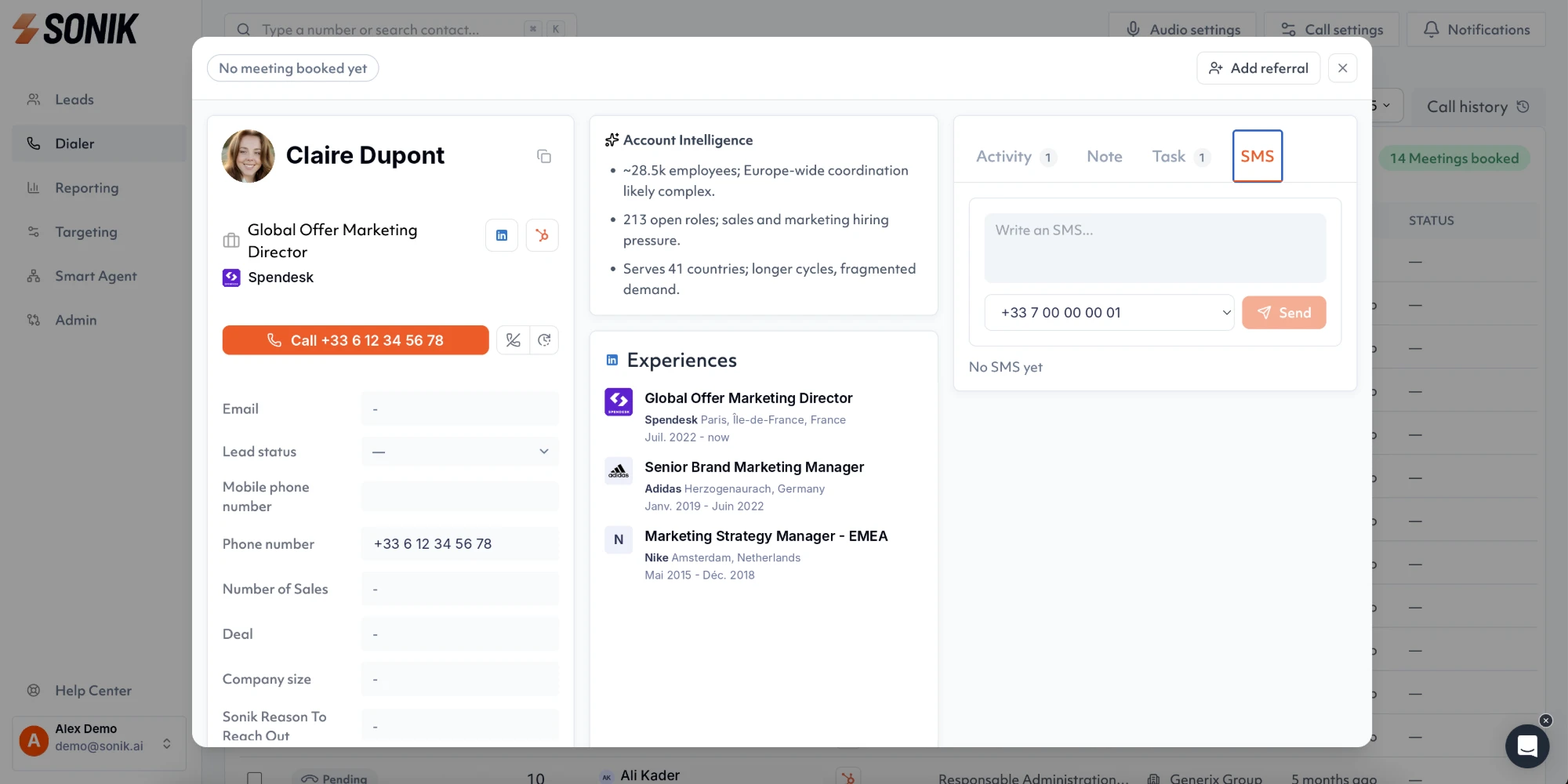
Two things in the product come straight from this data. AI call prep surfaces the trigger before the dial, because the best objection handling is an opener that does not create the objection. And after the call, AI coaching reviews the exchange so a rep can see where a question would have beaten a reply.
Parallel dialing matters here too. Objection handling is a skill built by repetition, and a rep having 20 conversations a day hears each of these objections far more often than a rep on a manual dialer. Reps get 5x more conversations with parallel dialing, which means 5x more practice. See how the dialer works.
SaaS objections are reflexes. Ask what they mean, ask how, then reply with a short answer and a next step. This week, pick the three objections you hear most and write the one question you will ask before answering each of them. Tape it to your screen and count how often you use it.

