Get started
Still unsure of the impact of Sonik?
See it for yourself and ask for your free trial


Phone prospecting in SaaS comes down to three decisions: who you call, when you call, and what you say in the first 20 seconds. Get the list right with signals, call at the persona's best slot, open with a trigger instead of a pitch, and a demo becomes a 7-10% outcome per conversation instead of 2-3%. This guide gives the European SaaS SDR the numbers and the structure.
From our benchmark of 1,000,000 B2B cold calls in France, built with Quentin Despas (Katana): the average connect rate is 11.3%. A rep dialing by hand gets 7 or 8 conversations a day. On a parallel dialer, 5x more, which is why our north-star is 20 conversations per SDR per day.
Twenty conversations at a 7% meeting rate is 1.4 demos a day, about 28 a month. At 2-3%, it is less than half that. Everything in this guide is about moving that percentage, because the volume problem is solved by the dialer.
The reference for the connect rate itself is our connect rate benchmark.
Your ICP tells you which companies. Signals tell you which ones this week. In SaaS, five signals outperform the rest in our experience.
Rank today's list by signal strength, then call top-down. Never dial a cold name while a signaled one is waiting.
Across all personas, 4pm connects at 15.8%, 10am at 14%, 8am at 9.8%. By persona:
In practice: block 10am to 11am for founders, 4pm to 5:30pm for everyone else, and use the rest of the day for signals work, follow-ups and email.
Name, company, trigger. "Hi Marie, Benoit from Sonik. I saw you opened three SDR roles in Lyon last week." No "how are you", no pitch. 65% of reps open with what they sell; do not be one of them.
"When teams hire SDRs that fast, the question is usually how many conversations each one will actually get. Is that on your mind, or am I off?" You have given a reason, named a problem and asked a question. They now talk.
Two or three questions starting with "how". "How are your reps dialing today?" "How many conversations a day does a good one get?" Discovery questions starting with "how" lift conversion by 190% in our data.
Whatever comes ("we use a tool already", "no budget", "send me an email"), ask "What do you mean?" before you answer. That one question lifts conversion by 197%. Then answer in two sentences.
Specific, small, dated. "Can I show you in 20 minutes on Thursday at 4pm how a team your size gets to 20 conversations a day? If it is not relevant you will know in five." Offer one slot, then a second if needed.
Count these for one week and you will find that two of them explain most of your lost demos.
B2B SaaS teams in France and Europe are our core customers, so this guide is our own playbook.

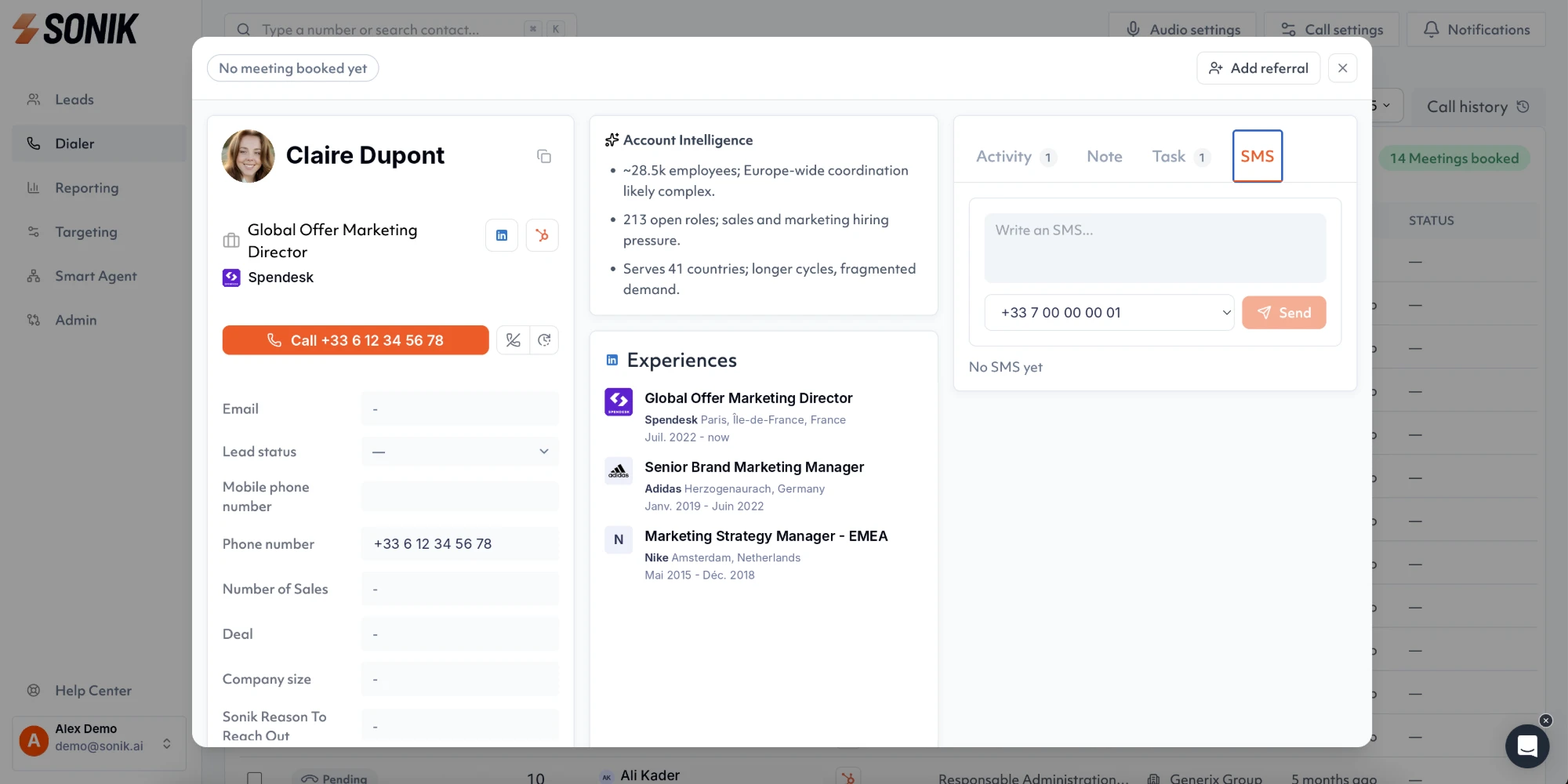
Sonik's parallel dialer handles the 5x. Signals handle the list: website visitors, job changes, closed-lost, dormant leads and social intent, ranked daily from the CRM. AI call prep puts the trigger on screen before the line connects, and AI coaching reviews the opener, the questions and the ask after every call.
Our mission is 2x more meetings through 5x more conversations with the right contacts. The structure above is how reps get there.
SaaS phone prospecting is a list problem, a timing problem and a first-20-seconds problem. Signals, persona slots and trigger openers solve them in that order. This week, build one list of accounts with a hiring or funding signal, call them at the persona's slot, and open with the trigger. Count demos per 20 conversations.

