Get started
Still unsure of the impact of Sonik?
See it for yourself and ask for your free trial


A SaaS sales pipeline is the sequence of states a buyer moves through between the moment you notice them and the moment they pay you every month. We run it in six stages: signal, conversation, meeting booked, qualified opportunity, proposal, signed and live. In our experience most SaaS pipelines do not break at the close, they break at stages one to three, which is why this guide spends most of its time there, with benchmarks from our analysis of 1,000,000 B2B cold calls in France.
SaaS has three properties that change how a pipeline behaves. Revenue is recurring, so a bad-fit deal costs you twice: once to close, once to churn. Cycles are longer, so a stage definition that is a feeling rather than an event lets deals sit for a quarter. And buying groups are wide, so a single contact is a fragile deal.
Put those together and late-stage fixes become expensive. A proposal that dies in legal was usually lost at qualification. A demo that goes nowhere was usually booked on a pitch-first opener to a persona who never had the problem.
The cheapest place to fix a SaaS pipeline is therefore the entry. Two numbers from our data show how much room there is: reps use only about 20% of the signals already in their CRM, and 50% of Sonik's own pipeline comes from signals that were already sitting there.
Each stage below has one exit event. If the event has not happened, the deal has not moved, whatever the rep feels.
We do not start the pipeline at "prospecting", we start it at a reason to call. A website visit from a target account, a champion who changed jobs, a closed-lost deal passing its six-month mark, a lead that went quiet after a demo. The exit event is an account on a call list with the trigger written next to the name. Benchmark: in our experience most teams act on roughly one signal in five.
A conversation is a live exchange with the decision-maker, not a gatekeeper or a voicemail. Exit event: the person picked up and you spoke. French B2B average connect rate is 11.3%, with a range of 11-20% depending on persona and time slot. At 4pm it is 15.8%, at 8am 9.8%. In our experience, most connects happen within the first three attempts. Our north star for this stage is 20 conversations per SDR per day.
Exit event: a calendar invite accepted, with a date. "Interested, will send times" is still stage 2. Benchmark: trigger-based openers reach a 7-10% meeting rate per conversation; pitch-first openers get 2-3%. In our data 65% of reps still open by explaining what they sell.
The meeting was held, the problem is confirmed, there is a next step with a date. Exit event: the prospect answered the "how" questions and agreed to the next step. Discovery questions that start with "how" lift conversion by 190% in our benchmark, which is why this stage is where we coach hardest.
Pricing is on the table and at least two people on the buyer side have seen it. Exit event: a second stakeholder joined a call. In our experience a single-threaded SaaS proposal is a coin flip; a multi-threaded one stalls far less often, because objections surface before the proposal, not after.
Signed is not the end for a subscription business. The stage closes when the first user logs in and the kickoff is done. A deal that never goes live churns at renewal and should count against the rep who closed it. Closed-lost deals leave this pipeline and re-enter stage 1 as a signal six months later.

The single biggest improvement we have seen in SaaS pipelines is not a tool, it is replacing stage definitions written as feelings ("engaged", "warm", "likely") with definitions written as events you can see in the CRM or the dialer. A meeting is in the calendar or it is not. A second contact was on the call or was not.
Three side effects follow. Forecasts stop depending on rep optimism. Pipeline reviews get shorter because there is nothing to debate. And stalled deals become visible, because "days since last exit event" is a number you can sort by.
Sonik is built around stages one to three. Signals pull website visitors, job changes, closed-lost anniversaries and dormant leads out of the CRM into a daily call list, so stage 1 fills itself instead of depending on a rep's spare afternoon.

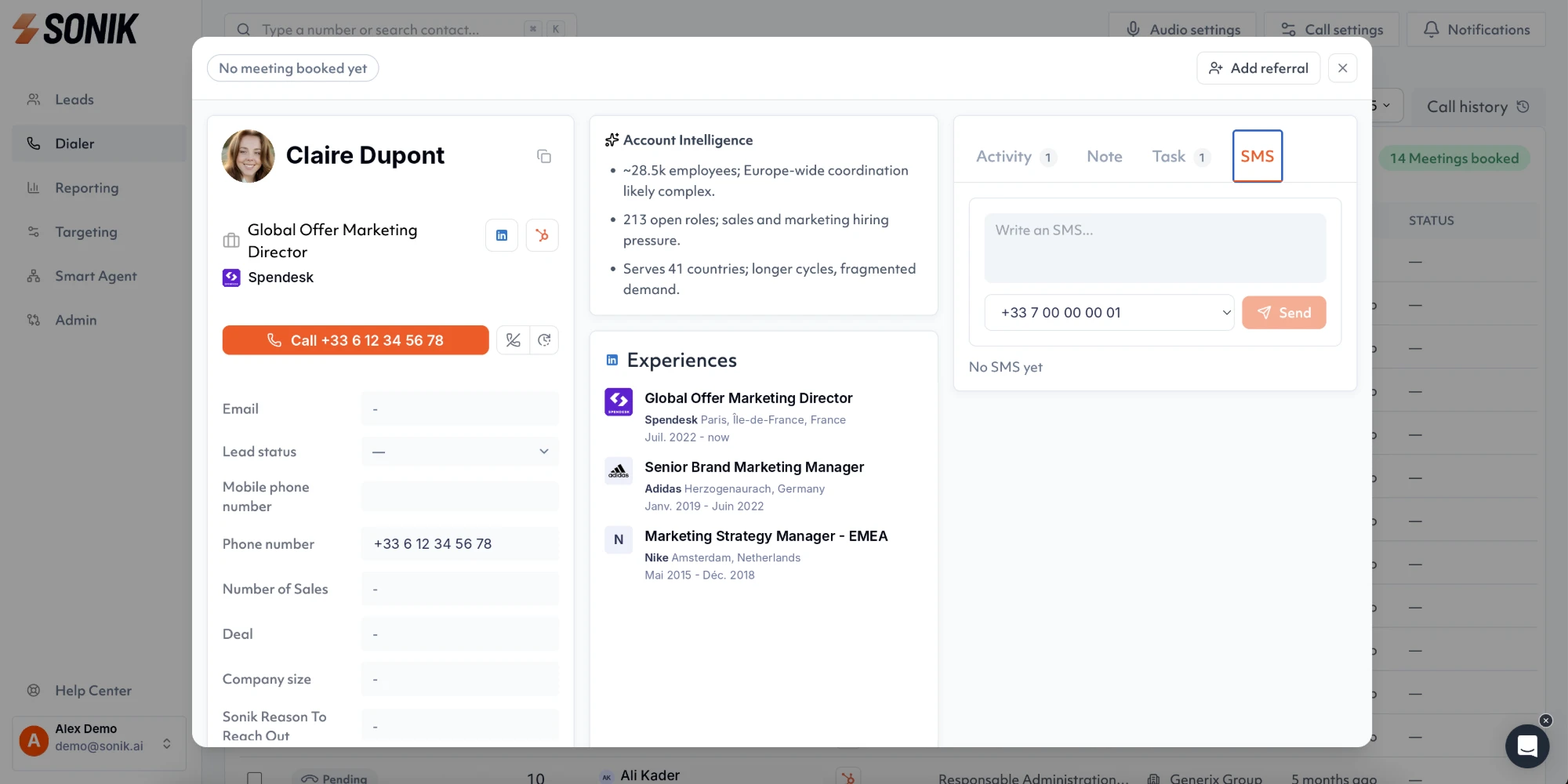
The parallel dialer handles stage 2: several lines at once, voicemails skipped, a live conversation handed to the rep with the trigger and the last CRM notes on screen. That is how a rep gets to 20 conversations a day.
Stage 3 is the rep's job, but AI call prep writes the trigger-based opener before the call, and coaching flags pitch-first openers and one-line objection handling after it. The dashboard reports conversion from each stage to the next, so you see where the funnel narrows before the quarter tells you.
A SaaS pipeline is only as predictable as its stage definitions and only as full as its signal list. Fix the top three stages first: signals in, conversations at the right slot, meetings booked trigger-first. This week, rewrite each stage of your pipeline as a single observable exit event and sort your open deals by days since that event. The deals at the top of that list are your real pipeline problem.

