Get started
Still unsure of the impact of Sonik?
See it for yourself and ask for your free trial

Sales by volume counts how many units, deals or conversations you produce. Sales by value counts what each of them is worth. In outbound, push volume when it measures conversations with the right people, and distrust it when it only measures dials, emails or leads nobody wanted.
Volume tells you how much motion you generated. Value tells you what that motion was worth. Revenue can rise while volume stays flat, because of price or mix, and volume can rise while revenue falls, because of discounts or poor-fit deals.
Before you debate the two, define the unit. For an SDR team there are at least five candidates: dials, connects, conversations, meetings and opportunities. Two leaders can look at the same quarter and disagree simply because one counts dials and the other counts accepted meetings.
Our position: count conversations. A dial is activity. A closed deal is a result. A conversation is the first unit that sits between them and that a rep can actually influence.
Volume is the right lens when the market is wide, the sales cycle is short and the deal size is small or medium. Think SaaS selling to thousands of French and European SMEs, where nobody needs a committee to say yes.
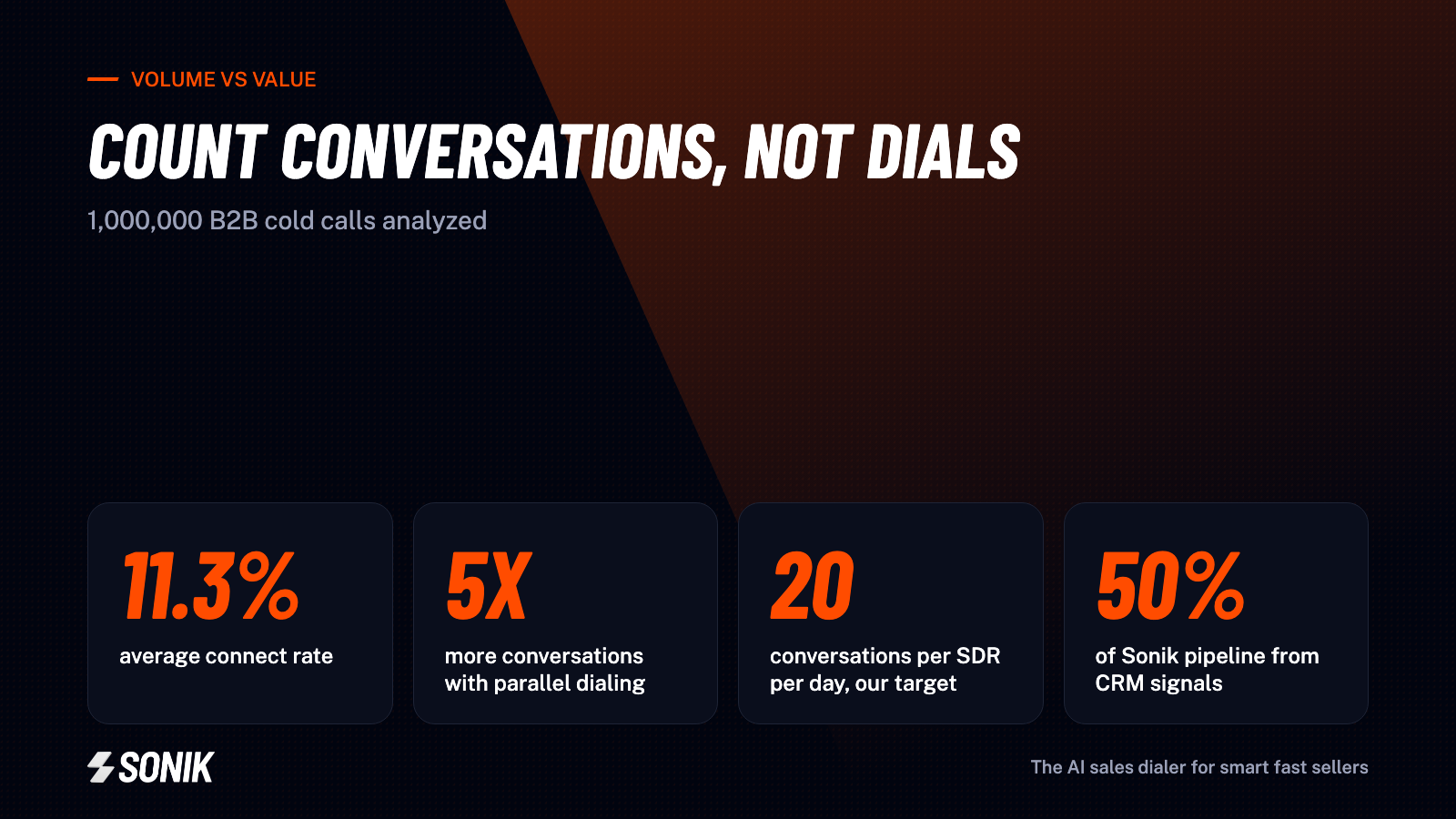
It is also the right lens when reps are limited by dead time, not by leads. Our benchmark of 1,000,000 French B2B cold calls shows an average connect rate of 11.3%. That means roughly 89 of every 100 dials end without a conversation. The shortage is rarely prospects. It is the time reps spend waiting on rings and voicemails.
That is why parallel dialing matters. It gives reps about five times more conversations in the same hours. Our north-star funnel is 20 conversations per day per SDR, a figure that is very hard to reach by dialing one number at a time.
Volume hurts when your total addressable market is small or when you sell to a buying committee. If you only have 400 target accounts, calling each of them ten times does not create more pipeline. It uses up the accounts.
There is data on where to stop. In our experience, most connects happen within the first three attempts. Attempts four to ten are mostly cost.
Volume also backfires when quality drops. In our benchmark, 65% of reps open by explaining what they sell. Doubling the number of pitch-first calls gives you twice as many calls that convert at 2-3%. It is faster failure, not more pipeline.
Many French B2B markets are smaller than they look. A vertical SaaS selling to HR directors in mid-sized French companies may have a few thousand real targets, not tens of thousands. In a market that size, a careless volume push burns accounts you will want to sell to for years.
It is also why timing and personas matter more here than raw activity. In our data, founders pick up more around 10am, marketing around 4pm and HR around 1pm. The same number of dials at the right hour gives more conversations without touching one extra account.
Take a rep with 20 conversations a day, which is 100 a week. At the 2-3% meeting rate we see with pitch-first openers, that is 2 to 3 meetings. At the 7-10% we see with trigger-based openers, the same 100 conversations give 7 to 10 meetings.
Both levers matter. Volume gets you to 100 conversations. Quality decides whether those conversations are worth having. A team that improves only one of them leaves most of the upside on the table.
Volume without limits drifts. These five numbers, reviewed weekly, keep it tied to value.
Define the thresholds in advance. For example, if the meeting rate drops below your own baseline for two weeks, pause the volume push and review lists and openers before adding more activity.
One more rule keeps volume honest: never compare reps on dials. A rep who makes 150 dials and has 8 conversations is not doing better than one who makes 100 dials and has 15. Reward conversations and accepted meetings, and the right behaviour follows.
Our mission is simple: twice as many meetings through five times more conversations with the right contacts. Both halves of that sentence matter, and the second half carries the guardrail.

The Sonik dialer runs parallel calls to create the volume. Signals from the CRM, such as job changes, dormant leads and closed-lost deals, decide who is on the list, so that volume goes to people with a reason to talk. Reps use only around 20% of the signals already in their CRM, which tells us that the list is usually the easiest lever.
Volume is a measurement choice, not a strategy. Pick conversations as your unit, push them up with better use of reps' time, and protect quality with a few weekly numbers.
This week, count how many real conversations each of your reps had last Tuesday, and compare it with the 20-a-day target. The gap tells you whether you have a volume problem or a value problem.

