Get started
Still unsure of the impact of Sonik?
See it for yourself and ask for your free trial


A sales signal on its own creates nothing. Pipeline is created when signals are collected, qualified and activated: several signals per account to spot the warmest leads, a filter that keeps about 15% of them, and a play triggered by the right rep in the right tool at the right time. We learned this the hard way, when a CRO told us our headline was wrong.
We thought we were building a signal company. Our headline said so: boost pipeline with signals. Then a CRO looked at it and told us it was wrong. It is not about boosting pipeline with signals. It is about identifying and engaging the warmest leads.
She was right, and we changed the headline. The signal is just the first step. What happens after it is where pipeline comes from, and most teams buying signal tools stop at step one.
A website visit tells you someone at the company looked at your pricing page. It does not tell you whether they are the buyer, whether they are in a project, or whether they were a student doing research. A job change tells you a contact moved. It does not tell you whether the new company fits your ICP.
One signal is noise with a timestamp. Three signals on the same account in two weeks, a pricing page visit, a new VP Sales, and a closed-lost deal from 18 months ago, is a lead that will pick up the phone.
The problem is rarely a lack of signals. Reps use only about 20% of the signals already in their CRM. The problem is that nothing turns them into calls.
Collect, in one place, every signal your CRM and your tools already produce:
The goal is not to act on each one. It is to score accounts by how many signals stack up. The warmest 10% of your CRM is visible only when the signals are read together.
Qualification is filtering. On average, teams that do this well keep around 15% of the signaled leads. The rest are real signals on the wrong people: wrong persona, wrong company size, an open deal already owned by someone, a contact who churned for a reason that still applies.
Two inputs make the filter work. CRM context first: is there an owner, an open opportunity, a do-not-call flag, a note from the last conversation. Then AI qualification: does the company match the ICP, is the contact the right persona, what is the likely reason to call.
Each lead that survives qualification is worth more than the raw signal that produced it, because a rep can call it without doing 10 minutes of research first.
Activation is where the 15% become conversations. Four decisions, each one usually left to chance:
That is when pipeline is created. Each qualification and each activation adds value the signal did not have.
Buying signals before building the process. A new intent feed on top of an unused CRM adds a tab, not a meeting.
Acting on single signals. Calling every website visitor burns the rep's time and the account's patience.
Routing warm leads to email. The whole value of a signal is the timing. A five-step sequence spends that timing over three weeks.
No feedback loop. If the rep's call outcome does not update the signal's weight, the qualification never improves.
Measuring signals instead of conversations. The number that matters is conversations started from signals, then meetings. Signals detected is a vanity metric.
Sonik Signals is built as the three-step process rather than a feed. It collects website visitors, job changes, closed-lost deals, dormant leads and social intent from the CRM and the website, qualifies them with CRM context and AI, and turns the ones that pass into dynamic call lists.
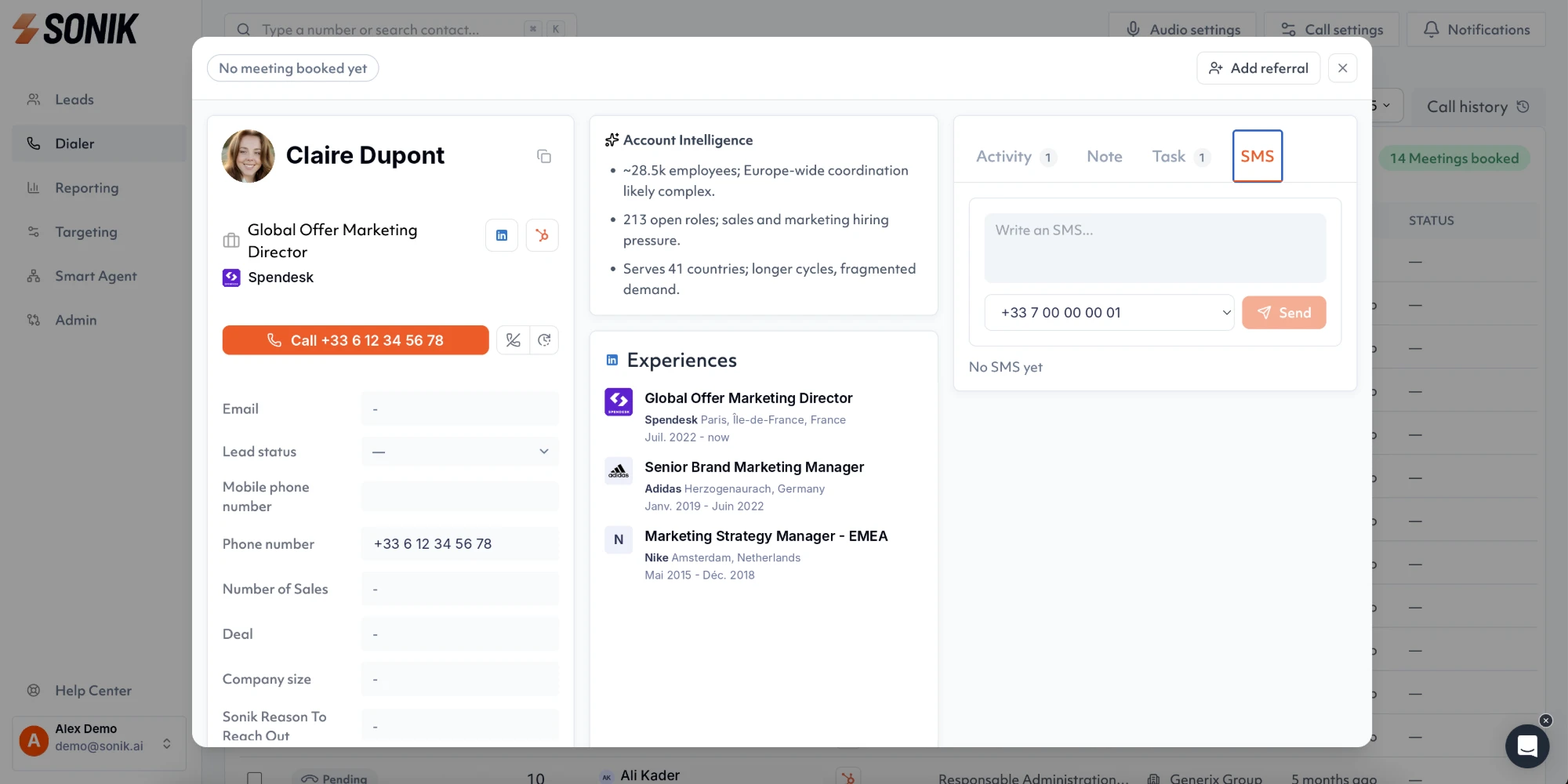
Activation happens in the dialer: the lead appears as a call for the right rep, with AI call preparation showing the signals and the reason to call, scheduled on the slot where that persona picks up. We run our own outbound this way, and 50% of our pipeline comes from signals that were already in our CRM. For the dormant-lead play in detail, see how to reactivate dormant leads.
Signals do not build pipeline. Process does: collect several signals per account, qualify down to the 15% worth a call, and activate with the right play at the right hour by the right rep. This week, export the accounts in your CRM with two or more signals in the last 30 days and count how many were called. That gap is your pipeline.

