Get started
Still unsure of the impact of Sonik?
See it for yourself and ask for your free trial


SDR ramp time is the number of days between a rep's first day and the day they carry a full quota. In our experience with European B2B SaaS teams it runs two to three months for SMB and mid-market, and four or more for enterprise, but the useful benchmark is not the average. It is the week-one meeting. A rep who books in week one ramps in half the time of a rep who books in week five, because confidence, not knowledge, is what ramp is made of.
There are three ways to define it and each gives a different number. Time to first meeting booked. Time to the first month at 100% of quota. Time to a conversation-to-meeting rate equal to the team average. Pick one and write it down, because "ramp" without a definition is how every manager quotes a different figure.
We prefer the third. Meetings depend on territory and list quality; the conversation-to-meeting rate measures the rep. A new SDR whose rate matches the team's by day 60 is ramped, even if the quota math says otherwise.
The ramp cost is easy to price. A French SDR with a loaded cost of 45,000 euros a year costs about 3,750 euros a month. Every month cut from ramp is that amount saved, plus the meetings that month would have produced.
Four factors explain most of the spread between a six-week ramp and a six-month one.
Deal complexity. Selling a 5,000-euro tool to a founder is learned in weeks. Selling a 100,000-euro platform to a buying committee needs the rep to understand six personas before a call is useful.
Prior experience. A rep coming from another SDR seat in the same market ramps in half the time, in our experience, mostly because they already know how a "no" sounds.
Conversations per day. This is the one you control. In the 1,000,000 French B2B cold calls we analysed with Quentin Despas (Katana), the average connect rate is 11.3%. A rep dialing by hand gets a handful of conversations a day; a rep on a parallel dialer gets 5x more. Ramp is a function of repetitions, and repetitions are a function of conversations.
Persistence. In our experience, most connects happen within the first three attempts. A new rep who gives up after one dial per contact is ramping on a third of the available conversations.
Week-one meetings are not luck. They come from choosing the list.
Give the new rep dormant leads: contacts who showed interest in the last 12 months and went quiet. A call to a known contact that opens with "How have you been?" succeeds about 10% of the time in our data, versus roughly 1.5% for a standard cold open. At 15 conversations a day, that is a meeting or two by Wednesday.
Add the callbacks and hot numbers from the team's queue. A prospect who called back is the warmest number in the CRM, and the new rep does not need a script to handle "you called me earlier?"
Keep cold lists for week three. Starting a rep on strangers at 11.3% connect and a 2-3% pitch-first meeting rate teaches them the job is impossible. It is not; the list was wrong.
Schedule the calling blocks where people answer: 10am (14% connect rate in our benchmark) and 4pm (15.8%), not 8am (9.8%). Founders around 10am, marketing around 4pm, HR around 1pm.
A listening library tagged by outcome. Fifty calls, half booked, half dead in 20 seconds. Five hours of listening before the first dial teaches the opener faster than any workshop.
AI call prep. The new rep's weakness is not courage, it is context. If the trigger and the first question are written on screen before the call rings, the first 20 seconds take care of themselves. Trigger-based openers reach a 7-10% meeting rate in our data.
Live listen-in and whisper. Ten minutes of a manager whispering "ask what they mean" during real objections beats an hour of roleplay. Asking "What do you mean?" before answering an objection lifts conversion by 197%.
One scorecard. Five lines, posted. The rep self-scores two calls a week. Ramp slows when "good" is a matter of opinion.
Month one: no quota, a target of 10 conversations a day by day 30. Month two: 50% of a tenured rep's meetings, 20 conversations a day. Month three: 75%. Day 91: 100%. In France, that lines up with the trial period, so the fit decision is made on real numbers rather than on how the rep seemed in meetings. The full plan is in our 30-60-90 onboarding plan.
New reps on Sonik start on the parallel dialer in their first week, which gives them the 5x conversation volume that ramp is built on. Signals build the dormant-lead, closed-lost and callback lists directly from the CRM, so the first list is the warm one.

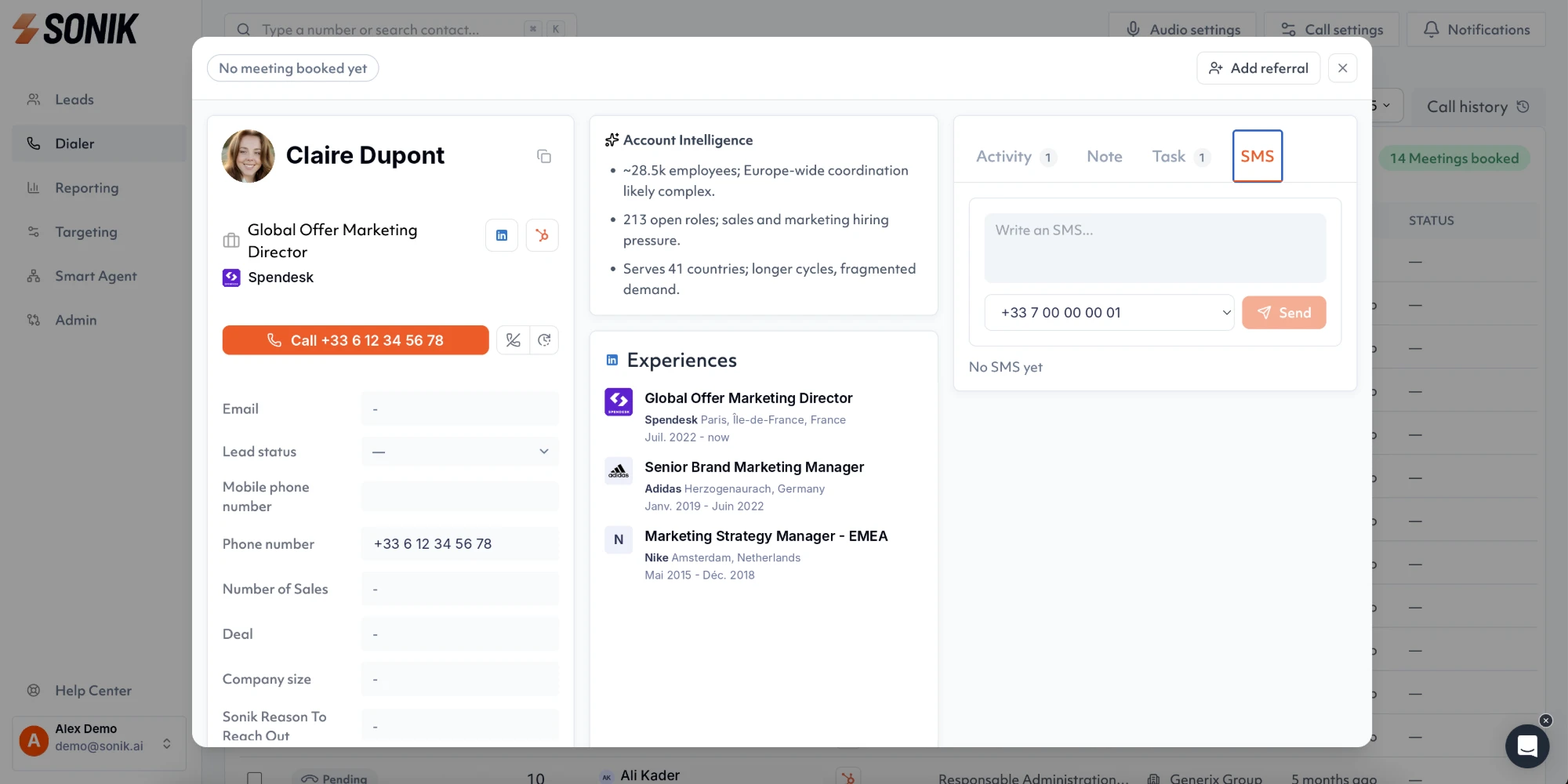
AI call prep puts the trigger and the first "how" question on screen before each call, and every call is recorded and summarised, so the listening library and the scorecard are ready on day one without a manager assembling them. We built this because our own first SDRs ramped on cold lists by hand, and it took a quarter longer than it should have.
Ramp time is repetitions divided by days. Raise the repetitions (parallel dialing, right time slots, third attempts) and lower the difficulty of the first ones (dormant leads, callbacks, AI prep), and a three-month ramp becomes six weeks. This week, if a new rep is starting, build their first list from contacts who went quiet in the last year and book their first 10am block for Wednesday.

