Get started
Still unsure of the impact of Sonik?
See it for yourself and ask for your free trial

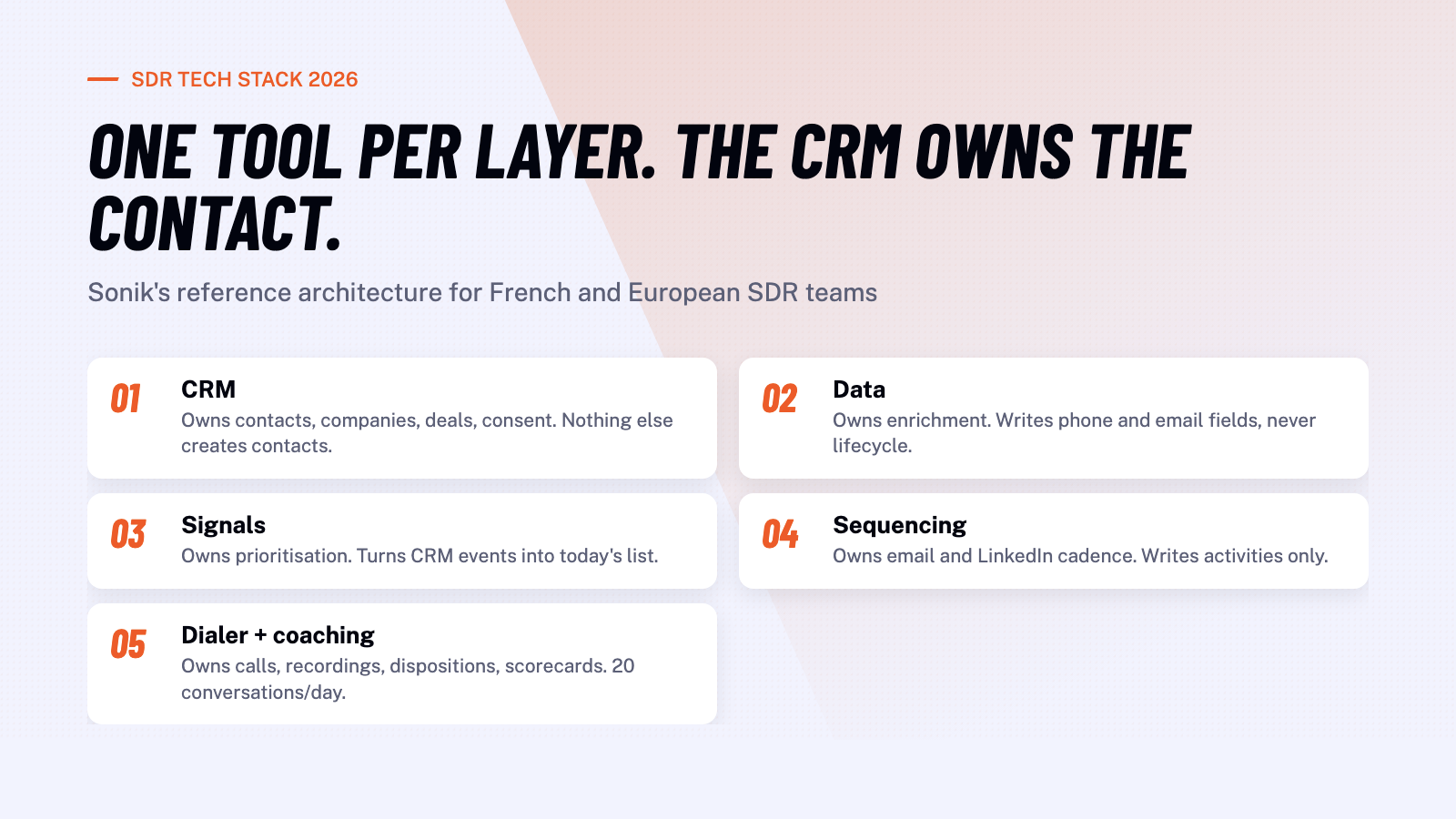
The ideal SDR tech stack in 2026 has five layers and exactly one tool per layer: a CRM that owns the contact, a data layer that enriches it, a signals layer that decides who to contact today, a sequencing layer for email and LinkedIn, and a dialer with coaching built in for the phone. Every layer writes to the CRM and none of them competes with another. Here is the reference architecture we recommend to French and European SDR teams, the ownership rules that keep it clean, the build order, and what it costs per seat.
Most SDR stacks were not designed. They accumulated. A sequencer bought in 2022, a data tool added when the mobile numbers ran out, a dialer trialled by one manager, a LinkedIn automation someone expensed. The result is a rep switching between six or eight tabs, two systems that both think they own the contact, and a CRM nobody trusts.
The cost is not the subscriptions. It is the conversations that do not happen. Our north-star for an SDR is 20 conversations a day. A rep who spends two hours a day copying data between tools does not get there.
The fix is a rule, not a product: one tool per layer, and the CRM owns the contact.
Owns contacts, companies, deals, lifecycle stage, owner, and consent. The rule that matters: no other tool creates contacts. Enrichment adds fields to existing records; the dialer logs activities on them; the sequencer enrols them. Break this rule and you get duplicates within a month.
Owns phone and email fields and firmographics. For European teams this layer deserves a real test: upload 200 target contacts and count mobiles found. A waterfall of two or three providers typically beats a single global database for France, Germany and the UK. This layer writes contact details and nothing else.
Owns the answer to "who do we contact today and why". Inputs: website visitors from target accounts, job changes, closed-lost anniversaries, dormant leads, LinkedIn engagement. Most of it is already in the CRM; reps act on about 20% of it. Half of Sonik's own pipeline comes from signals that were already sitting in our CRM. This layer is often configuration plus one tracking tool, not a big subscription.
Owns email and LinkedIn cadences. Writes activities to the CRM contact. Creates call tasks but does not make the calls. European multichannel sequencers do this well with GDPR defaults; CRM-native sequences are enough for small teams.
Owns the phone: numbers, parallel dialing, voicemail detection, dispositions, recordings, transcripts and scorecards. Reads call tasks from layer 4 and priorities from layer 3. This is the layer with the biggest lever for a phone-led team, because conversations per rep is the input that moves everything else: a parallel dialer gives about 5x more conversations than one-line dialing, and our analysis of 1,000,000 B2B calls in France shows an 11.3% average connect rate that reaches 15.8% at 4pm when the list is timed by persona.
We put coaching inside this layer on purpose. A separate conversation-intelligence tool for SDRs is a sixth subscription that duplicates recordings; the dialer already has the audio.
Build in this order: CRM, then data, then the engine of your motion (dialer if phone-led, sequencer if email-led), then signals, then the remaining channel. Coaching comes with the dialer.
On budget, here is what we see in France, as orders of magnitude rather than quotes:
So a fully equipped SDR runs in our experience between roughly 250 and 600 euros per month in tooling, against a loaded salary cost several times higher. The question is never whether the stack is expensive. It is whether it delivers 20 conversations a day. At that volume, one extra meeting a week pays for the whole stack.
Four checks, once a quarter, thirty minutes:
Sonik is layer 5 with the plumbing of layer 3. It is an AI sales dialer that reads signals from HubSpot or Salesforce (website visitors, job changes, closed-lost, dormant leads, social intent), builds a prioritised daily calling list by persona and time slot, dials in parallel with local European numbers, shows the trigger before pickup, and writes dispositions, recordings and AI notes back to the CRM contact. Coaching runs on the same recordings: trigger openers, "how" questions, objection handling.

We apply the one-tool-per-layer rule to ourselves. Sonik does not sell data and does not run email sequences; it plugs into the data and sequencing tools a team already has and never creates contacts in the CRM. Details on the dialer page and the signals page.
Five layers, one tool each, the CRM owns the contact, every other tool writes activities. Build CRM, data, engine, signals, second channel, in that order, and audit quarterly on conversations per rep. This week, list every tool your SDRs log into and write its layer next to it. The overlaps and the gaps will be obvious in ten minutes.

