Get started
Still unsure of the impact of Sonik?
See it for yourself and ask for your free trial


Yes, call the C-suite first, especially in companies under a few hundred employees. In the 1,000,000 French B2B cold calls we analyzed with Quentin Despas (Katana), leadership connects above 15% and founders peak around 10am, both above the 11.3% average. Executives are not harder to reach than managers. They are harder to keep on the line, which is a different problem with a different fix.
The playbook most SDRs inherit says: start low, build a case, climb. The assumption underneath is that executives do not pick up unknown numbers. Our benchmark does not support it.
In our experience the "executives do not answer" belief comes from calling landlines. A CEO's desk phone rings on the switchboard. A CEO's mobile rings on the CEO. With mobile numbers, the senior person is often the most reachable contact in the account.
Three reasons, all structural.
First, nobody filters their mobile. In a 50 to 300-person European company, the founder has no assistant, and the VP Sales certainly does not. The phone rings, they look at it, they decide.
Second, they are paid to be curious. A founder sees an unknown number and thinks customer, investor, candidate, journalist. Picking up is a 10-second bet with a real upside.
Third, they get fewer cold calls than their managers, because most reps are told not to call them. Being the one rep who does is an advantage on its own.
Benoit, our founder, spent five years as an account executive at Google Cloud, growing his quota from €1.5M to €10M. The habit he kept from those years is simple: start where the budget sits. A manager can tell you the problem exists. Only the executive can tell you whether it is worth solving this year.
That does not mean pitching the CEO. It means using the first conversation to learn what is on the executive's list, get a name, and come back down the org chart with context nobody else has.
Starting with the C-suite is the right default in three situations.
Start lower in two cases: enterprise accounts where the executive is three layers from the use case, and technical products where the practitioner will veto anything they did not choose. Even then, call the executive once. The worst outcome is a referral to the right manager, and a referral from the boss is an opener that works.
Here is where most reps lose the executive they reached. In our benchmark, 65% of reps open by explaining what they sell. Pitch-first openers reach a 2-3% meeting rate. Trigger-based openers, built on something that happened at the prospect's company, reach 7-10%.
With an executive, the gap is wider, because they decide in 20 seconds. The structure that works for us:
When the executive objects, do not answer. Ask "What do you mean?" first. In our benchmark that one question lifts conversion by 197%, because the first objection is rarely the real one.
A C-suite call is not a closing call. It is an intelligence call. The sequence that works:
Each layer makes the next call warmer. A rep who does this on ten accounts has ten threads, not ten contacts.
Sonik's signals surface the moments when an executive is most likely to take a call: a new head of sales in the seat, a closed-lost account where the sponsor changed, a target account visiting your site. Those contacts move to the top of the day's calling session with the trigger attached, so the rep opens with the fact rather than the pitch.

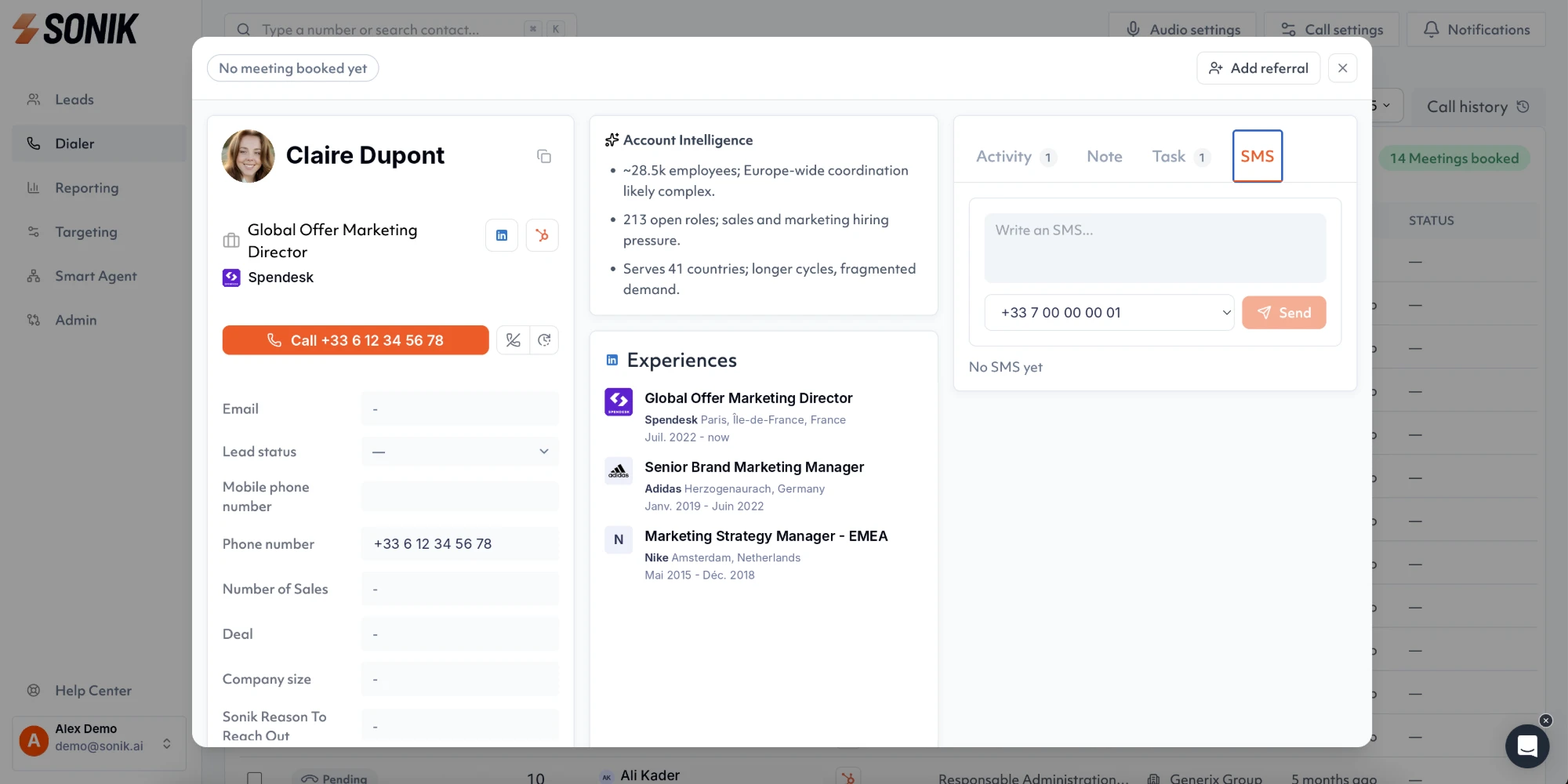
AI call prep writes the one-line context before the dial, and parallel dialing means a rep can run a session of 30 founders at 10am and actually talk to the ones who pick up. See Sonik Signals.
Executives answer above 15% in French B2B, more than the average persona. The myth comes from landlines and from pitch-first openers that burn the 20 seconds an executive gives you. This week, take your top 20 accounts, find the founder's or VP's mobile, and call them at 10am with a trigger and a "how" question. Count how many pick up. It will not be zero.

