Get started
Still unsure of the impact of Sonik?
See it for yourself and ask for your free trial


No. You should replace the waiting in your SDRs' day with AI, not the SDRs. In mid-market and enterprise sales, SDRs are the first voice your prospects hear, your number one pipeline builders and your next generation of closers. Those are too strategic to hand to a bot. Here is the argument, the numbers, and a way to decide for your own team.
A CEO told me last week: "We're thinking of replacing our SDR team with AI." I nearly choked on my croissant.
I understood the temptation. SDRs are a visible line in the cost structure. They move on after 12 to 18 months. And every AI tool on LinkedIn says it can replace them by next quarter. If you only look at the spreadsheet, the swap looks obvious.
But SDRs are not a line in your cost structure. They are the heartbeat of your pipeline, and the spreadsheet does not show what they actually do.
For most of your market, the SDR is the brand. The tone, the relevance, the way they handle a brush-off: that is the first impression of your company. Across the 1,000,000 B2B cold calls we analyzed with Katana, 6% of calls end in under 20 seconds because the rep is perceived as a telemarketer. Imagine that number when the "rep" is a synthetic voice.
In mid-market and enterprise, meetings come from conversations. Conversations require a human asking a real question and listening. Discovery questions starting with "how" lift conversion by 190%. Asking "What do you mean?" before answering an objection lifts it by 197%. These are human moves, and they are where the pipeline is made.
Most top AEs started as BDRs. The 12-to-18-month tenure that looks like churn in the spreadsheet is actually your AE pipeline: people who learned your market, your objections and your customers on the phone before they ever ran a deal. Remove the SDR role and in two years you are hiring AEs who have never cold called your buyer.
If you had a role that shapes the perception of your brand, feeds your sales engine and grows your next generation of closers, would you really give up on it?
The real problem with an SDR team is not the SDRs. It is how much of their day is spent not selling.
The average connect rate in the benchmark is 11.3%. At a 5% pickup rate, which is where many cold lists sit, 95% of attempts never become a conversation. A rep dialing manually gets 3.2 conversations an hour. The rest of the hour is rings, voicemails and wrong numbers.
That is what AI should replace. A parallel dialer with voicemail detection takes the same rep to 16.2 conversations an hour, 5x more. Signal agents replace the hours spent building lists: reps use only about 20% of the signals already in their CRM, and 50% of Sonik's pipeline comes from signals that were already there. AI call prep replaces the ten minutes of research before each call.
Do that, and one SDR holds the conversations of five. You get the cost saving the CEO wanted, with the humans still in the chair.
Sonik's whole design is built on the answer above: keep the human, automate the waiting. Signal agents build each SDR's warm list every morning from the CRM. The parallel dialer removes rings, voicemails and IVRs so the SDR only hears a person. AI call prep puts the reason to reach out on screen before every pickup.

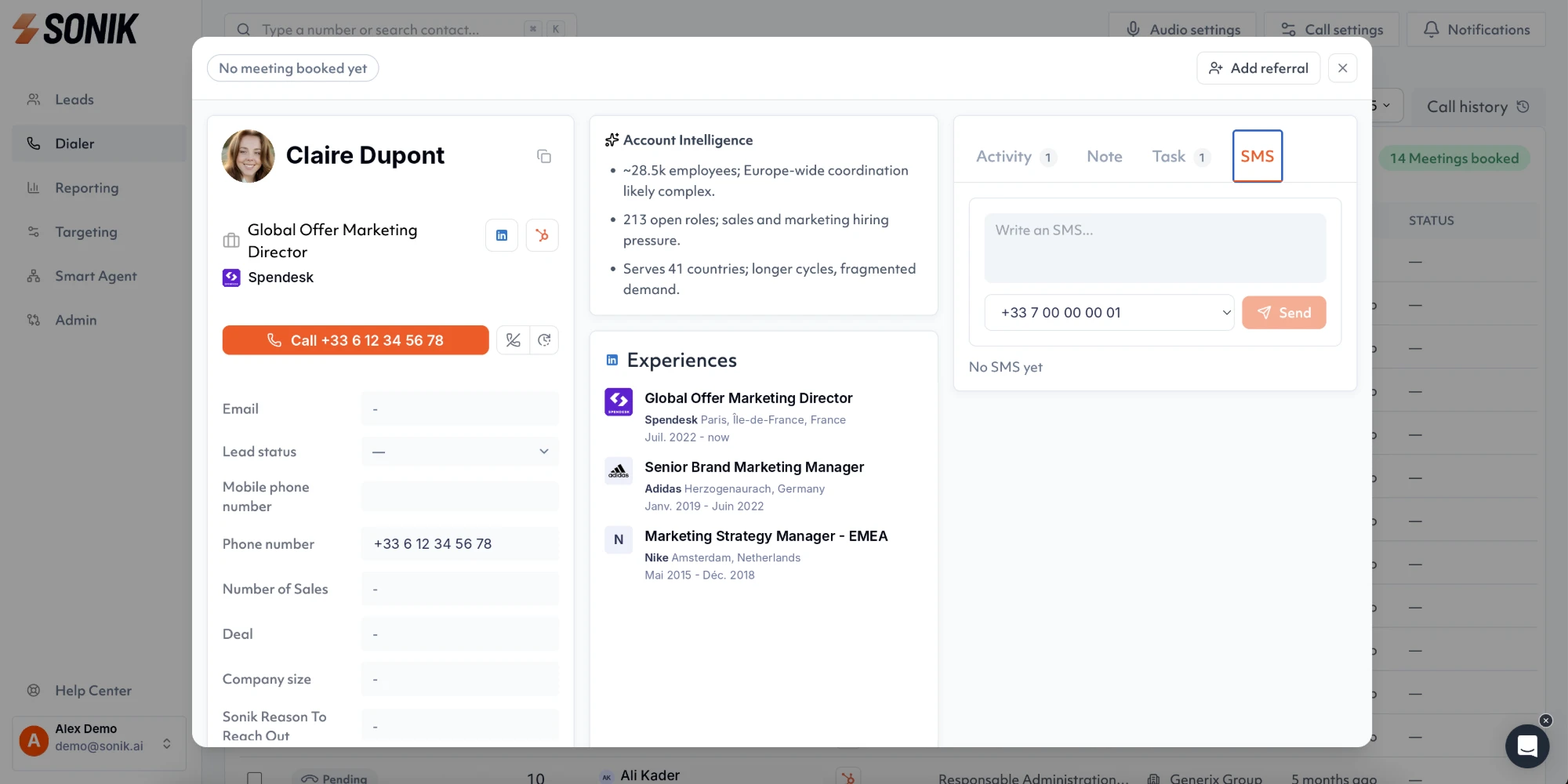
The SDR does what the SDR is for: listen, challenge, build trust, book the meeting. Our north-star is 20 conversations per day per SDR, for 2x more meetings. The economics work out to the cost saving the CEO was looking for, without giving up the first voice, the pipeline or the future AEs. See the dialer page, or the related post on making more sales calls without hiring more SDRs.
Some functions are too strategic to replace with AI, and SDRs are one of them. Replace the 95% of their day that is waiting, not the 5% that is selling. This week, ask one SDR to count live conversations per calling hour. If the answer is 3, you do not have an SDR problem. You have a dialing problem, and that one AI can fix.

