Get started
Still unsure of the impact of Sonik?
See it for yourself and ask for your free trial


A sales agent workspace is one screen where a rep sees why to contact an account (signals), what to say (AI call prep), does the work (parallel dialing, email) and gets the outcome written back to the CRM. A sales engagement platform schedules tasks. A workspace decides which task matters now and gives the rep the context to do it well. The CRM stays the system of record in both cases.
The term appeared in 2025 and 2026 as vendors looked for a word to describe a tool that is neither a sequencer, nor a dialer, nor a data provider, but all three built around an AI layer.
Strip the marketing and you get four blocks on one screen:
An AI agent in that workspace does the research, drafts the message and proposes the order of the call list. The rep still makes the call. That last point is the whole design choice, and we come back to it below.
Sales engagement platforms were built for one job: run a multi-step cadence on a list and track who did their tasks. They did that job well. Email volume went up, and for a few years reply rates followed.
Their limit is structural. A cadence is a calendar. It fires step 3 on day 5 whether the prospect visited your pricing page yesterday or lost their job this morning.
A workspace replaces the calendar with a queue. The queue is re-ordered by what happened in the last 24 hours. That is the entire difference, and it changes three things:
Our benchmark on 1,000,000 B2B cold calls in France explains why this matters. A trigger-based opener books a meeting 7 to 10% of the time. A pitch-first opener books 2 to 3%. Yet 65% of reps open by explaining what they sell, largely because the trigger is not in front of them when the prospect picks up.
Most workspace pitches sell you third-party intent data. In our experience, the best signals are first-party and already sitting in HubSpot or Salesforce.
Reps use about 20% of the signals their CRM already holds. The other 80% are closed-lost deals from 12 months ago, contacts who changed company, leads that went quiet after a demo, website visitors matched to an open opportunity.
50% of Sonik's own pipeline comes from signals that were already in our CRM. A workspace earns its place when it surfaces those before it sells you new data. We wrote about the mechanics in how to reactivate dormant leads.
Consolidation is the pitch. Be careful what you consolidate.
The CRM stays the system of record. A workspace that keeps its own contact database becomes a shadow CRM within a quarter. RevOps loses the ability to report, and the rep ends up updating two systems. Every action should write to HubSpot or Salesforce, not next to it.
Enrichment stays a waterfall. Mobile coverage in Europe is uneven, and in our experience no single provider covers French mobile numbers well enough on its own. You want several sources behind the workspace, not one bundled database.
Data stays in Europe. Call recordings and transcripts are personal data under GDPR. Ask where they are stored, who the sub-processors are and how long they are kept. A workspace built for the US market often has no clear answer, and your DPO will ask.
Four questions to ask in the demo:
If the answer to question 1 is "by sequence step", you are looking at a sequencer with an AI badge. If the answer to question 3 is a pause, you are looking at a power dialer.
We built Sonik around the call, because that is where the meeting is won. The workspace shows the rep a queue ordered by CRM signals (website visitors, job changes, closed-lost, dormant leads, social intent), an AI prep card with the trigger and a suggested opener, and a parallel dialer that gives 5x more conversations than one-line dialing.

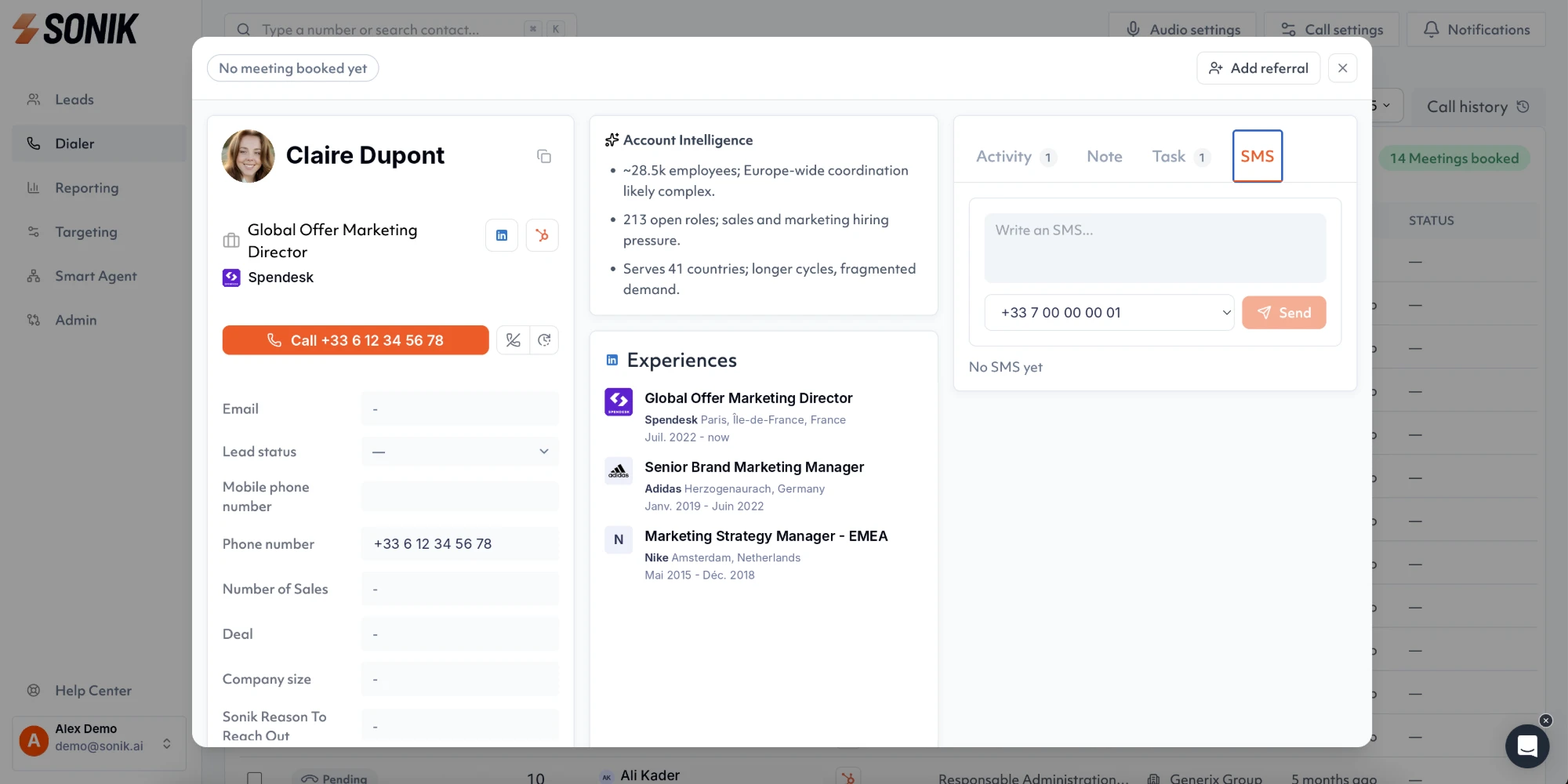
HubSpot or Salesforce stays the system of record. Every call, summary and next step is written back there. Our north-star metric is 20 conversations per SDR per day, because the funnel math in Europe starts from an 11.3% average connect rate.
See the dialer and the signals for the detail.
A sales agent workspace is a queue ordered by signals, with context and a dialer on the same screen, and the CRM as the only database. The category is new; the need is not. This week, pull your reps' call lists and check how they are ordered. If the answer is "by sequence step" or "A to Z", that is where your effectiveness is leaking.

