Get started
Still unsure of the impact of Sonik?
See it for yourself and ask for your free trial


An AI dialer is a sales dialer that decides who to call, prepares the rep before the pickup and tells them what happened after, on top of dialing several lines at once. Voicemail detection on a single line is automation, not AI. The category earns its name when the software works on the three things that move meetings: the contact, the opener and the follow-up. Here is our definition, and what it changes for a French SDR team.
Every vendor uses the word, so start with what does not qualify.
An AI dialer, in our definition, has to do at least three of the following: rank the call list from signals rather than alphabetical order, show the rep a prepared opener before the pickup, transcribe and summarise the call, write a structured outcome and next step to the CRM, and give the rep feedback on what they said. Parallel dialing underneath is what makes this worth doing at volume.
This is the part most dialers skip, and it is the one with the largest effect. Reps use only about 20% of the signals already sitting in their CRM. The rest is there, unread: a prospect who visited the pricing page yesterday, a champion who changed jobs, a closed-lost deal from 11 months ago whose contract is up, a lead that went quiet after a demo.
At Sonik, 50% of our own pipeline comes from signals that were already in the CRM. Not bought intent data, our own CRM. An AI dialer reads those events and builds the day's list from them: closed-lost coming up for renewal at the top, pricing-page visitors next, then job changes, then the cold list.
It also picks the hour. Our analysis of 1,000,000 B2B cold calls in France gives an average connect rate of 11.3%, but founders pick up more around 10am, HR around 1pm, marketing around 4pm. 4pm overall connects at 15.8%, 8am at 9.8%. A dialer that knows the persona can schedule the block.
65% of reps open a cold call by explaining what they sell. In our benchmark, pitch-first openers book a meeting in 2 to 3% of conversations. Trigger-based openers, where the rep names the reason for the call ("you hired three SDRs last month"), book 7 to 10%. That is a 3x gap, and it depends entirely on whether the rep has the trigger in front of them when the prospect picks up.
On a parallel dialer, the pickup arrives without warning. There is no time to read a LinkedIn profile. The AI dialer has to put the trigger, the last touch and a suggested first sentence on the screen in the half-second between the pickup and the bridge. That is the hard engineering problem, and the one that separates AI dialers from fast dialers.
After the call, three things need to happen without the rep typing: a summary, a structured outcome (meeting booked, callback at 4pm Thursday, not interested because of X) and a next step in the CRM.
Then the coaching. Our data shows discovery questions starting with "how" lift conversion by 190%, and asking "What do you mean?" before answering an objection lifts it by 197%. A manager cannot listen to 20 conversations per rep per day. The AI can, and it can tell the rep "you answered the price objection in 4 seconds, try asking what they meant first" that same afternoon.
This is a composite of what we see in our experience with teams in Paris and Lyon, with the assumptions stated so you can swap in yours.
Before. Four SDRs on a cloud phone system. 50 dials a day each, one at a time, in the order the CRM list loads. Connect rate 11%, so 5 to 6 conversations per rep per day. Pitch-first opener, meeting rate about 3%. Roughly 0.2 meetings per rep per day: 3 to 4 meetings a week for the team. Half an hour a day each on CRM notes.
After. Same four SDRs on an AI dialer with 4 parallel lines, list ranked by CRM signals, blocks at 10am and 4pm by persona. 20 conversations per rep per day (our north star). Trigger-based opener, meeting rate 8%. 1.6 meetings per rep per day: 30 meetings a week for the team. Notes written by the software.
The dialing speed explains the jump from 6 to 20 conversations. The signals and the prep explain the jump from 3% to 8%. Multiply them and you get the result. Neither alone gets there.
Sonik was built around that three-job definition. The dialer runs up to 4 parallel lines. The signals layer reads website visits, job changes, closed-lost dates, dormant leads and social intent from HubSpot or Salesforce and ranks the day's list. Each pickup lands with the trigger and a suggested opener on screen, and the call goes back to the CRM as a structured outcome with an AI summary.

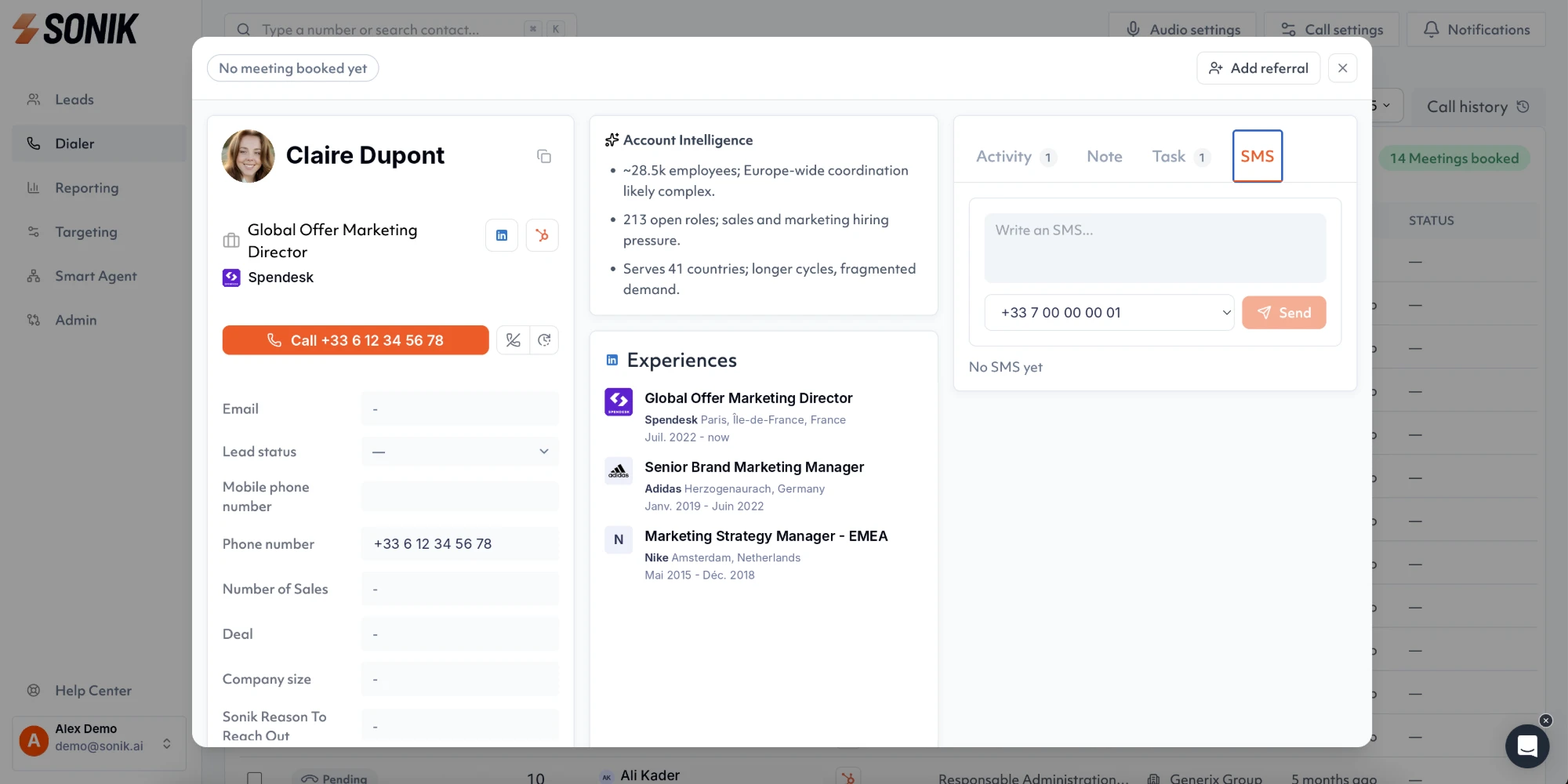
Coaching is built on the 1,000,000-call benchmark we ran with Quentin Despas of Katana: openers, "how" questions, objection handling. Our target for customers is 2x more meetings through 5x more conversations with the right contacts, and that order matters: right contacts first, then volume.
Modes and numbers are on the dialer page.
An AI dialer is not a faster phone. It is software that picks the contact, prepares the opener and writes the follow-up, with parallel dialing underneath so that all of this happens 20 times a day per rep instead of 6. This week, open your CRM and count the closed-lost deals older than 10 months and the contacts who visited your site in the last 7 days. That is the list an AI dialer would have called this morning.

