Get started
Still unsure of the impact of Sonik?
See it for yourself and ask for your free trial


An auto dialer is any software that dials phone numbers from a list without a rep keying them in. That is the whole definition, and it is why the term causes confusion: it covers a one-line power dialer, a four-line parallel dialer and a contact-center predictive dialer, three products with very different results and very different legal exposure. Auto dialers are legal in France. What the law regulates is who you call, when, from which number, and what happens when nobody is there. Here is the map.
Auto dialer is the parent category. The subtypes:
Not auto dialers: a robocall system (plays a recording, no human on the line), click-to-call in a CRM, and an "AI SDR" voice agent that holds the conversation itself. In France a recorded-message cold call to a consumer is a separate and much more restricted practice.
This is the part US guides get wrong for European readers, because they transpose the TCPA. France has its own rules, and most of them are about the list and the number, not the dialer. This is our operating understanding, not legal advice; confirm the edge cases with counsel.
Under the GDPR, the CNIL accepts legitimate interest (article 6.1.f) as the basis for B2B prospecting, provided the call relates to the person's professional role, they are informed, and they can object easily. Record objections and honour them in the dialer, not in a spreadsheet.
Since 11 August 2026, cold calling consumers in France requires prior consent. The Bloctel opt-out list that governed consumer calls until then is no longer the test; consent is. This does not apply to professionals called in their professional capacity, but it bites on sole traders and personal mobiles that end up in B2B lists. Clean those out.
Since 2024, French operators verify that the displayed number belongs to the caller (the authentication mechanism introduced under the Naegelen law) and block calls that fail. Any auto dialer that offers "local presence" by displaying a number you do not own will have its calls blocked. Use numbers you own and monitor their reputation.
Check with counsel whether any abandoned-call threshold applies in each country you call. But silent and repeated calls are the practices that generate complaints to the DGCCRF, which can fine unlawful cold-calling practices up to 75,000 euros for an individual and 375,000 euros for a company under the Consumer Code. For B2B the practical penalty arrives faster: a number that generates silent calls gets flagged as spam and stops connecting.
Recording a call requires informing both parties at the start, a stated purpose and a retention period. The CNIL has published guidance on workplace call recording. Set retention per country in the dialer and keep recordings on EU servers.
Our analysis of 1,000,000 B2B cold calls in France puts the average connect rate at 11.3%. Use that to size the tool.
Sonik is an auto dialer in the parallel subtype, with a 1-line power mode for hot lists, and no predictive mode. We built it in France around the rules above: owned French and EU numbers with reputation monitoring, an abandoned-call counter that is expected to read zero, objection logging in the dialer, and recordings with per-country retention.
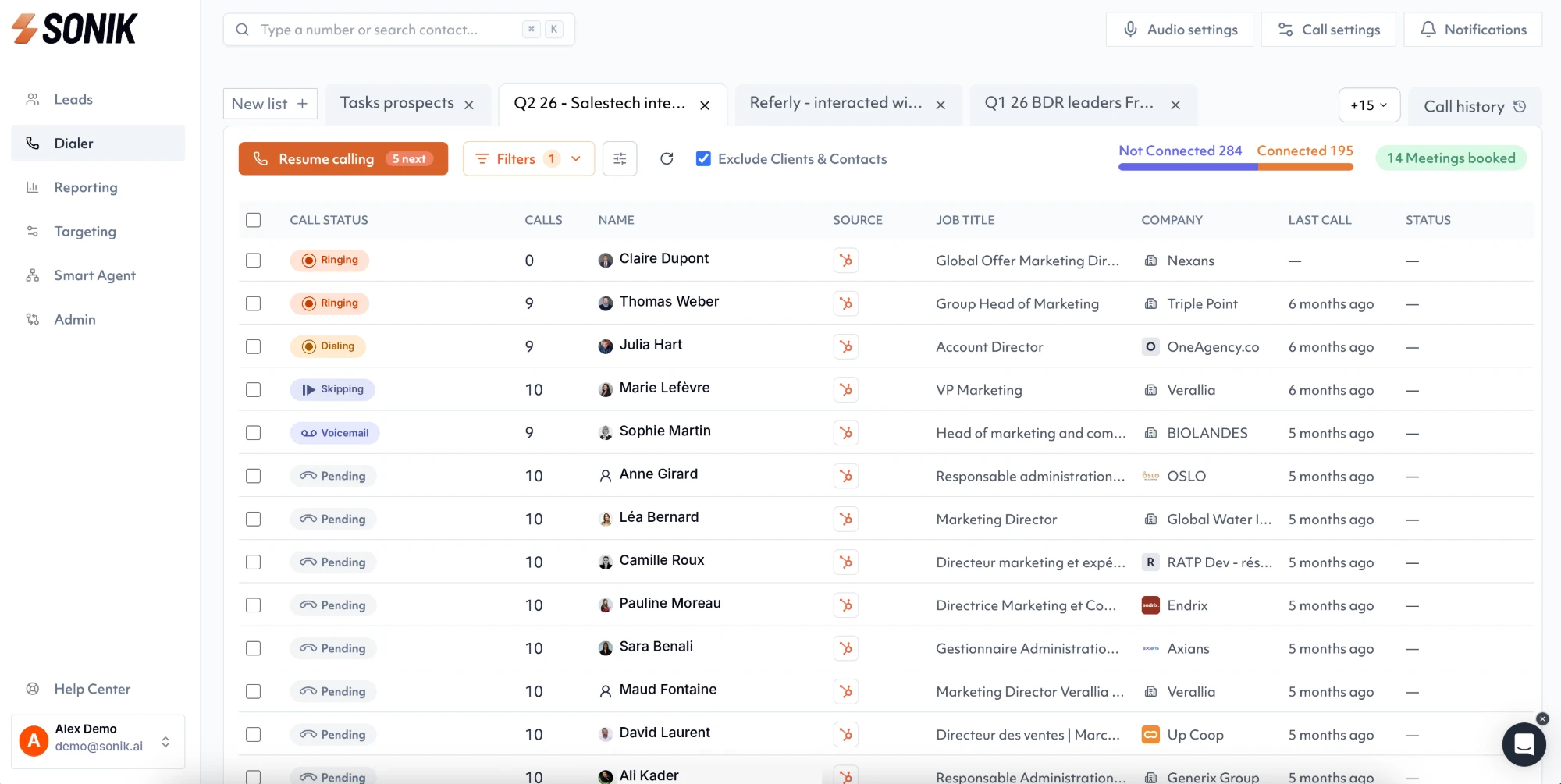
The list is ranked from CRM signals (website visits, job changes, closed-lost, dormant leads, social intent), the trigger is on screen before the pickup, and the outcome and AI summary go back to HubSpot or Salesforce. Half of our own pipeline comes from signals that were already in the CRM.
Details on the dialer page and the signals page.
An auto dialer is legal in France, and the law cares about your list, your number and your abandoned calls, not about the software category. Choose the subtype by dials per rep per day, and set it up for the European rules from day one. This week, ask your dialer vendor two questions: which numbers do we own, and what was our abandoned-call rate last month.